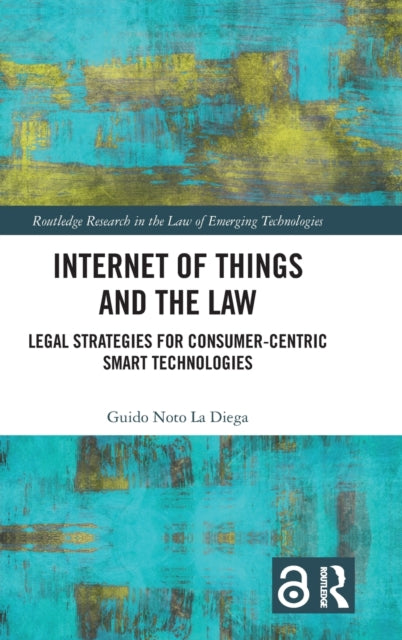
Guido Noto La Diega
Internet of Things and the Law: Legal Strategies for Consumer-Centric Smart Technologies
Internet of Things and the Law: Legal Strategies for Consumer-Centric Smart Technologies
We can order this item for you. Delivery usually takes about 4 to 6 weeks.
This item is not held in our immediate stock. We will order it for you after checkout.
Estimated delivery: About 4 to 6 weeks
YOU SAVE £12.84
- Condition: Brand new
- UK Delivery times: Usually arrives within 2 - 3 working days
- UK Shipping: Fee starts at £3.89. Subject to product weight & dimension
Bulk ordering. Want 15 or more copies? Get a personalised quote and bigger discounts. Learn more about bulk orders.
Couldn't load pickup availability
- More about Internet of Things and the Law: Legal Strategies for Consumer-Centric Smart Technologies
The Internet of Things (IoT) is a sociotechnological phenomenon that is primarily responsible for the shift from tangible wealth and power to their disembodied counterparts. This book aims to explore how laws can be interpreted to empower IoT end users and steer rematerialisation in a human-centric and socially just direction. It focuses on the IoT, the sociotechnological phenomenon that is responsible for this shift, and concludes with a call for collective resistance against 'smart capitalism'.
Format: Hardback
Length: 378 pages
Publication date: 14 October 2022
Publisher: Taylor & Francis Ltd
The Internet of Things (IoT) has emerged as a transformative technology that is reshaping the way we live, work, and interact with the world. With its ability to connect devices and enable them to communicate and share data, the IoT has the potential to bring about significant benefits in areas such as healthcare, transportation, and energy efficiency. However, along with these benefits comes a range of legal and ethical challenges that must be addressed.
One of the key legal issues surrounding the IoT is the question of privacy and data protection. As devices become increasingly connected to the internet, they collect and store vast amounts of personal information, including sensitive data such as health records, financial information, and personal preferences. This information can be vulnerable to hacking, theft, and misuse, which could have serious consequences for individuals and society as a whole.
Another legal issue is the question of liability and responsibility. When devices malfunction or cause harm, who is responsible for the resulting damages? This can be particularly difficult to determine in cases where multiple parties are involved, such as when a device is manufactured by one company and used by another.
There are also concerns about the security of IoT devices. As these devices are often connected to the internet and can be accessed remotely, they are vulnerable to cyberattacks and other forms of digital intrusion. This could lead to the theft of sensitive information, the disruption of critical infrastructure, and even physical harm to individuals.
To address these legal and ethical challenges, there are a range of legal strategies that can be employed. One approach is to adopt a consumer-centric approach to the development and regulation of IoT technologies. This means that the interests of consumers should be prioritized in the design and implementation of IoT devices and services, and that consumers should have clear and transparent rights and protections in relation to their data.
Another approach is to adopt a multidisciplinary approach to the regulation of IoT technologies. This means that the regulation of IoT should involve a range of stakeholders, including government agencies, industry, and civil society
society. This can help to ensure that the regulation is effective, efficient, and socially just, and that it takes into account the diverse range of perspectives and interests that are involved in the development and use of IoT technologies.
In addition to these legal strategies, there are also a range of ethical considerations that must be taken into account. One of the key ethical considerations is the question of transparency and accountability. IoT devices and services should be designed and implemented in a way that is transparent and accountable to consumers, and that consumers should have clear and transparent rights and protections in relation to their data.
Another ethical consideration is the question of privacy and security. IoT devices and services should be designed and implemented in a way that respects the privacy and security of individuals, and that takes into account the diverse range of perspectives and interests that are involved in the development and use of IoT technologies.
Finally, there is the question of sustainability and environmental impact. IoT technologies have the potential to contribute to environmental sustainability by enabling the reduction of waste, the optimization of energy consumption, and the promotion of renewable energy sources. However, there are also concerns about the environmental impact of the production and disposal of IoT devices, and about the potential for these devices to contribute to climate change.
In conclusion, the Internet of Things has the potential to bring about significant benefits to society, but it also presents a range of legal and ethical challenges that must be addressed. By adopting a consumer-centric approach to the development and regulation of IoT technologies, by adopting a multidisciplinary approach to the regulation of IoT technologies, and by taking into account the diverse range of perspectives and interests that are involved in the development and use of IoT technologies, we can help to ensure that the IoT is developed and used in a way that is transparent, accountable, socially just, and sustainable.
Dimension: 234 x 156 (mm)
ISBN-13: 9781138604797
UK and International shipping information
UK and International shipping information
We deliver throughout the United Kingdom and to 128 countries and territories worldwide, including the United States, Australia, Canada, Germany, Spain and France.