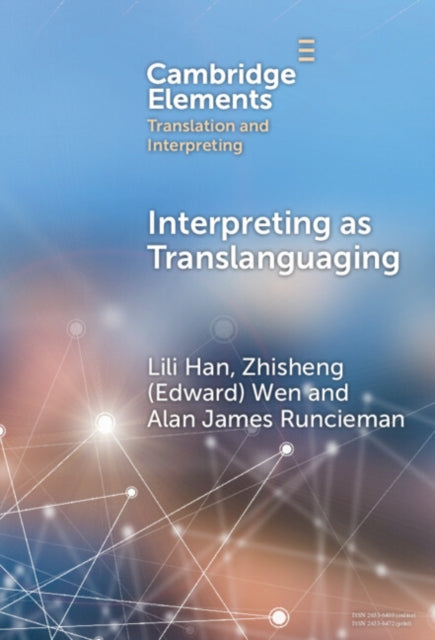
LiliHan,ZhishengWen,Alan JamesRuncieman
Interpreting as Translanguaging: Theory, Research, and Practice
Interpreting as Translanguaging: Theory, Research, and Practice
💎 Earn 84 Points (£0.84) on this item.
We can order this item for you. Delivery usually takes about 4 to 6 weeks.
This item is not held in our immediate stock. We will order it for you after checkout.
Estimated delivery: About 4 to 6 weeks
YOU SAVE £1.01
- Condition: Brand new
- UK Delivery times: Usually arrives within 2 - 3 working days
- UK Shipping: Fee starts at £2.39. Subject to product weight & dimension
Bulk ordering. Want 15 or more copies? Get a personalised quote and bigger discounts. Learn more about bulk orders.
Couldn't load pickup availability
- More about Interpreting as Translanguaging: Theory, Research, and Practice
The Element provides a comprehensive analysis of translanguaging-in-interpreting and interpreting-in-translanguaging, drawing on evidence from an empirical investigation. It proposes an integrated account of translanguaging and interpreting, with implications for interpreting theory, pedagogy, and instruction.
Format: Paperback / softback
Length: 75 pages
Publication date: 30 November 2023
Publisher: Cambridge University Press
Drawing on the burgeoning literature in translanguaging theory and research, the Element offers a comprehensive analysis of the embedded model of translanguaging-in-interpreting and interpreting-in-translanguaging, from theoretical and practical perspectives, bolstered by evidence from an exploratory empirical investigation. To achieve this objective, the authors first trace the emergence and historical development of the key concepts and fundamental tenets of translanguaging and interpreting separately and then combined. This is followed by reviews of relevant literature, synthesizing how translanguaging theories and research methods can be applied in specific domains of interpreting studies, such as community and public service interpreting. An integrated account of translanguaging and interpreting is proposed and elaborated. The theoretical and methodological implications of this integrative perspective are teased out, with a view to illuminating interpreting theory, pedagogy, and instruction.
Translanguaging, as a theoretical framework, has gained significant attention in recent years, particularly in the field of interpreting studies. It recognizes the inherent multilingualism of individuals and the importance of leveraging their linguistic resources to facilitate communication and understanding. Translanguaging, therefore, advocates for a more inclusive and equitable approach to interpreting that recognizes and values the diverse linguistic backgrounds and experiences of both interpreters and clients.
One of the key concepts of translanguaging is the idea of "embeddedness." This refers to the fact that language is not a standalone entity but is deeply intertwined with other aspects of our lives, such as culture, identity, and social context. Translanguaging recognizes that interpreters bring their own linguistic and cultural backgrounds to the interpreting process, which can have a significant impact on the quality of the interpretation.
Another important concept of translanguaging is the idea of "hybridization." This refers to the process of combining different languages and linguistic styles to create new forms of communication. Hybridization is particularly relevant in interpreting studies, where interpreters may need to switch between multiple languages and linguistic styles to effectively communicate with clients from different linguistic and cultural backgrounds.
Translanguaging also emphasizes the importance of recognizing and valuing the linguistic resources of clients. This means that interpreters should strive to understand the linguistic and cultural nuances of their clients and provide interpretations that are culturally sensitive and appropriate.
In terms of practical applications, translanguaging has implications for interpreting theory, pedagogy, and instruction. Interpreting programs can incorporate translanguaging principles to promote a more inclusive and equitable approach to interpreting. This can involve training interpreters to recognize and value their own linguistic and cultural backgrounds, as well as training them to work with clients from diverse linguistic and cultural backgrounds.
Interpreting pedagogy can also be influenced by translanguaging. Translanguaging advocates for a more interactive and collaborative approach to interpreting, where interpreters work together with clients to create a shared understanding of the communication. This can involve using hybridization techniques to create new forms of communication that are more accessible and effective for clients from different linguistic and cultural backgrounds.
Finally, translanguaging has implications for interpreting instruction. Translanguaging can be used to develop interpreting curricula that are more inclusive and culturally sensitive. This can involve incorporating translanguaging principles into interpreting courses, as well as using case studies and role-plays that reflect the diverse linguistic and cultural backgrounds of clients.
In conclusion, translanguaging is a theoretical framework that recognizes the multilingualism of individuals and the importance of leveraging their linguistic resources to facilitate communication and understanding. It emphasizes the idea of embeddedness, hybridization, and the recognition and valuing of the linguistic resources of clients. Translanguaging has implications for interpreting theory, pedagogy, and instruction, and can promote a more inclusive and equitable approach to interpreting. As the field of interpreting studies continues to evolve, translanguaging will likely play an increasingly important role in shaping the future of interpreting practice.
Weight: 118g
Dimension: 151 x 228 x 6 (mm)
ISBN-13: 9781009375894
This item can be found in:
UK and International shipping information
UK and International shipping information
UK Delivery and returns information:
- Delivery within 2 - 3 days when ordering in the UK.
- Shipping fee for UK customers from £2.39. Fully tracked shipping service available.
- Returns policy: Return within 30 days of receipt for full refund.
International deliveries:
Shulph Ink now ships to Australia, Belgium, Canada, France, Germany, Ireland, Italy, India, Luxembourg Saudi Arabia, Singapore, Spain, Netherlands, New Zealand, United Arab Emirates, United States of America.
- Delivery times: within 5 - 10 days for international orders.
- Shipping fee: charges vary for overseas orders. Only tracked services are available for most international orders. Some countries have untracked shipping options.
- Customs charges: If ordering to addresses outside the United Kingdom, you may or may not incur additional customs and duties fees during local delivery.