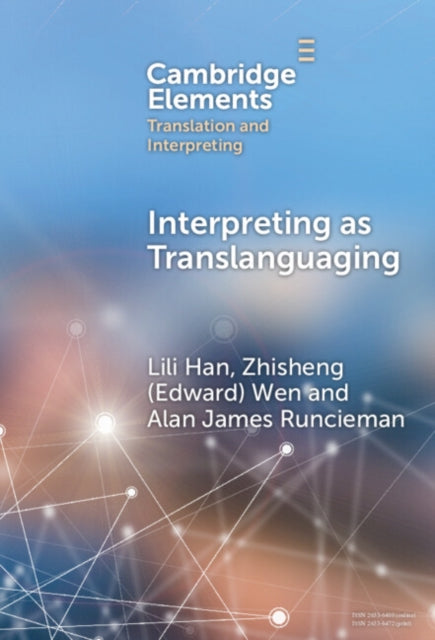
LiliHan,ZhishengWen,Alan JamesRuncieman
Interpreting as Translanguaging: Theory, Research, and Practice
Interpreting as Translanguaging: Theory, Research, and Practice
💎 Earn 259 Points (£2.59) on this item.
We can order this item for you. Delivery usually takes about 4 to 6 weeks.
This item is not held in our immediate stock. We will order it for you after checkout.
Estimated delivery: About 4 to 6 weeks
YOU SAVE £3.08
- Condition: Brand new
- UK Delivery times: Usually arrives within 2 - 3 working days
- UK Shipping: Fee starts at £3.89. Subject to product weight & dimension
Bulk ordering. Want 15 or more copies? Get a personalised quote and bigger discounts. Learn more about bulk orders.
Couldn't load pickup availability
- More about Interpreting as Translanguaging: Theory, Research, and Practice
The Element provides a comprehensive analysis of translanguaging-in-interpreting and interpreting-in-translanguaging, drawing on evidence from an empirical investigation. It proposes an integrated account of translanguaging and interpreting, with implications for interpreting theory, pedagogy, and instruction.
Format: Hardback
Length: 75 pages
Publication date: 30 November 2023
Publisher: Cambridge University Press
Drawing on the burgeoning literature in translanguaging theory and research, the Element offers a comprehensive analysis of the embedded model of translanguaging-in-interpreting and interpreting-in-translanguaging, from theoretical and practical perspectives, bolstered by evidence from an exploratory empirical investigation. To achieve this objective, the authors first trace the emergence and historical development of the key concepts and fundamental tenets of translanguaging and interpreting separately and then combined. This is followed by reviews of relevant literature, synthesizing how translanguaging theories and research methods can be applied in specific domains of interpreting studies, such as community and public service interpreting. An integrated account of translanguaging and interpreting is proposed and elaborated. The theoretical and methodological implications of this integrative perspective are teased out, with a view to illuminating interpreting theory, pedagogy, and instruction.
Translanguaging, as a theoretical framework, has gained significant attention in recent years, particularly in the field of interpreting studies. It recognizes the inherent multilingualism of individuals and the importance of leveraging their linguistic resources to facilitate communication and understanding. Translanguaging, therefore, advocates for a more inclusive and equitable approach to interpreting, where interpreters are encouraged to draw on their multiple languages and cultural backgrounds to provide effective and culturally sensitive services.
One of the key concepts in translanguaging is the idea of "embeddedness." This refers to the fact that languages and cultures are intertwined and cannot be separated from one another. Translanguaging recognizes that interpreters bring with them a wealth of linguistic and cultural knowledge that can enrich the interpreting process and enhance communication between different communities.
Another important aspect of translanguaging is the concept of "bilingualism." Bilingualism is not seen as a binary condition where individuals are either fully proficient in one language or completely fluent in another. Rather, it is recognized as a fluid and dynamic process where individuals can switch between languages and cultures depending on the context and the needs of the interlocutor.
Translanguaging also emphasizes the importance of language learning and acquisition. It recognizes that language learning is not a linear process and that individuals can acquire new languages and cultures at different stages of their lives. Translanguaging advocates for a more flexible and inclusive approach to language learning, where individuals are encouraged to learn and use multiple languages and cultures to communicate and interact with others.
In interpreting studies, translanguaging has significant implications for both theory and practice. From a theoretical perspective, translanguaging offers a new lens through which to understand the complexities of interpreting and the role of interpreters in facilitating communication between different cultures. It provides a framework for analyzing the linguistic and cultural resources that interpreters bring to the interpreting process and for exploring the ways in which these resources can be leveraged to enhance communication and understanding.
From a practical perspective, translanguaging has implications for interpreting pedagogy and instruction. It emphasizes the importance of incorporating multilingual and cultural perspectives into interpreting training programs and encourages interpreters to develop their linguistic and cultural competence. Translanguaging also emphasizes the importance of collaboration and teamwork in interpreting, where interpreters are encouraged to work together with other professionals, such as healthcare providers, social workers, and legal professionals, to provide comprehensive and effective services to their clients.
In conclusion, translanguaging is a theoretical framework that recognizes the inherent multilingualism of individuals and the importance of leveraging their linguistic resources to facilitate communication and understanding. It emphasizes the idea of embeddedness, bilingualism, language learning, and acquisition, and has significant implications for interpreting theory and practice. By adopting a translanguaging perspective, interpreters can enhance their linguistic and cultural competence, provide more effective and culturally sensitive services, and contribute to the promotion of inclusivity and equity in communication.
ISBN-13: 9781009462631
UK and International shipping information
UK and International shipping information
We deliver throughout the United Kingdom and to 128 countries and territories worldwide, including the United States, Australia, Canada, Germany, Spain and France.