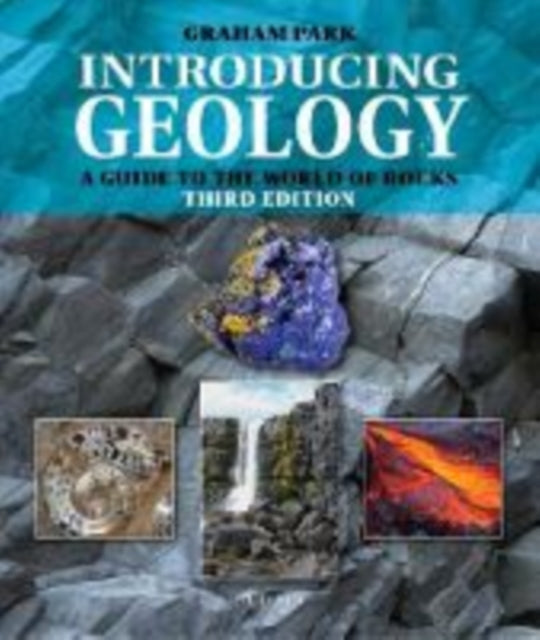
Graham Park
Introducing Geology: A Guide to the World of Rocks
Introducing Geology: A Guide to the World of Rocks
💎 Earn 125 Points (£1.25) on this item.
- Condition: Brand new
- UK Delivery times: Usually arrives within 2 - 3 working days
- UK Shipping: Fee starts at £3.89. Subject to product weight & dimension
Bulk ordering. Want 15 or more copies? Get a personalised quote and bigger discounts. Learn more about bulk orders.
Couldn't load pickup availability
- More about Introducing Geology: A Guide to the World of Rocks
The world is made of rock, and Graham Parks' introductory book has established itself as a key resource for those looking for a straightforward explanation of what geology tells us about the world. It is intended for those whose interest in geology has been awakened and is an ideal primer for those considering the study of earth sciences more formally.
Format: Paperback / softback
Length: 144 pages
Publication date: 08 November 2018
Publisher: Dunedin Academic Press
Our planet is composed primarily of rock, even though vegetation, concrete, or water cover a significant portion of the Earth's surface. However, if one excavates deep enough, solid rock will always be encountered. Individuals residing in landscapes with prominent rock outcrops may have pondered the nature of these rocks and their journey to their current location. Graham Parks' introductory book has quickly become a valuable resource for those seeking a straightforward explanation of what geology reveals about our world. By examining rocks, one can discover numerous captivating objects, including crystals and fossils, that ignite our curiosity. Fossils, in particular, while intriguing on their own, provide valuable insights into the biological evolution of life on Earth by revealing their context within geological time. This book is lavishly illustrated and designed for individuals who have developed an interest in geology, perhaps through media coverage of earthquakes or dinosaurs, and wish to delve deeper into the subject. Technical terms are kept to a minimum, and a glossary is provided to clarify any unfamiliar terms.
The Earth's surface is covered by a diverse range of natural features, including vegetation, concrete, and water. However, beneath these superficial layers lies a solid foundation composed primarily of rock. This rock, which forms the bedrock upon which our planet rests, extends deep into the Earth's interior. While much of the Earth's surface is hidden from view, those who venture into the wilderness or explore remote areas often come across exposed rock formations. These outcrops provide a glimpse into the geological history of our planet and offer a unique opportunity to observe the diverse range of rocks that make up our world.
Rocks can be classified into various types based on their composition, structure, and formation processes. Some common rock types include igneous rocks, which are formed from molten magma; sedimentary rocks, which are created through the accumulation and deposition of sediments; and metamorphic rocks, which result from the transformation of pre-existing rocks under the influence of heat, pressure, and/or chemical agents. Each type of rock has its own unique characteristics and can provide valuable insights into the Earth's past.
When examining rocks, it is important to consider their physical properties, such as color, texture, and hardness. These properties can provide clues about the rock's origin and history. For example, igneous rocks are typically dark in color and have a rough texture, while sedimentary rocks are often light in color and have a smooth texture. Metamorphic rocks, on the other hand, may exhibit a range of colors and textures depending on the conditions under which they were formed.
In addition to their physical properties, rocks can also contain valuable information about the Earth's past. Fossils, for instance, are the remains or traces of ancient organisms that have been preserved in the rock over millions of years. By studying fossils, scientists can learn about the evolution of life on Earth and the different species that have existed throughout history. Fossils can also provide insights into the climate and environmental conditions of the past, as well as the processes that have shaped the Earth's surface.
Rocks can also be used to study the Earth's structure and composition. Geologists use a variety of techniques, such as seismic imaging and geophysical surveys, to map the Earth's interior and study the movement of tectonic plates. These techniques can provide valuable information about the Earth's geological history and the processes that have shaped the Earth's surface over millions of years.
In conclusion, rocks are an essential component of our planet and play a crucial role in shaping its history and future. By examining rocks, we can gain valuable insights into the Earth's past, present, and future. From the physical properties of rocks to the information they contain about fossils and the Earth's structure, rocks offer a wealth of knowledge that can help us better understand our world and its place in the universe.
Weight: 286g
Dimension: 166 x 194 x 16 (mm)
ISBN-13: 9781780460758
Edition number: 3 New edition
UK and International shipping information
UK and International shipping information
We deliver throughout the United Kingdom and to 128 countries and territories worldwide, including the United States, Australia, Canada, Germany, Spain and France.