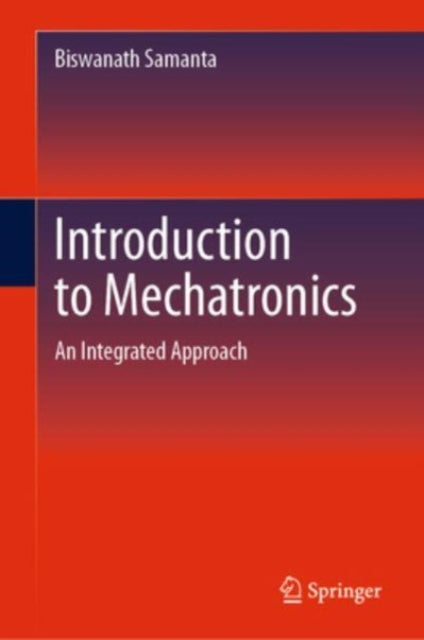
Biswanath Samanta
Introduction to Mechatronics: An Integrated Approach
Introduction to Mechatronics: An Integrated Approach
💎 Earn 371 Points (£3.71) on this item.
We can order this item for you. Delivery usually takes about 4 to 6 weeks.
This item is not held in our immediate stock. We will order it for you after checkout.
Estimated delivery: About 4 to 6 weeks
YOU SAVE £15.66
- Condition: Brand new
- UK Delivery times: Usually arrives within 2 - 3 working days
- UK Shipping: Fee starts at £2.39. Subject to product weight & dimension
Bulk ordering. Want 15 or more copies? Get a personalised quote and bigger discounts. Learn more about bulk orders.
Couldn't load pickup availability
- More about Introduction to Mechatronics: An Integrated Approach
This textbook provides an integrated approach to mechatronics, emphasizing computer programming with Matlab, LabVIEW, and C++. It includes examples and program codes for simulation and analysis, and utilizes Tinkercad for virtual lab experience.
Format: Hardback
Length: 355 pages
Publication date: 09 May 2023
Publisher: Springer International Publishing AG
This comprehensive textbook offers an integrated approach to mechatronics, encompassing a wide range of topics such as instrumentation, circuits, electronics, computer-based data acquisition and analysis, analog and digital signal processing, sensors, actuators, digital logic circuits, microcontroller programming, and interfacing. Throughout the text, a strong emphasis is placed on the utilization of computer programming, with Matlab being utilized for system modeling, simulation, and analysis, LabVIEW for data acquisition and signal processing, and C++ for Arduino-based microcontroller programming and interfacing. To enhance understanding and application of the concepts, Prof. Samanta provides numerous examples accompanied by detailed program codes, facilitating simulation and analysis. Additionally, the book incorporates the use of the virtual simulation platform Tinkercad to offer students a virtual lab experience, further enhancing their grasp of theoretical concepts.
Instrumentation encompasses the measurement and control of physical quantities, including temperature, pressure, and voltage. It plays a crucial role in various industries, such as manufacturing, automotive, and aerospace, to ensure the quality and reliability of products. Instrumentation systems are designed to collect and process data, and then transmit it to control systems for optimal performance.
Circuits are the pathways through which electrical current flows. They can be classified into two main types: analog and digital. Analog circuits operate on continuous signals, such as sound and temperature, while digital circuits operate on discrete signals, such as binary digits (0 and 1). Digital circuits are more efficient and reliable than analog circuits, and are widely used in modern electronics and computer systems.
Electronics is the branch of engineering that deals with the design, development, and application of electronic devices and systems. It encompasses a wide range of technologies, including transistors, diodes, integrated circuits, and microcontrollers. Electronics is used in a variety of applications, such as communication, entertainment, healthcare, and transportation.
Computer-based data acquisition and analysis involves the use of computers and software to collect and process data from sensors and other sources. This data can be used for various purposes, such as monitoring and controlling industrial processes, analyzing scientific data, and developing predictive models. Computer-based data acquisition and analysis is an essential tool in modern science and engineering.
Analog and digital signal processing are two important techniques used in mechatronics to manipulate and analyze electrical signals. Analog signals are continuous signals that can be represented in various ways, such as voltage, current, and frequency. Digital signals, on the other hand, are discrete signals that can be represented in binary digits (0 and 1). Digital signal processing is more efficient and precise than analog signal processing, and is widely used in communication systems, digital imaging, and audio processing.
Sensors are devices that detect and respond to physical quantities. They are used in a wide range of applications, such as robotics, automotive, and healthcare. Sensors can be classified into two main types: active and passive. Active sensors require power to operate, while passive sensors do not. Passive sensors, such as thermistors and strain gauges, are commonly used in mechatronics applications.
Actuators are devices that convert electrical signals into mechanical motion. They are used in a wide range of applications, such as robotics, aerospace, and industrial automation. Actuators can be classified into two main types: linear and rotary. Linear actuators, such as motors and solenoids, are commonly used in mechatronics applications, while rotary actuators, such as servomotors and actuators, are used in industrial automation.
Digital logic circuits are circuits that operate on binary digits (0 and 1). They are used in a wide range of applications, such as computers, communication systems, and digital imaging. Digital logic circuits are designed to perform logical operations, such as AND, OR, and XOR, on binary data.
Microcontroller programming is the process of writing software for microcontrollers, which are small, low-power computers that are commonly used in embedded systems. Microcontrollers are used in a wide range of applications, such as robotics, automotive, and consumer electronics. Microcontroller programming is an essential skill in mechatronics and is widely used in industry.
Interfacing is the process of connecting different components of a system together. It involves the use of cables, connectors, and protocols to transmit data and power between components. Interfacing is an essential skill in mechatronics and is widely used in industry.
In conclusion, this comprehensive textbook offers an integrated approach to mechatronics, encompassing a wide range of topics such as instrumentation, circuits, electronics, computer-based data acquisition and analysis, analog and digital signal processing, sensors, actuators, digital logic circuits, microcontroller programming, and interfacing. The use of computer programming is emphasized throughout the text, with Matlab, LabVIEW, and C++ being utilized for system modeling, simulation, and analysis, respectively. Prof. Samanta provides numerous examples along with appropriate program codes, for simulation and analysis, that are discussed in detail to illustrate the concepts covered in each section. Additionally, the book incorporates the use of the virtual simulation platform Tinkercad to offer students a virtual lab experience, further enhancing their grasp of theoretical concepts. By mastering these topics, students will be well-prepared to pursue careers in mechatronics and other related fields.
Weight: 804g
Dimension: 235 x 155 (mm)
ISBN-13: 9783031293191
Edition number: 1st ed. 2023
UK and International shipping information
UK and International shipping information
UK Delivery and returns information:
- Delivery within 2 - 3 days when ordering in the UK.
- Shipping fee for UK customers from £2.39. Fully tracked shipping service available.
- Returns policy: Return within 30 days of receipt for full refund.
International deliveries:
Shulph Ink now ships to Australia, Belgium, Canada, France, Germany, Ireland, Italy, India, Luxembourg Saudi Arabia, Singapore, Spain, Netherlands, New Zealand, United Arab Emirates, United States of America.
- Delivery times: within 5 - 10 days for international orders.
- Shipping fee: charges vary for overseas orders. Only tracked services are available for most international orders. Some countries have untracked shipping options.
- Customs charges: If ordering to addresses outside the United Kingdom, you may or may not incur additional customs and duties fees during local delivery.