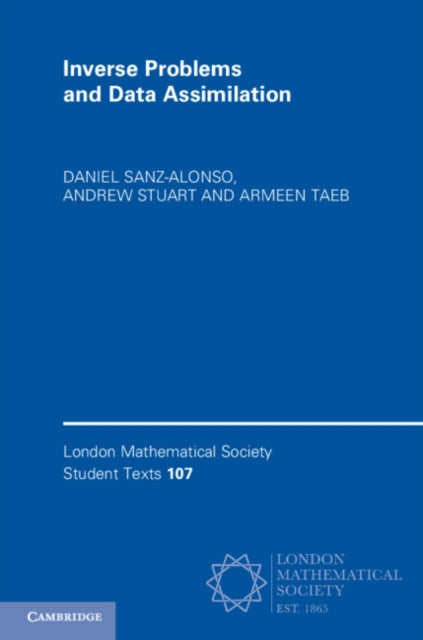
DanielSanz-Alonso,AndrewStuart,ArmeenTaeb
Inverse Problems and Data Assimilation
Inverse Problems and Data Assimilation
💎 Earn 146 Points (£1.46) on this item.
We can order this item for you. Delivery usually takes about 4 to 6 weeks.
This item is not held in our immediate stock. We will order it for you after checkout.
Estimated delivery: About 4 to 6 weeks
YOU SAVE £1.74
- Condition: Brand new
- UK Delivery times: Usually arrives within 2 - 3 working days
- UK Shipping: Fee starts at £2.39. Subject to product weight & dimension
Bulk ordering. Want 15 or more copies? Get a personalised quote and bigger discounts. Learn more about bulk orders.
Couldn't load pickup availability
- More about Inverse Problems and Data Assimilation
Inverse problems and data assimilation are explored, with an emphasis on their systematic underpinnings and applications in the mathematical sciences and science and engineering. The book covers topics such as maximum a posteriori estimation, gradient descent, variational Bayes, Monte Carlo, importance sampling, and Markov chain Monte Carlo, and includes examples and exercises for self-study.
Format: Paperback / softback
Length: 221 pages
Publication date: 31 August 2023
Publisher: Cambridge University Press
This comprehensive introduction serves as a gateway into the realm of inverse problems and data assimilation, catering to advanced undergraduates and aspiring graduate students in the mathematical sciences. It also captivates researchers in science and engineering who seek to understand the systematic foundations of methodologies widely employed in their respective fields. The authors delve into inverse problems and data assimilation in sequence, before delving into the application of data assimilation techniques to tackle diverse inverse problems by introducing an artificial algorithmic time. The topics covered encompass maximum a posteriori estimation, stochastic gradient descent, variational Bayes, Monte Carlo, importance sampling, and Markov chain Monte Carlo for inverse problems. Additionally, the book explores 3DVAR, 4DVAR, extended and ensemble Kalman filters, and particle filters for data assimilation. Packed with numerous examples and exercises, this text serves as an invaluable companion for courses and self-study alike.
Introduction:
Inverse problems and data assimilation play pivotal roles in diverse fields, ranging from physics and engineering to environmental science and social sciences. These interdisciplinary areas involve the reconstruction of unknown quantities from observed data, often under challenging conditions where traditional analytical solutions are not feasible. This introduction aims to provide a comprehensive and accessible overview of these topics, catering to students and researchers with a background in mathematics, physics, or computer science.
Inverse Problems:
Inverse problems arise when we seek to estimate or reconstruct a quantity of interest from measurements or observations. These problems can be categorized into two main types: ill-posed and well-posed. Ill-posed problems involve data that are insufficient or noisy, making it difficult to obtain a precise solution. Well-posed problems, on the other hand, have a clear mathematical structure and can be solved using standard numerical methods.
Data Assimilation:
Data assimilation is a process that combines measurements from multiple sources, such as sensors, satellites, and numerical models, to improve the accuracy and reliability of predictions. It involves the integration of different types of data and the development of algorithms to estimate the state of a system at a given time. Data assimilation techniques are widely used in weather forecasting, climate modeling, and oceanography, among other fields.
Artificial Algorithmic Time:
One of the key challenges in inverse problems and data assimilation is the development of efficient algorithms that can handle large datasets and complex systems. In this introduction, we will explore the use of artificial algorithmic time, which is a technique that allows us to break down a complex problem into smaller, manageable subproblems. This approach enables us to develop more efficient algorithms and solve inverse problems more effectively.
Topics Covered:
The book will cover a wide range of topics related to inverse problems and data assimilation. These topics include:
- Maximum a posteriori estimation: This is a statistical method used to estimate the parameters of a model or system based on observed data. It involves minimizing the difference between the observed data and the model's predictions.
- Stochastic gradient descent: This is a numerical optimization technique used to find the minimum of a function or a set of functions. It is commonly used in machine learning and optimization problems.
- Variational Bayes: This is a Bayesian inference method used to estimate the parameters of a model or system based on observed data. It involves minimizing the expected cost of the model's predictions.
- Monte Carlo: This is a numerical method used to generate random samples from a probability distribution. It is commonly used in simulation and uncertainty quantification.
- Importance sampling: This is a sampling technique used to estimate the parameters of a model or system from a small number of observed data points. It involves assigning a higher probability to data points that are more likely to contribute to the solution.
- Markov chain Monte Carlo: This is a Monte Carlo method used to estimate the parameters of a model or system from a large number of random samples. It is particularly useful in Bayesian inference problems.
- 3DVAR, 4DVAR, extended and ensemble Kalman filters, and particle filters: These are data assimilation techniques used in weather forecasting and climate modeling. They involve the integration of multiple observations and models to improve the accuracy of predictions.
Examples and Exercises:
The book will include a wealth of examples and exercises to help students understand the concepts and apply the techniques discussed in the text. These examples will cover a range of applications, from weather forecasting to climate modeling, and will help students develop their skills in inverse problems and data assimilation.
Conclusion:
Inverse problems and data assimilation are fundamental tools in modern science and engineering. This introduction provides a comprehensive and accessible overview of these topics, catering to students and researchers with a background in mathematics, physics, or computer science. By exploring the use of artificial algorithmic time and covering a wide range of topics, the book aims to equip readers with the skills and knowledge necessary to solve complex inverse problems and improve the accuracy of predictions in diverse fields.
Weight: 342g
Dimension: 152 x 229 x 15 (mm)
ISBN-13: 9781009414296
This item can be found in:
UK and International shipping information
UK and International shipping information
UK Delivery and returns information:
- Delivery within 2 - 3 days when ordering in the UK.
- Shipping fee for UK customers from £2.39. Fully tracked shipping service available.
- Returns policy: Return within 30 days of receipt for full refund.
International deliveries:
Shulph Ink now ships to Australia, Belgium, Canada, France, Germany, Ireland, Italy, India, Luxembourg Saudi Arabia, Singapore, Spain, Netherlands, New Zealand, United Arab Emirates, United States of America.
- Delivery times: within 5 - 10 days for international orders.
- Shipping fee: charges vary for overseas orders. Only tracked services are available for most international orders. Some countries have untracked shipping options.
- Customs charges: If ordering to addresses outside the United Kingdom, you may or may not incur additional customs and duties fees during local delivery.