Giulio Di Basilio
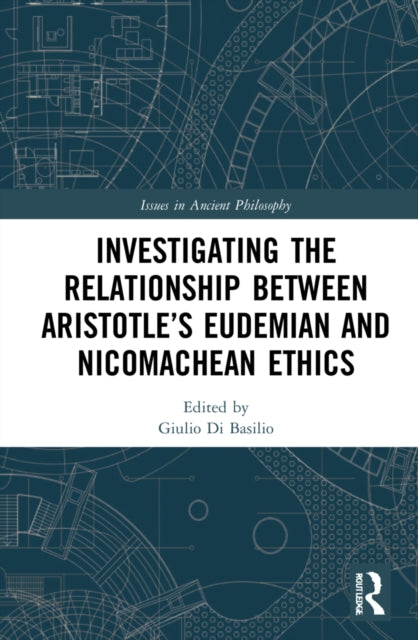
Investigating the Relationship Between Aristotle's Eudemian and Nicomachean Ethics
Investigating the Relationship Between Aristotle's Eudemian and Nicomachean Ethics
We can order this item for you. Delivery usually takes about 4 to 6 weeks.
This item is not held in our immediate stock. We will order it for you after checkout.
Estimated delivery: About 4 to 6 weeks
YOU SAVE £15.13
- Condition: Brand new
- UK Delivery times: Usually arrives within 2 - 3 working days
- UK Shipping: Fee starts at £3.89. Subject to product weight & dimension
Bulk ordering. Want 15 or more copies? Get a personalised quote and bigger discounts. Learn more about bulk orders.
Couldn't load pickup availability
- More about Investigating the Relationship Between Aristotle's Eudemian and Nicomachean Ethics
This collection of essays explores the relationship between Aristotles Eudemian and Nicomachean Ethics, highlighting their continuities and divergences, and offering new perspectives on Aristotles ethical thought. It is of interest to students and scholars of ancient philosophy and ethics.
Format: Hardback
Length: 210 pages
Publication date: 17 June 2022
Publisher: Taylor & Francis Ltd
This collection of essays delves into significant themes from Aristotle's ethics, with a particular focus on the relationship between his Eudemian and Nicomachean Ethics. Building upon a recent resurgence of interest in Aristotle's Eudemian Ethics, which serves as a valuable complement to the Nicomachean Ethics in understanding the evolution of Aristotle's ethical ideas, this volume brings together a series of innovative studies by renowned scholars. These studies explore the interplay between the two works, examining their continuities and divergences, while also showcasing a diverse range of approaches and perspectives on the central questions posed by Aristotle's ethical thought.
In investigating the relationship between Aristotles Eudemian and Nicomachean Ethics, this collection aims to contribute to ongoing debates surrounding Aristotle's ethical philosophy and to inspire new approaches that take both of his surviving ethical treatises seriously. The volume will appeal to students and scholars of ancient philosophy and ethics, particularly those interested in Aristotle's two ethics.
The Eudemian Ethics is a seminal work in Aristotle's ethical philosophy, emphasizing the pursuit of happiness as the ultimate goal of human life. It emphasizes the importance of virtue, both as a means of achieving happiness and as a desirable end in itself. The Nicomachean Ethics, on the other hand, is a later work that focuses on the nature of moral virtue and the cultivation of a good human life.
One of the key themes explored in this collection is the relationship between the Eudemian and Nicomachean Ethics. While the Eudemian Ethics emphasizes the pursuit of happiness as the ultimate goal, the Nicomachean Ethics emphasizes the importance of moral virtue and the cultivation of a good human life. The essays in this collection examine how these two works complement each other and how they can be used to develop a comprehensive understanding of Aristotle's ethical philosophy.
Another theme explored in this collection is the role of pleasure and pain in Aristotle's ethical philosophy. The Eudemian Ethics emphasizes the pursuit of pleasure as the ultimate goal, while the Nicomachean Ethics emphasizes the importance of avoiding pain and the cultivation of virtue. The essays in this collection examine how these two concepts relate to each other and how they can be used to guide ethical decision-making.
The collection also explores the ethical implications of Aristotle's views on the nature of human nature and the role of social institutions in promoting virtuous behavior. Aristotle believed that human nature is fundamentally good, but that it is corrupted by social institutions and external factors. The essays in this collection examine how these views can be used to develop a more nuanced understanding of human nature and how social institutions can be reformed to promote virtuous behavior.
In addition to these themes, the collection also includes essays that examine the historical and cultural context of Aristotle's ethical philosophy. Aristotle believed that his ethical philosophy was universal and applicable to all human societies, regardless of their cultural or historical context. The essays in this collection examine how these views can be reconciled with the diversity of human societies.
In conclusion, this collection of essays offers a comprehensive and insightful exploration of the relationship between Aristotles Eudemian and Nicomachean Ethics, as well as the broader themes of pleasure, pain, human nature, and social institutions in Aristotle's ethical philosophy. It will be of interest to students and scholars of ancient philosophy and ethics, particularly those interested in Aristotle's two ethics.
Weight: 560g
Dimension: 234 x 156 (mm)
ISBN-13: 9780367344986
UK and International shipping information
UK and International shipping information
We deliver throughout the United Kingdom and to 128 countries and territories worldwide, including the United States, Australia, Canada, Germany, Spain and France.