Shulph Ink
IoT and AI Technologies for Sustainable Living: A Practical Handbook
IoT and AI Technologies for Sustainable Living: A Practical Handbook
💎 Earn 589 Points (£5.89) on this item.
We can order this item for you. Delivery usually takes about 4 to 6 weeks.
This item is not held in our immediate stock. We will order it for you after checkout.
Estimated delivery: About 4 to 6 weeks
YOU SAVE £7.00
- Condition: Brand new
- UK Delivery times: Usually arrives within 2 - 3 working days
- UK Shipping: Fee starts at £2.39. Subject to product weight & dimension
Bulk ordering. Want 15 or more copies? Get a personalised quote and bigger discounts. Learn more about bulk orders.
Couldn't load pickup availability
- More about IoT and AI Technologies for Sustainable Living: A Practical Handbook
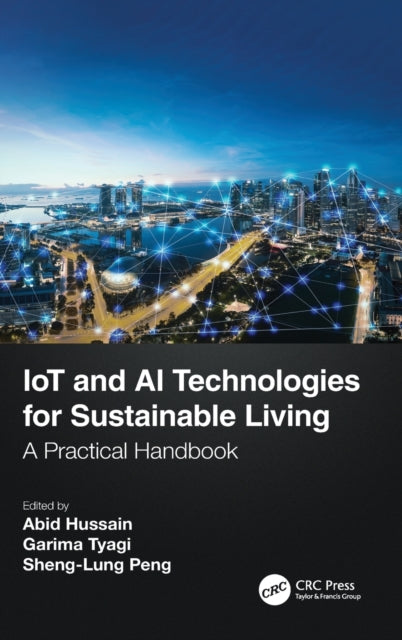
This book discusses the latest methodologies, tools, and techniques related to the Internet of Things and Artificial Intelligence in a single volume, focusing on their application in sustainable living. It covers areas such as agriculture, healthcare, bioinformatics, and multimedia mining, and emphasizes the need for AI and IoT to promote a sustainable future. The book includes practical examples and tools such as genetic algorithms, cloud computing, water resource management, web mining, machine learning, and Natural Language Processing.
Format: Hardback
Length: 334 pages
Publication date: 18 October 2022
Publisher: Taylor & Francis Ltd
The Internet of Things (IoT) and Artificial Intelligence (AI) have emerged as powerful tools that have the potential to revolutionize various aspects of our lives, including sustainable living. In this comprehensive handbook, we bring together the latest methodologies, tools, and techniques related to IoT and AI in a single volume, aiming to provide insight into their use in building a more sustainable future.
The areas of application for IoT and AI in sustainable living are diverse and wide-ranging. In agriculture, for instance, IoT and AI can be used to optimize crop yields, reduce waste, and improve water management. Smart farming techniques, such as precision agriculture and drones, can help farmers monitor crops, detect pests, and apply fertilizers and pesticides more efficiently. IoT sensors can also be used to monitor soil moisture, temperature, and other environmental factors, allowing farmers to make informed decisions about planting and harvesting.
In healthcare, IoT and AI can be used to improve patient outcomes and reduce healthcare costs. Wearable devices, such as smartwatches and fitness trackers, can monitor patients' health and provide real-time data to healthcare providers. AI algorithms can analyze this data to identify patterns and predict potential health issues, allowing for early intervention and prevention. AI-powered medical imaging systems can also help doctors diagnose diseases more accurately and efficiently.
Bioinformatics, the field that combines biology and computer science, is another area where IoT and AI can have significant impact. AI algorithms can be used to analyze large datasets of genetic information, allowing researchers to identify genetic mutations and patterns that can lead to disease. IoT sensors can be used to monitor the environment and collect data on the health and behavior of animals, plants, and other living organisms, providing valuable insights into their ecosystems and habitats.
Self-diagnosis systems, body sensor networks, and multimedia mining are also areas where IoT and AI can be used to improve sustainable living. Self-diagnosis systems can be used to monitor patients' health and provide personalized medical advice, while body sensor networks can be used to monitor the health and behavior of individuals in real-time. Multimedia mining can be used to analyze large datasets of multimedia content, such as images, videos, and audio, to extract valuable information and insights.
In addition to these areas, IoT and AI can also be used in multimedia forensics and security. IoT sensors can be used to monitor and secure critical infrastructure, such as power grids, transportation systems, and water treatment plants. AI algorithms can be used to analyze surveillance footage and identify potential threats, allowing for timely intervention and prevention.
To develop an understanding of the need for AI and IoT to have a sustainable era of human living, it is essential to explore the tools and techniques covered in this handbook. Genetic algorithms, cloud computing, water resource management, web mining, machine learning, block chaining, learning algorithms, sentimental analysis, and Natural Language Processing (NLP) are some of the tools that are discussed in detail.
Genetic algorithms are used to optimize complex systems, such as water resource management, by simulating the behavior of natural systems. Cloud computing is a powerful tool that allows for the storage and processing of large datasets, making it easier to analyze and interpret data. Water resource management is an important area where IoT and AI can be used to optimize water usage and reduce water waste. Web mining is a technique that is used to extract valuable information from web data, such as social media posts and online reviews. Machine learning is a subset of AI that allows machines to learn from data and improve their performance over time. Block chaining is a distributed ledger technology that is used to secure transactions and prevent fraud. Learning algorithms are used to train machines to make predictions and decisions based on data. Sentimental analysis is a technique that is used to analyze text data and identify the emotional tone of the content. NLP is a field that is used to analyze and interpret human language, allowing machines to understand and respond to human speech.
In conclusion, IoT and AI Technologies for Sustainable Living: A Practical Handbook is a valuable resource for researchers, engineers, practitioners, and graduate and doctoral students working in the field of cloud computing. It provides a comprehensive discussion of modeling and implementation in water resource optimization, recognizing pest patterns, traffic scheduling, web mining, cyber security, and cyber forensics. The tools covered include genetic algorithms, cloud computing, water resource management, web mining, machine learning, block chaining, learning algorithms, sentimental analysis, and Natural Language Processing (NLP). By exploring these tools and techniques, we can develop an understanding of the need for AI and IoT to have a sustainable era of human living.
Weight: 632g
Dimension: 162 x 240 x 26 (mm)
ISBN-13: 9780367507114
UK and International shipping information
UK and International shipping information
UK Delivery and returns information:
- Delivery within 2 - 3 days when ordering in the UK.
- Shipping fee for UK customers from £2.39. Fully tracked shipping service available.
- Returns policy: Return within 30 days of receipt for full refund.
International deliveries:
Shulph Ink now ships to Australia, Belgium, Canada, France, Germany, Ireland, Italy, India, Luxembourg Saudi Arabia, Singapore, Spain, Netherlands, New Zealand, United Arab Emirates, United States of America.
- Delivery times: within 5 - 10 days for international orders.
- Shipping fee: charges vary for overseas orders. Only tracked services are available for most international orders. Some countries have untracked shipping options.
- Customs charges: If ordering to addresses outside the United Kingdom, you may or may not incur additional customs and duties fees during local delivery.