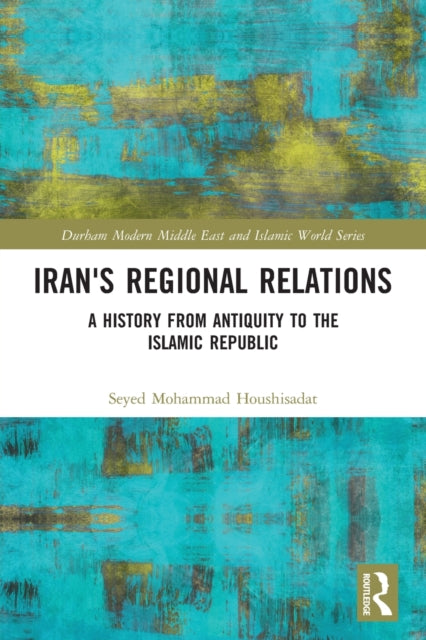
Seyed Mohammad Houshisadat
Iran's Regional Relations: A History from Antiquity to the Islamic Republic
Iran's Regional Relations: A History from Antiquity to the Islamic Republic
💎 Earn 221 Points (£2.21) on this item.
We can order this item for you. Delivery usually takes about 4 to 6 weeks.
This item is not held in our immediate stock. We will order it for you after checkout.
Estimated delivery: About 4 to 6 weeks
YOU SAVE £2.63
- Condition: Brand new
- UK Delivery times: Usually arrives within 2 - 3 working days
- UK Shipping: Fee starts at £2.39. Subject to product weight & dimension
Bulk ordering. Want 15 or more copies? Get a personalised quote and bigger discounts. Learn more about bulk orders.
Couldn't load pickup availability
- More about Iran's Regional Relations: A History from Antiquity to the Islamic Republic
This book provides a comprehensive analytical and theoretical survey of Iranian foreign relations in the Middle East from Antiquity until the Islamic Republic,focusing on the interplay between domestic-level changes and region-wide interaction.
Format: Paperback / softback
Length: 290 pages
Publication date: 29 April 2022
Publisher: Taylor & Francis Ltd
This book delves into the intricate interplay between domestic-level transformations and broader regional interactions, offering a comprehensive analytical and theoretical exploration of Iranian foreign relations in the Middle East from antiquity to the Islamic Republic. Spanning a vast expanse of time, it charts the evolution of political regimes in Persia, including the Median kingdom and the Sassanid Empire, as well as the rule of various dynasties such as the Abbasids, Mongols, Safavids, and Qajars. The author reflects on the enduring factors that have shaped Iran's relations with the rest of the region, encompassing geography, culture, policymaker beliefs, decision-making structures, and sub-regional systems. Through a detailed analysis, the book provides a profound understanding of Iranian foreign relations across a remarkable 4,700-year period.
Introduction:
The study of Iranian foreign relations in the Middle East is a complex and multifaceted endeavor that requires a comprehensive analytical and theoretical framework. This book aims to provide such a survey, focusing on the interplay between domestic-level changes and region-wide interactions. By examining the historical trajectory of Iran's relations with the Middle East, we can gain insights into the enduring factors that have shaped its interactions with its neighbors and the broader international community.
Persian Regimes:
The book begins by tracing the development of Persian regimes from antiquity to the Islamic Republic. It explores the early stages of Persian civilization, including the rise of the Median kingdom and the establishment of the Sassanid Empire. These regimes played significant roles in shaping the political and cultural landscape of the region, and their interactions with neighboring states and empires had a lasting impact on the region's history.
Dynastic Rule:
The book then delves into the rule of various dynasties in Persia, such as the Abbasids, Mongols, Safavids, and Qajars. Each dynasty brought its own unique set of challenges and opportunities to the region. The Abbasids, for instance, were known for their religious tolerance and cultural patronage, while the Mongols were renowned for their military conquests and political instability. The Safavids, on the other hand, were known for their religious conservatism and their efforts to expand their empire.
Regional Interactions:
Throughout the book, the author emphasizes the importance of regional interactions in shaping Iranian foreign relations. He discusses the influence of neighboring states, such as Egypt, Iraq, and Turkey, on Iran's political and economic development. He also explores the role of regional powers, such as the Ottoman Empire and the Persian Gulf monarchies, in shaping Iran's foreign policy.
Geography and Culture:
Geography and culture play a crucial role in shaping Iranian foreign relations. The country's location on the crossroads.
Iran's strategic location on the crossroads, bordering several countries and regions, has played a significant role in shaping its foreign policy. The country's proximity to oil-rich regions has also influenced its relations with the West, particularly the United States and Europe. Additionally, Iran's rich cultural heritage and diverse population have contributed to its complex and multifaceted relations with the rest of the world.
Policymaker Beliefs:
Policymaker beliefs and ideologies also play a significant role in shaping Iranian foreign relations. The country's Islamic Republic ideology, which emphasizes the importance of sovereignty, independence, and the promotion of the Islamic faith, has influenced its foreign policy decisions. The country's religious beliefs have also played a role in its relations with neighboring countries, particularly those with a majority Muslim population.
Decision-Making Structures:
The decision-making structures in Iran also play a role in shaping its foreign relations. The country's theocracy, with its Supreme Leader as the ultimate authority, has influenced its foreign policy decisions. The country's military, which has played a significant role in shaping its foreign policy in the past, also continues to play a role in shaping its relations with the rest of the world.
Sub-Regional Systems:
Sub-regional systems, such as the Arab League and the Organization of Islamic Cooperation, also play a role in shaping Iranian foreign relations. The country's membership in these organizations has influenced its relations with other member states and has contributed to its efforts to promote its interests in the region.
Conclusion:
In conclusion, this book provides a comprehensive analytical and theoretical survey of Iranian foreign relations in the Middle East from antiquity to the Islamic Republic. It delves into the intricate interplay between domestic-level changes and broader regional interactions, offering a rich and nuanced understanding of the country's historical trajectory. By examining the enduring factors that have shaped Iran's relations with the rest of the region, we can gain insights into the challenges and opportunities that the country faces in the future. The book is a valuable resource for scholars, researchers, and policymakers interested in understanding the complex and multifaceted dynamics of Iranian foreign relations in the Middle East.
Weight: 540g
Dimension: 234 x 156 (mm)
ISBN-13: 9780367547707
UK and International shipping information
UK and International shipping information
UK Delivery and returns information:
- Delivery within 2 - 3 days when ordering in the UK.
- Shipping fee for UK customers from £2.39. Fully tracked shipping service available.
- Returns policy: Return within 30 days of receipt for full refund.
International deliveries:
Shulph Ink now ships to Australia, Belgium, Canada, France, Germany, Ireland, Italy, India, Luxembourg Saudi Arabia, Singapore, Spain, Netherlands, New Zealand, United Arab Emirates, United States of America.
- Delivery times: within 5 - 10 days for international orders.
- Shipping fee: charges vary for overseas orders. Only tracked services are available for most international orders. Some countries have untracked shipping options.
- Customs charges: If ordering to addresses outside the United Kingdom, you may or may not incur additional customs and duties fees during local delivery.