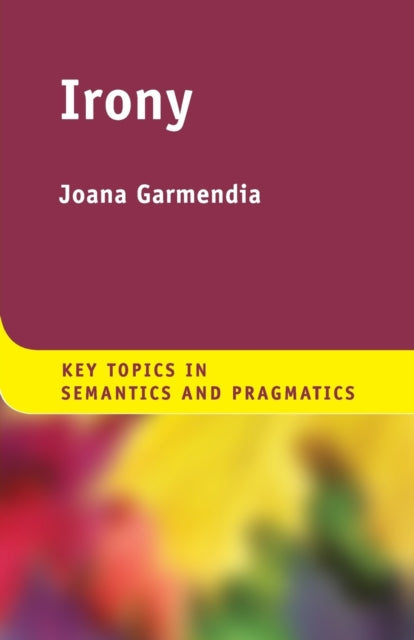
JoanaGarmendia
Irony
Irony
💎 Earn 160 Points (£1.60) on this item.
We can order this item for you. Delivery usually takes about 4 to 6 weeks.
This item is not held in our immediate stock. We will order it for you after checkout.
Estimated delivery: About 4 to 6 weeks
YOU SAVE £1.90
- Condition: Brand new
- UK Delivery times: Usually arrives within 2 - 3 working days
- UK Shipping: Fee starts at £2.39. Subject to product weight & dimension
Bulk ordering. Want 15 or more copies? Get a personalised quote and bigger discounts. Learn more about bulk orders.
Couldn't load pickup availability
- More about Irony
Irony is a complex topic that explores the meaning of language and is studied in various disciplines. This book provides an introduction to the pragmatics of irony, covering key work from different perspectives and exploring its various uses and misunderstandings across cultures. It also discusses the key debates on the pragmatics of irony, such as whether it is always negative, why speakers communicate via irony, and how it differs from sarcasm. The book includes examples and activities to help readers apply the theoretical frameworks to real-life situations.
Format: Paperback / softback
Length: 178 pages
Publication date: 17 September 2020
Publisher: Cambridge University Press
Irony is a fascinating subject that plays a crucial role in the study of language meaning. This book offers an introduction to the pragmatics of irony, surveying significant research conducted in various disciplines such as semantics, pragmatics, philosophy, and literary studies, and adopting diverse theoretical perspectives, including Grice's approach, Sperber and Wilson's echoic account, and Clark and Gerrig's pretense theory. It explores the various uses of irony and examines how it can be misinterpreted across cultures, before delving into the central debates surrounding the pragmatics of irony. These include questions such as whether irony is always negative, why speakers employ irony in communication, and the strategies they typically use. Additionally, the book distinguishes between irony and sarcasm, and explores whether irony is always humorous. To address these questions, fundamental pragmatic concepts are introduced and explained, supported by numerous examples and engaging activities that enable readers to apply the theoretical frameworks to real-world instances of irony.
Irony: An Enigmatic Topic at the Heart of Language Meaning
Irony is a captivating topic that holds a central place in the study of language meaning. This book provides a comprehensive introduction to the pragmatics of irony, encompassing key research conducted across various disciplines such as semantics, pragmatics, philosophy, and literary studies, and drawing upon diverse theoretical perspectives. Among these perspectives, Grice's approach, Sperber and Wilson's echoic account, and Clark and Gerrig's pretense theory stand out as significant contributions to the field. The book delves into the diverse applications of irony, examining how it can be misunderstood across cultures and exploring the fundamental debates surrounding the pragmatics of irony. These debates include questions such as whether irony is always negative, why speakers employ irony in communication, and the strategies they typically use. Additionally, the book distinguishes between irony and sarcasm, and explores whether irony is always humorous. To address these questions, the book introduces basic pragmatic notions and provides numerous examples and engaging activities that enable readers to apply the theoretical frameworks to real-world instances of irony.
Exploring the Pragmatics of Irony
Irony is a multifaceted phenomenon that plays a significant role in language communication. It involves a deliberate contrast between what is said and what is meant, often resulting in a humorous or ironic effect. The book explores the various uses of irony, including its role in humor, satire, and social commentary. It also examines how irony can be misunderstood across cultures, leading to miscommunication and conflict. To address these challenges, the book introduces basic pragmatic notions and provides numerous examples and engaging activities that enable readers to apply the theoretical frameworks to real-world instances of irony. The book also explores the relationship between irony and sarcasm, highlighting their similarities and differences. By examining these topics, the book aims to provide a comprehensive understanding of the pragmatics of irony and its role in language communication.
Understanding Irony in Different Contexts
Irony is a versatile tool that can be used in various contexts, including literature, film, and everyday conversation. The book explores how irony is used in different genres and styles, and how it can be interpreted differently by different audiences. It also examines the role of irony in creating tension and suspense in literature and film, and how it can be used to convey complex ideas and emotions. By understanding the different contexts in which irony is used, the book aims to provide readers with a deeper appreciation of the complexity and richness of language communication. The book also explores the relationship between irony and other rhetorical devices, such as metaphor and simile, and how they can be used together to create powerful and memorable messages. By examining these topics, the book aims to provide a comprehensive understanding of the pragmatics of irony and its role in language communication.
The Debates on the Pragmatics of Irony
The pragmatics of irony is a complex and multifaceted topic that has been the subject of much debate. The book explores the central debates surrounding the pragmatics of irony, including whether irony is always negative, why speakers employ irony in communication, and the strategies they typically use. It also examines the relationship between irony and other rhetorical devices, such as metaphor and simile, and how they can be used together to create powerful and memorable messages. By examining these topics, the book aims to provide a comprehensive understanding of the pragmatics of irony and its role in language communication. The book also explores the relationship between irony and other rhetorical devices, such as metaphor and simile, and how they can be used together to create powerful and memorable messages. By examining these topics, the book aims to provide a comprehensive understanding of the pragmatics of irony and its role in language communication.
Conclusion
In conclusion, irony is a fascinating topic that plays a crucial role in the study of language meaning. This book provides a comprehensive introduction to the pragmatics of irony, encompassing key research conducted across various disciplines and drawing upon diverse theoretical perspectives. By exploring the various uses of irony, examining how it can be misunderstood across cultures, and addressing the central debates surrounding the pragmatics of irony, the book aims to provide a comprehensive understanding of the pragmatics of irony and its role in language communication. Whether you are a student, researcher, or simply interested in the power of language, this book is a valuable resource that will help you develop a deeper appreciation of the complexity and richness of language communication.
Weight: 234g
Dimension: 140 x 215 x 14 (mm)
ISBN-13: 9781107465916
UK and International shipping information
UK and International shipping information
UK Delivery and returns information:
- Delivery within 2 - 3 days when ordering in the UK.
- Shipping fee for UK customers from £2.39. Fully tracked shipping service available.
- Returns policy: Return within 30 days of receipt for full refund.
International deliveries:
Shulph Ink now ships to Australia, Belgium, Canada, France, Germany, Ireland, Italy, India, Luxembourg Saudi Arabia, Singapore, Spain, Netherlands, New Zealand, United Arab Emirates, United States of America.
- Delivery times: within 5 - 10 days for international orders.
- Shipping fee: charges vary for overseas orders. Only tracked services are available for most international orders. Some countries have untracked shipping options.
- Customs charges: If ordering to addresses outside the United Kingdom, you may or may not incur additional customs and duties fees during local delivery.