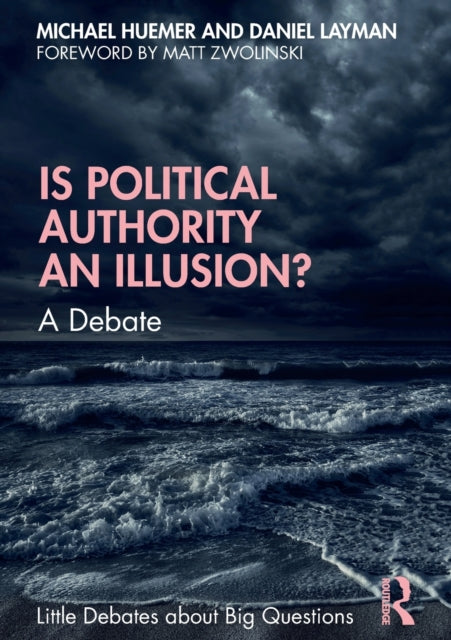
MichaelHuemer,DanielLayman
Is Political Authority an Illusion?: A Debate
Is Political Authority an Illusion?: A Debate
💎 Earn 160 Points (£1.60) on this item.
We can order this item for you. Delivery usually takes about 4 to 6 weeks.
This item is not held in our immediate stock. We will order it for you after checkout.
Estimated delivery: About 4 to 6 weeks
YOU SAVE £1.91
- Condition: Brand new
- UK Delivery times: Usually arrives within 2 - 3 working days
- UK Shipping: Fee starts at £3.89. Subject to product weight & dimension
Bulk ordering. Want 15 or more copies? Get a personalised quote and bigger discounts. Learn more about bulk orders.
Couldn't load pickup availability
- More about Is Political Authority an Illusion?: A Debate
The book "Political Authority" discusses the issue of political authority and why people should obey the commands of those with political power. Michael Huemer argues that political authority is an illusion and that no one is entitled to rule over anyone, while Daniel Layman argues that democratic governments have authority to protect our rights and are accountable to the people.
Format: Paperback / softback
Length: 208 pages
Publication date: 10 November 2021
Publisher: Taylor & Francis Ltd
Political authority is a complex and contentious issue that has been debated for centuries. It refers to the power that one person or group of people holds over others, allowing them to make decisions and enforce their will. While some argue that political authority is necessary for the functioning of society, others believe that it is inherently unjust and should be limited.
One of the most prominent arguments in favor of political authority is the social contract theory. This theory suggests that individuals willingly give up some of their freedoms in exchange for protection and security provided by the government. According to this view, political authority is justified because it is necessary to maintain order and prevent chaos.
However, there are many criticisms of this theory. One of the most significant is that it fails to account for the fact that not all individuals have equal bargaining power. Some people, such as those who are marginalized or oppressed, may be forced to give up their freedoms without receiving anything in return. This creates a power imbalance that can be exploited by those in power.
Another argument against political authority is the hypothetical contract theory. This theory suggests that individuals enter into a contract with the government, giving it the right to rule over them in exchange for certain benefits. However, this theory also faces criticism, as it assumes that individuals are capable of making rational decisions about their own best interests. In reality, many people are influenced by external factors, such as social norms, propaganda, and fear, which can lead them to make decisions that are not in their best interests.
Democratic theories of authority also argue that political authority is necessary to protect individual rights. These theories suggest that the government should be accountable to the people and that individuals should have the right to participate in the decision-making process. However, there are also criticisms of these theories. One of the most significant is that they may not be effective in protecting individual rights in all situations. For example, in times of crisis, the government may need to make decisions that override individual rights in order to protect the public.
Utilitarian theories of authority argue that political authority is justified if it results in the greatest good for the greatest number of people. These theories suggest that the government should prioritize the needs of the community over the needs of individual citizens. However, there are also criticisms of these theories. One of the most significant is that they may not be able to account for the diverse needs and interests of different communities.
In response to these criticisms, Michael Huemer argues that political authority is an illusion and that no one is entitled to rule over anyone. He discusses and rebuts the major theories supporting political authority's rightfulness, including implicit social contract theory, hypothetical contract theories, democratic theories of authority, and utilitarian theories.
Huemer argues that the social contract theory is flawed because it fails to account for the fact that not all individuals have equal bargaining power. He also argues that the hypothetical contract theory is flawed because it assumes that individuals are capable of making rational decisions about their own best interests. Finally, he argues that democratic theories of authority are flawed because they may not be effective in protecting individual rights in all situations.
Daniel Layman, on the other hand, argues that democratic governments have authority because they are needed to protect our rights and because they are accountable to the people. He discusses and rebuts the arguments of Huemer, arguing that democratic governments are necessary to protect individual rights and that they are accountable to the people.
Layman argues that democratic governments are necessary to protect individual rights because they provide a framework for resolving conflicts and protecting the rights of individuals. He also argues that democratic governments are accountable to the people because they are elected by the people and are responsible for their actions.
Layman also argues that democratic governments are necessary to protect individual rights because they provide a framework for resolving conflicts and protecting the rights of individuals. He also argues that democratic governments are accountable to the people because they are elected by the people and are responsible for their actions.
In conclusion, the issue of political authority is a complex and contentious one that has been debated for centuries. While some argue that political authority is necessary for the functioning of society, others believe that it is inherently unjust and should be limited. The social contract theory, hypothetical contract theory, democratic theories of authority, and utilitarian theories all offer different perspectives on the issue, but each faces criticism. Michael Huemer argues that political authority is an illusion and that no one is entitled to rule over anyone, while Daniel Layman argues that democratic governments have authority because they are needed to protect our rights and are accountable to the people.
Dimension: 216 x 138 (mm)
ISBN-13: 9780367347451
UK and International shipping information
UK and International shipping information
We deliver throughout the United Kingdom and to 128 countries and territories worldwide, including the United States, Australia, Canada, Germany, Spain and France.