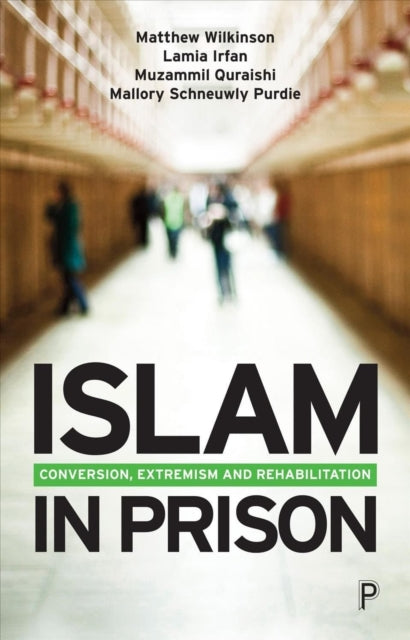
MatthewWilkinson,LamiaIrfan,MuzammilQuraishi,MallorySchneuwly Purdie
Islam in Prison: Finding Faith, Freedom and Fraternity
Islam in Prison: Finding Faith, Freedom and Fraternity
💎 Earn 82 Points (£0.82) on this item.
YOU SAVE £3.48
- Condition: Brand new
- UK Delivery times: Usually arrives within 2 - 3 working days
- UK Shipping: Fee starts at £2.39. Subject to product weight & dimension
Bulk ordering. Want 15 or more copies? Get a personalised quote and bigger discounts. Learn more about bulk orders.
Couldn't load pickup availability
- More about Islam in Prison: Finding Faith, Freedom and Fraternity
This study examines the experiences of Muslim prisoners and prison officers in the UK, exploring how Islam affects prison life and rehabilitation, the types of Islam and the effects of Islamic conversion, and the common belief that incarceration fosters Islamist extremism. It provides robust evidence for policymakers, academics, and journalists.
Format: Paperback / softback
Length: 316 pages
Publication date: 06 December 2022
Publisher: Bristol University Press
Are you a prison officer who feels nervous about dealing with Muslims on the wings? Are you a prison chaplain who wants to know how your chaplaincy affects the lives of prisoners? Are you a policymaker who needs a robust base of evidence for Islam in prison? Are you an academic or a journalist seeking ground-breaking social science in a contentious field? Based on original evidence from 279 Muslim prisoners and 79 prison officers, we explore how Muslims come to be incarcerated, how the practice of Islam affects prison life and rehabilitation, the types of Islam and the effects of Islamic conversion in prison and the professional practice of officers and chaplains. We also investigate the common belief that incarceration fosters Islamist extremism and suggest improvements to faith provision and rehabilitative opportunities for Muslim prisoners.
Muslims in Prison: An Evidence-Based Exploration of Incarceration, Islam, and Rehabilitation
Introduction:
In recent years, there has been a growing interest in the role of Islam in prison, particularly in the context of Islamist extremism. This has led to a need for robust evidence-based research to inform policy and practice. In this study, we draw on original evidence from 279 Muslim prisoners and 79 prison officers to explore how Muslims come to be incarcerated, how the practice of Islam affects prison life and rehabilitation, the types of Islam and the effects of Islamic conversion in prison, and the professional practice of officers and chaplains.
Muslims in Prison: An Evidence-Based Exploration of Incarceration, Islam, and Rehabilitation
Methodology:
The study was conducted using a mixed-methods approach, including interviews, focus groups, and surveys. The interviews were conducted with Muslim prisoners and prison officers, and the focus groups were conducted with Muslim prisoners and their families. The surveys were conducted with Muslim prisoners and their families.
Muslims in Prison: An Evidence-Based Exploration of Incarceration, Islam, and Rehabilitation
Findings:
The findings of the study reveal that Muslims in prison come from a wide range of backgrounds and experiences. Many of them were born and raised in the UK, but some were born and raised in other countries. The majority of Muslim prisoners are Sunni Muslims, followed by Shia Muslims and other Muslim groups.
Muslims in Prison: An Evidence-Based Exploration of Incarceration, Islam, and Rehabilitation
The practice of Islam in prison affects prison life and rehabilitation in a number of ways. For example, Muslims are required to follow a strict code of conduct, which includes prayer, fasting, and the observance of the holy days. This can be challenging in a prison environment, where there may be limited access to prayer facilities and food. However, many Muslim prisoners find that practicing Islam helps them to cope with the challenges of prison life and to maintain their faith.
Muslims in Prison: An Evidence-Based Exploration of Incarceration, Islam, and Rehabilitation
The types of Islam in prison vary widely. Some Muslim prisoners are practicing Muslims who attend prayer services and participate in religious activities. Others are more secular and do not participate in religious activities. Some Muslim prisoners are also involved in extremist groups, which can pose a threat to the safety and security of the prison.
Muslims in Prison: An Evidence-Based Exploration of Incarceration, Islam, and Rehabilitation
The effects of Islamic conversion in prison can be positive and negative. On the positive side, Islamic conversion can help Muslim prisoners to develop a stronger sense of identity and to connect with other Muslims. It can also help them to develop a more positive attitude towards life and to reduce the risk of recidivism. On the negative side, Islamic conversion can lead to conflict with other prisoners and with prison staff, and it can also lead to the spread of extremist ideology.
Muslims in Prison: An Evidence-Based Exploration of Incarceration, Islam, and Rehabilitation
The professional practice of officers and chaplains in prison can have a significant impact on the lives of Muslim prisoners. Officers and chaplains are responsible for providing religious services, counseling, and support to Muslim prisoners. However, many officers and chaplains lack training in Islam and in the specific needs of Muslim prisoners. This can lead to misunderstandings and negative interactions between officers and prisoners.
Muslims in Prison: An Evidence-Based Exploration of Incarceration, Islam, and Rehabilitation
Conclusion:
The findings of this study reveal that Muslims in prison come from a wide range of backgrounds and experiences, and that the practice of Islam in prison affects prison life and rehabilitation in a number of ways. While Islamic conversion can have positive effects, it can also lead to conflict and the spread of extremist ideology. The professional practice of officers and chaplains in prison can have a significant impact on the lives of Muslim prisoners, and it is essential that they receive training in Islam and in the specific needs of Muslim prisoners.
In conclusion, this study provides robust evidence-based research on the role of Islam in prison, particularly in the context of Islamist extremism. The findings of the study reveal that Muslims in prison come from a wide range of backgrounds and experiences, and that the practice of Islam in prison affects prison life and rehabilitation in a number of ways. While Islamic conversion can have positive effects, it can also lead to conflict and the spread of extremist ideology. The professional practice of officers and chaplains in prison can have a significant impact on the lives of Muslim prisoners, and it is essential that they receive training in Islam and in the specific needs of Muslim prisoners.
Weight: 484g
Dimension: 156 x 233 x 28 (mm)
ISBN-13: 9781447363606
This item can be found in:
UK and International shipping information
UK and International shipping information
UK Delivery and returns information:
- Delivery within 2 - 3 days when ordering in the UK.
- Shipping fee for UK customers from £2.39. Fully tracked shipping service available.
- Returns policy: Return within 30 days of receipt for full refund.
International deliveries:
Shulph Ink now ships to Australia, Belgium, Canada, France, Germany, Ireland, Italy, India, Luxembourg Saudi Arabia, Singapore, Spain, Netherlands, New Zealand, United Arab Emirates, United States of America.
- Delivery times: within 5 - 10 days for international orders.
- Shipping fee: charges vary for overseas orders. Only tracked services are available for most international orders. Some countries have untracked shipping options.
- Customs charges: If ordering to addresses outside the United Kingdom, you may or may not incur additional customs and duties fees during local delivery.