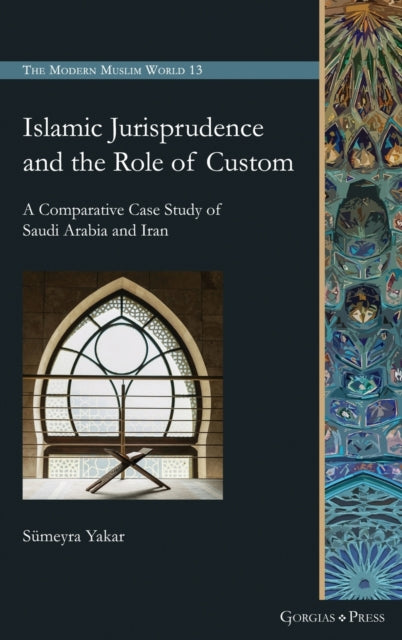
Sumeyra Yakar
Islamic Jurisprudence and the Role of Custom: A Comparative Case Study of Saudi Arabia and Iran
Islamic Jurisprudence and the Role of Custom: A Comparative Case Study of Saudi Arabia and Iran
💎 Earn 566 Points (£5.66) on this item.
- Condition: Brand new
- UK Delivery times: Usually arrives within 2 - 3 working days
- UK Shipping: Fee starts at £2.39. Subject to product weight & dimension
Bulk ordering. Want 15 or more copies? Get a personalised quote and bigger discounts. Learn more about bulk orders.
Couldn't load pickup availability
- More about Islamic Jurisprudence and the Role of Custom: A Comparative Case Study of Saudi Arabia and Iran
The analysis examines the relationship between Islamic law (sharīʿa) and custom (ʿurf) in contemporary Saudi and Iranian legal approaches, focusing on personal and social issues. It explores the methodological perspectives, scholars' opinions, and court verdicts, highlighting the interaction between custom and textual authority.
Format: Hardback
Length: 301 pages
Publication date: 15 March 2022
Publisher: Gorgias Press
Islamic law (sharīʿa) and custom (ʿurf) are two important legal systems that govern the lives of individuals in Saudi Arabia and Iran. While sharīʿa is the primary source of Islamic law, ʿurf is a set of customs and practices that have evolved over time and are specific to a particular region or community. This analysis examines the connection between sharīʿa and ʿurf, identifying the ways in which personal and social issues are treated within contemporary Saudi and Iranian legal approaches.
The methodological perspective adopted by Saudi-Ḥanbalī and Iranian-Jaʿfarī scholars towards the sharʿī status of ʿurf is examined in three particular categories: the methodological perspective (classic and contemporary), the sharʿī opinions of scholars (fatwā), and the court verdicts of judges (aḥkām). The interaction between custom and textual authority is emphasized, developing an analytical framework of shar‘ī rules that pertain to social relations in general and marital issues in particular.
One of the key findings of this analysis is that sharīʿa and ʿurf are not mutually exclusive but rather complement each other. While sharīʿa provides a comprehensive set of rules and principles that govern all aspects of life, ʿurf provides a practical and flexible framework that allows individuals to adapt to changing circumstances. This complementarity is particularly evident in the area of marital issues, where sharīʿa provides a set of rules that govern the marriage contract, divorce, and inheritance, while ʿurf provides a set of customs and practices that govern the daily life of married couples.
Another important finding of this analysis is that the sharʿī opinions of scholars (fatwā) and the court verdicts of judges (aḥkām) play a significant role in shaping the sharʿī status of ʿurf. Scholars are responsible for interpreting the Quran and the Sunnah and issuing fatwā that provide guidance on various issues. Judges are responsible for interpreting the fatwā and issuing court verdicts that apply the law to specific cases.
The interaction between custom and textual authority is also important in shaping the sharʿī status of ʿurf. Custom is often based on the practices of previous generations and is deeply ingrained in the culture of a particular region or community. Textual authority, on the other hand, is based on the Quran and the Sunnah and provides a more universal and timeless set of rules.
However, there are also challenges associated with the interaction between custom and textual authority. One of the main challenges is the potential for conflict between different customs and practices. This conflict can arise when different groups within a community have different interpretations of the Quran and the Sunnah. To address this challenge, scholars and judges must work together to develop a consensus on the sharʿī status of ʿurf.
Another challenge is the potential for the erosion of traditional customs and practices. This erosion can occur as a result of modernization, globalization, and the influence of Western culture. To address this challenge, scholars and judges must work to promote the preservation of traditional customs and practices while also adapting them to changing circumstances.
In conclusion, Islamic law (sharīʿa) and custom (ʿurf) are two important legal systems that govern the lives of individuals in Saudi Arabia and Iran. While sharīʿa provides a comprehensive set of rules and principles that govern all aspects of life, ʿurf provides a practical and flexible framework that allows individuals to adapt to changing circumstances. The interaction between custom and textual authority is important in shaping the sharʿī status of ʿurf, and scholars and judges must work together to develop a consensus on the sharʿī status of ʿurf. By doing so, we can ensure that Islamic law remains relevant and effective in the modern world.
Dimension: 229 x 152 (mm)
ISBN-13: 9781463243517
This item can be found in:
UK and International shipping information
UK and International shipping information
UK Delivery and returns information:
- Delivery within 2 - 3 days when ordering in the UK.
- Shipping fee for UK customers from £2.39. Fully tracked shipping service available.
- Returns policy: Return within 30 days of receipt for full refund.
International deliveries:
Shulph Ink now ships to Australia, Belgium, Canada, France, Germany, Ireland, Italy, India, Luxembourg Saudi Arabia, Singapore, Spain, Netherlands, New Zealand, United Arab Emirates, United States of America.
- Delivery times: within 5 - 10 days for international orders.
- Shipping fee: charges vary for overseas orders. Only tracked services are available for most international orders. Some countries have untracked shipping options.
- Customs charges: If ordering to addresses outside the United Kingdom, you may or may not incur additional customs and duties fees during local delivery.