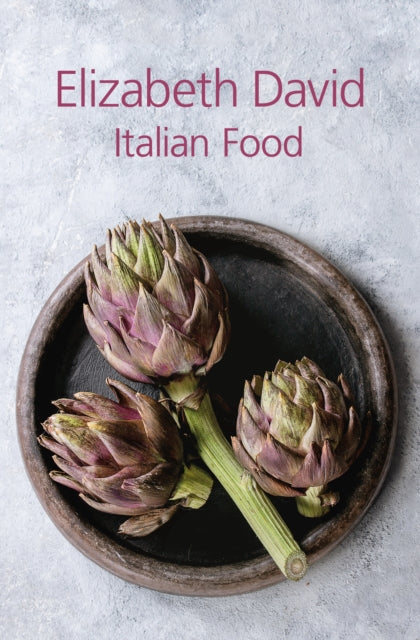
Elizabeth David
Italian Food
Italian Food
YOU SAVE £4.74
- Condition: Brand new
- UK Delivery times: Usually arrives within 2 - 3 working days
- UK Shipping: Fee starts at £3.89. Subject to product weight & dimension
Bulk ordering. Want 15 or more copies? Get a personalised quote and bigger discounts. Learn more about bulk orders.
Couldn't load pickup availability
- More about Italian Food
Elizabeth David's Italian Food is a seminal work that changed the way we think about and cook Italian cuisine. She introduced us to the vast diversity of ingredients, methods, and language used in Italian cooking, and showed that there is no such thing as a national cuisine. The book is filled with detailed information about kitchens and cooking from the 14th, 15th, and 18th centuries, and is organized by type of dish rather than by region. It is a work of scholarship, filled with asides and quotes from Italian writers and thinkers, and includes appendices of bibliographies and notes on wine. David's writings continue to inspire and influence chefs and home cooks today, and her masterpiece is essential to any serious cookery book collection.
Format: Hardback
Length: 406 pages
Publication date: 31 May 2019
Publisher: Grub Street Publishing
"Basil was no more than the name of bachelor uncles, courgette was printed in italics as an alien word, and few of us knew how to eat spaghetti or pick a globe artichoke to pieces. Then came Elizabeth David like sunshine, writing with brief elegance about good food, that is, about food well contrived, well cooked. She made us understand that we could do better with what we had.
Published in 1954, the importance of this book, which required a full year's research in Italy, can only be appreciated when you realize that she was working in a post-rationing England that regarded Italian cuisine as nothing more than variations on pasta and veal. What she discovered was an enormous wealth of regional diversity in ingredients, methods, and even language, where the same pasta shape can be called three or four names in different parts of the country. She understood that all Italian cooking is regional; there is no national cuisine, and so there are eight recipes for aubergines, fourteen for artichokes, five for fennel, and seven for lentils, all from different regions. But if such descriptions seem to today's reader overly thorough, it is because many of her 1950s audience would have never heard of risotto, gorgonzola, prosciutto, or even olive oil, let alone been able to purchase them.
This is a critical and analytical look at Italian food - her personality and point of view come out on almost every page - organized by type of dish rather than by region and is full of details of kitchens and cooking by painters from the 14th, 15th, and 18th centuries. The book is filled with asides and quotes from Italian writers and thinkers, and as confirmation that this is more a work of scholarship than a simple book on cookery, there are appendices of bibliographies.
"Basil was no more than the name of bachelor uncles, courgette was printed in italics as an alien word, and few of us knew how to eat spaghetti or pick a globe artichoke to pieces. Then came Elizabeth David like sunshine, writing with brief elegance about good food, that is, about food well contrived, well cooked. She made us understand that we could do better with what we had.
Published in 1954, the importance of this book, which required a full year's research in Italy, can only be appreciated when you realize that she was working in a post-rationing England that regarded Italian cuisine as nothing more than variations on pasta and veal. What she discovered was an enormous wealth of regional diversity in ingredients, methods, and even language, where the same pasta shape can be called three or four names in different parts of the country. She understood that all Italian cooking is regional; there is no national cuisine, and so there are eight recipes for aubergines, fourteen for artichokes, five for fennel, and seven for lentils, all from different regions. But if such descriptions seem to today's reader overly thorough, it is because many of her 1950s audience would have never heard of risotto, gorgonzola, prosciutto, or even olive oil, let alone been able to purchase them.
This is a critical and analytical look at Italian food - her personality and point of view come out on almost every page - organized by type of dish rather than by region and is full of details of kitchens and cooking by painters from the 14th, 15th, and 18th centuries. The book is filled with asides and quotes from Italian writers and thinkers, and as confirmation that this is more a work of scholarship than a simple book on cookery, there are appendices of bibliographies.
"Basil was no more than the name of bachelor uncles, courgette was printed in italics as an alien word, and few of us knew how to eat spaghetti or pick a globe artichoke to pieces. Then came Elizabeth David like sunshine, writing with brief elegance about good food, that is, about food well contrived, well cooked. She made us understand that we could do better with what we had.
Published in 1954, the importance of this book, which required a full year's research in Italy, can only be appreciated when you realize that she was working in a post-rationing England that regarded Italian cuisine as nothing more than variations on pasta and veal. What she discovered was an enormous wealth of regional diversity in ingredients, methods, and even language, where the same pasta shape can be called three or four names in different parts of the country. She understood that all Italian cooking is regional; there is no national cuisine, and so there are eight recipes for aubergines, fourteen for artichokes, five for fennel, and seven for lentils, all from different regions. But if such descriptions seem to today's reader overly thorough, it is because many of her 1950s audience would have never heard of risotto, gorgonzola, prosciutto, or even olive oil, let alone been able to purchase them.
This is a critical and analytical look at Italian food - her personality and point of view come out on almost every page - organized by type of dish rather than by region and is full of details of kitchens and cooking by painters from the 14th, 15th, and 18th centuries. The book is filled with asides and quotes from Italian writers and thinkers, and as confirmation that this is more a work of scholarship than a simple book on cookery, there are appendices of bibliographies."
Weight: 532g
Dimension: 186 x 143 x 28 (mm)
ISBN-13: 9781911621294
UK and International shipping information
UK and International shipping information
We deliver throughout the United Kingdom and to 128 countries and territories worldwide, including the United States, Australia, Canada, Germany, Spain and France.