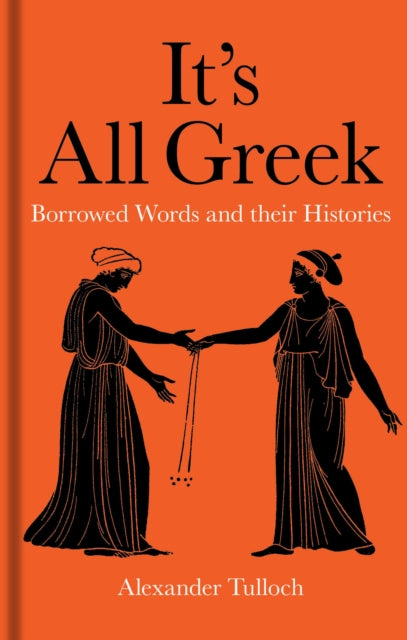
Alexander Tulloch
It's All Greek: Borrowed Words and their Histories
It's All Greek: Borrowed Words and their Histories
💎 Earn 49 Points (£0.49) on this item.
YOU SAVE £3.03
- Condition: Brand new
- UK Delivery times: Usually arrives within 2 - 3 working days
- UK Shipping: Fee starts at £2.39. Subject to product weight & dimension
Bulk ordering. Want 15 or more copies? Get a personalised quote and bigger discounts. Learn more about bulk orders.
Couldn't load pickup availability
- More about It's All Greek: Borrowed Words and their Histories
Did you know that marmalade, pirate, sketch and purse trace their linguistic origins back to the Athens of 500 bce? This book offers a word-by-word look at the influence of Greek on everyday words in English, telling the stories behind their etymological developments.
Format: Hardback
Length: 224 pages
Publication date: 16 November 2018
Publisher: Bodleian Library
Most of us are aware that words such as geometry, mathematics, phobia, and hypochondria derive from ancient Greek, but did you know that marmalade, pirate, sketch, and purse can also trace their linguistic origins back to the Athens of 500 BCE? This book offers a word-by-word look at the influence of Greek on everyday words in English, telling the stories behind the etymological developments of each example and tracing their routes into modern English via Latin and European languages. It also explains connections with ancient Greek culture, in particular mythology, politics, and warfare, and includes proverbs and quotations from Greek literature. Taken together, these words show how we are deeply indebted to the language spoken in Athens 2,500 years ago for the everyday vocabulary we use when conducting our daily business.
Introduction:
The influence of Greek on English is profound and far-reaching, extending beyond the realm of science and mathematics. Words like geometry, mathematics, phobia, and hypochondria have their roots in ancient Greek, but it is not limited to these technical terms. Everyday words like marmalade, pirate, sketch, and purse also have their origins in the Athens of 500 BCE. This book aims to explore the etymological origins of these words and their journey through time, shedding light on the cultural and linguistic connections between ancient Greece and modern English.
The Influence of Greek on English:
Greek has had a significant impact on the development of English, particularly in the fields of science, mathematics, and medicine. Words like geometry, mathematics, and phobia, which originated in Greek, have become integral parts of our language. These words have not only helped us to understand the world around us but have also shaped our thinking and communication.
However, the influence of Greek goes beyond these technical terms. Everyday words like marmalade, pirate, sketch, and purse also have their roots in ancient Greece. These words reflect the cultural and societal aspects of ancient Greece, from its cuisine and cuisine to its literature and mythology.
Etymological Origins:
The etymological origins of these words can be traced back to various sources. Some words, like marmalade and pirate, have their origins in the Greek language itself. For example, the word marmalade comes from the Greek word "marmar," which means "jelly." Similarly, the word pirate comes from the Greek word "pira," which means "to rob."
Other words, like sketch and purse, have their origins in Latin and European languages. For instance, the word sketch comes from the Latin word "sketch," which means "to draw." The word purse comes from the Latin word "pursue," which means "to run after."
Connections with Ancient Greek Culture:
The connections between these words and ancient Greek culture are numerous. Many of these words have their roots in Greek mythology, politics, and warfare. For example, the word marmalade is associated with the Greek goddess of love, Aphrodite, who is often depicted as carrying a jar of marmalade. The word pirate is derived from the Greek word "pira," which means "to rob."
Similarly, the word sketch comes from the Greek word "skhephos," which means "shield." The word purse comes from the Greek word "purse," which means "to carry." These words not only reflect the cultural and historical aspects of ancient Greece but also provide us with insights into the values and beliefs of the Greek people.
Conclusion:
In conclusion, the influence of Greek on English is undeniable. Words like geometry, mathematics, phobia, and hypochondria have become part of our everyday vocabulary, while words like marmalade, pirate, sketch, and purse have their origins in ancient Greece. These words not only reflect the cultural and linguistic connections between ancient Greece and modern English but also provide us with a glimpse into the values and beliefs of the Greek people. By understanding the etymological origins of these words, we can appreciate the rich heritage of the Greek language and its impact on the development of English.
Weight: 390g
Dimension: 126 x 192 x 20 (mm)
ISBN-13: 9781851245055
UK and International shipping information
UK and International shipping information
UK Delivery and returns information:
- Delivery within 2 - 3 days when ordering in the UK.
- Shipping fee for UK customers from £2.39. Fully tracked shipping service available.
- Returns policy: Return within 30 days of receipt for full refund.
International deliveries:
Shulph Ink now ships to Australia, Belgium, Canada, France, Germany, Ireland, Italy, India, Luxembourg Saudi Arabia, Singapore, Spain, Netherlands, New Zealand, United Arab Emirates, United States of America.
- Delivery times: within 5 - 10 days for international orders.
- Shipping fee: charges vary for overseas orders. Only tracked services are available for most international orders. Some countries have untracked shipping options.
- Customs charges: If ordering to addresses outside the United Kingdom, you may or may not incur additional customs and duties fees during local delivery.