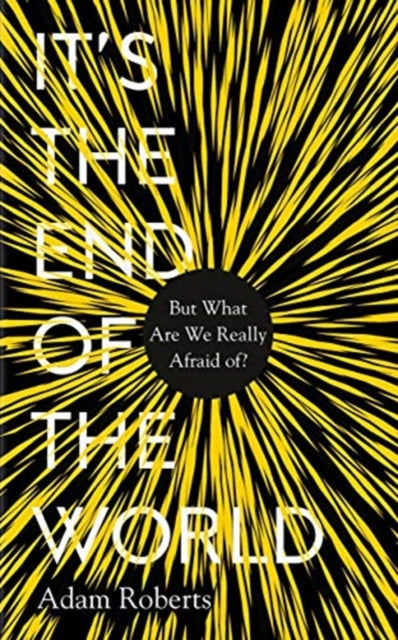
Adam Roberts
It's the End of the World: But What Are We Really Afraid Of?
It's the End of the World: But What Are We Really Afraid Of?
💎 Earn 53 Points (£0.53) on this item.
YOU SAVE £4.38
- Condition: Brand new
- UK Delivery times: Usually arrives within 2 - 3 working days
- UK Shipping: Fee starts at £2.39. Subject to product weight & dimension
Bulk ordering. Want 15 or more copies? Get a personalised quote and bigger discounts. Learn more about bulk orders.
Couldn't load pickup availability
- More about It's the End of the World: But What Are We Really Afraid Of?
In his book, "Are We Doomed?", Professor Adam Roberts explores different cultural visions of the end of the world and what they say about us. He examines fears of an uncaring universe, uncontrollable environment, human capacity for destruction, and our own mortality. The book covers a range of end-of-world scenarios, from fiction to reality, including last man and dying earth fiction, zombies, contagions, aliens, bombs, and robots.
\n Format: Hardback
\n Length: 288 pages
\n Publication date: 05 November 2020
\n Publisher: Elliott & Thompson Limited
\n
Are we doomed? Is an almighty power or an earth-shattering meteor waiting for us just around the corner?
In this thought-provoking book, Professor Adam Roberts explores our many different cultural visions of the end of the world - likely and unlikely, mundane and bizarre - and what they say about how we see ourselves and our societies. What is it is that we are really afraid of? An uncaring universe; an uncontrollable environment; the human capacity for destruction; or just our own, personal apocalypse - our mortality?
From last man and dying earth fiction to zombies swarming on screen and the ruined landscapes of immersive gaming, via sweeping contagions, invading aliens, falling bombs and rising robots, buckle up for the end of the world.
The idea of the end of the world has fascinated humanity for centuries, and it remains a topic of intense interest and speculation today. In this book, Professor Adam Roberts explores our many different cultural visions of the end of the world, likely and unlikely, mundane and bizarre, and what they say about how we see ourselves and our societies.
One of the most common fears associated with the end of the world is the fear of an uncaring universe. This fear is often expressed in science fiction literature and movies, where the universe is portrayed as a cold, indifferent place where human life is insignificant. This fear can be particularly powerful in times of crisis, such as the COVID-19 pandemic, when it feels like the world is out of control and we are powerless to stop it.
Another fear associated with the end of the world is the fear of an uncontrollable environment. This fear is often expressed in natural disaster movies and literature, where the environment is portrayed as a powerful force that can wipe out human life without warning. This fear can be particularly powerful in times of climate change, when it feels like the earth is warming and we are powerless to stop it.
The fear of the human capacity for destruction is also a common theme in the end of the world literature. This fear is often expressed in movies and literature that depict wars, genocide, and other acts of violence that have the potential to wipe out entire populations. This fear can be particularly powerful in times of political instability, when it feels like the world is on the brink of disaster.
Finally, the fear of our own personal apocalypse, or our mortality, is also a common theme in the end of the world literature. This fear is often expressed in literature and movies that depict the end of the world as a personal experience, where individuals are forced to confront their own mortality and the meaning of their lives. This fear can be particularly powerful in times of personal crisis, such as the death of a loved one or the diagnosis of a terminal illness.
In addition to these fears, there are many other cultural visions of the end of the world, ranging from the mundane to the bizarre. For example, some people believe that the end of the world will be marked by a massive earthquake or volcanic eruption, while others believe that the end of the world will be brought about by a supernatural event, such as the return of Jesus Christ or the arrival of aliens.
Despite these many different cultural visions of the end of the world, there is one thing that they all have in common: they all say something about how we see ourselves and our societies. The end of the world is often seen as a moment of crisis, a time when we are forced to confront our own mortality and the meaning of our lives. This can be a powerful moment of self-reflection and growth, but it can also be a time of fear and despair.
In conclusion, the idea of the end of the world has fascinated humanity for centuries, and it remains a topic of intense interest and speculation today. In this book, Professor Adam Roberts explores our many different cultural visions of the end of the world, likely and unlikely, mundane and bizarre, and what they say about how we see ourselves and our societies. Whether we are doomed or not, the end of the world is a powerful reminder of the importance of self-reflection, growth, and compassion for others.
\n Weight: 334g\n
Dimension: 144 x 223 x 25 (mm)\n
ISBN-13: 9781783964741\n \n
UK and International shipping information
UK and International shipping information
UK Delivery and returns information:
- Delivery within 2 - 3 days when ordering in the UK.
- Shipping fee for UK customers from £2.39. Fully tracked shipping service available.
- Returns policy: Return within 30 days of receipt for full refund.
International deliveries:
Shulph Ink now ships to Australia, Belgium, Canada, France, Germany, Ireland, Italy, India, Luxembourg Saudi Arabia, Singapore, Spain, Netherlands, New Zealand, United Arab Emirates, United States of America.
- Delivery times: within 5 - 10 days for international orders.
- Shipping fee: charges vary for overseas orders. Only tracked services are available for most international orders. Some countries have untracked shipping options.
- Customs charges: If ordering to addresses outside the United Kingdom, you may or may not incur additional customs and duties fees during local delivery.