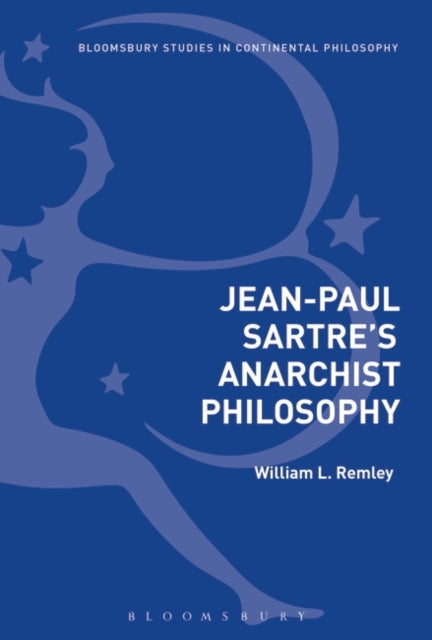
William L.Remley
Jean-Paul Sartre's Anarchist Philosophy
Jean-Paul Sartre's Anarchist Philosophy
💎 Earn 185 Points (£1.85) on this item.
We can order this item for you. Delivery usually takes about 4 to 6 weeks.
This item is not held in our immediate stock. We will order it for you after checkout.
Estimated delivery: About 4 to 6 weeks
- Condition: Brand new
- UK Delivery times: Usually arrives within 2 - 3 working days
- UK Shipping: Fee starts at £3.89. Subject to product weight & dimension
Bulk ordering. Want 15 or more copies? Get a personalised quote and bigger discounts. Learn more about bulk orders.
Couldn't load pickup availability
- More about Jean-Paul Sartre's Anarchist Philosophy
Jean-Paul Sartres political writings, from his early works of the 1920s to Critique of Dialectical Reason, are heavily influenced by anarchists such as Proudhon and Bakunin. However, scholarly debate overwhelmingly concludes that his political philosophy is a Marxist one. William L. Remley's book sheds new light on the crucial role of anarchism in Sartres writing, arguing that it fundamentally underpins the body of his political work. It is only in understanding Sartres anarchism that one can appreciate the full meaning of the Critique and Sartres entire political philosophy.
Format: Paperback / softback
Length: 272 pages
Publication date: 22 August 2019
Publisher: Bloomsbury Publishing PLC
Jean-Paul Sartre's political writings, spanning from his early works of the 1920s to his monumental Critique of Dialectical Reason, are deeply influenced by anarchist thinkers such as Proudhon and Bakunin. However, despite the significant impact of anarchism on his political philosophy, scholarly debate overwhelmingly concludes that his political philosophy is primarily Marxist. In this groundbreaking study, William L. Remley sheds new light on the crucial role of anarchism in Sartre's writing, contending that it fundamentally underpins the body of his political work. This book offers a timely re-invigoration of this topic by introducing newly translated material from Sartre's early oeuvre and providing a fresh perspective on his Critique of Dialectical Reason. By arguing that Sartre's political philosophy espouses a far more radical anarchist position than has been previously attributed to it, Jean-Paul Sartre's Anarchist Philosophy not only fills an important gap in Sartre scholarship but also initiates a much-needed revision of twentieth-century thought from an anarchist perspective.
Jean-Paul Sartre's Political Writings and Anarchism
Jean-Paul Sartre's political writings, spanning from his early works of the 1920s to his monumental Critique of Dialectical Reason, are deeply influenced by anarchist thinkers such as Proudhon and Bakunin. However, despite the significant impact of anarchism on his political philosophy, scholarly debate overwhelmingly concludes that his political philosophy is primarily Marxist. In this groundbreaking study, William L. Remley sheds new light on the crucial role of anarchism in Sartre's writing, contending that it fundamentally underpins the body of his political work. This book offers a timely re-invigoration of this topic by introducing newly translated material from Sartre's early oeuvre and providing a fresh perspective on his Critique of Dialectical Reason. By arguing that Sartre's political philosophy espouses a far more radical anarchist position than has been previously attributed to it, Jean-Paul Sartre's Anarchist Philosophy not only fills an important gap in Sartre scholarship but also initiates a much-needed revision of twentieth-century thought from an anarchist perspective.
Anarchism in Sartre's Political Writings
Anarchism is a political ideology that rejects the existence of hierarchical structures and advocates for the abolition of all forms of authority. It emphasizes individual freedom, social equality, and the rejection of coercion and domination. Anarchism has been a significant influence on many social and political movements throughout history, including the French Revolution, the Russian Revolution, and the Civil Rights Movement in the United States. In Sartre's political writings, anarchism is evident in his critique of traditional political systems, his emphasis on individual autonomy, and his advocacy for social and political change.
Scholarly Debate on Sartre's Political Philosophy
Scholarly debate on Sartre's political philosophy has been ongoing for many years. While some scholars have argued that Sartre's political philosophy is primarily Marxist, others have suggested that it is more nuanced and complex. One of the main arguments against Sartre's Marxist interpretation is that it fails to account for his emphasis on individual freedom and autonomy. Anarchism, on the other hand, provides a more comprehensive framework for understanding Sartre's political philosophy, as it emphasizes the importance of individual freedom and the rejection of coercion and domination.
William L. Remley's Study on Anarchism in Sartre's Writings1>
William L. Remley's study on anarchism in Sartre's writings is a significant contribution to the field of Sartre scholarship. Remley argues that anarchism is a fundamental aspect of Sartre's political philosophy and that it fundamentally underpins the body of his political work. He contends that Sartre's anarchism is not simply a theoretical position but a practical one that informs his political activism and his writing. Remley's study provides a fresh perspective on Sartre's political philosophy by highlighting the importance of anarchism in his work.
Anarchism in Sartre's Critique of Dialectical Reason
Sartre's Critique of Dialectical Reason is a monumental work that explores the nature of dialectical reasoning and its implications for social and political change. In this work, Sartre argues that dialectical reasoning is inherently flawed and that it leads to the perpetuation of hierarchical structures and the oppression of individuals. Anarchism provides a critical critique of dialectical reasoning, as it emphasizes the importance of individual freedom and the rejection of coercion and domination. Remley's study shows that anarchism is a central theme in Sartre's Critique of Dialectical Reason and that it provides a framework for understanding his critique of dialectical reasoning.
Conclusion
Jean-Paul Sartre's political writings, spanning from his early works of the 1920s to his monumental Critique of Dialectical Reason, are deeply influenced by anarchist thinkers such as Proudhon and Bakunin. While scholarly debate overwhelmingly concludes that his political philosophy is primarily Marxist, William L. Remley's study on anarchism in Sartre's writings offers a fresh perspective on Sartre's political philosophy. Remley argues that anarchism is a fundamental aspect of Sartre's political philosophy and that it fundamentally underpins the body of his political work. By highlighting the importance of anarchism in Sartre's Critique of Dialectical Reason, Remley's study provides a timely re-invigoration of this topic and initiates a much-needed revision of twentieth-century thought from an anarchist perspective.
Weight: 450g
Dimension: 156 x 233 x 19 (mm)
ISBN-13: 9781350126695
UK and International shipping information
UK and International shipping information
We deliver throughout the United Kingdom and to 128 countries and territories worldwide, including the United States, Australia, Canada, Germany, Spain and France.