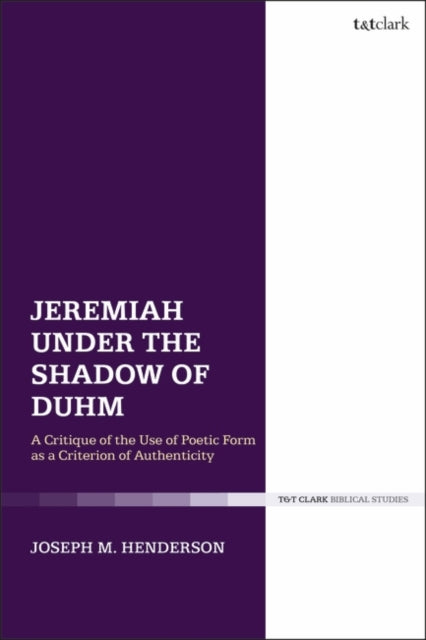
Joseph M.Henderson
Jeremiah Under the Shadow of Duhm: A Critique of the Use of Poetic Form as a Criterion of Authenticity
Jeremiah Under the Shadow of Duhm: A Critique of the Use of Poetic Form as a Criterion of Authenticity
💎 Earn 145 Points (£1.45) on this item.
YOU SAVE £3.80
- Condition: Brand new
- UK Delivery times: Usually arrives within 2 - 3 working days
- UK Shipping: Fee starts at £2.39. Subject to product weight & dimension
Bulk ordering. Want 15 or more copies? Get a personalised quote and bigger discounts. Learn more about bulk orders.
Couldn't load pickup availability
- More about Jeremiah Under the Shadow of Duhm: A Critique of the Use of Poetic Form as a Criterion of Authenticity
Joe Henderson challenges the assumption that poetic form in the book of Jeremiah indicates authenticity, arguing that it is best understood as an attempt to bring the book into conformity with nineteenth-century systems of aesthetics, historiography, and theology. He contends that continued adherence to this assumption has held back recent attempts to "move beyond Duhm" and overcome the fragmentation of the book. Rhetorical critics and redaction critics rely on the assumed authenticity of the poetry, but Henderson argues that the dramatic nature of these chapters undermines their use for Duhms historical-critical projects and reveals what actually unifies them—narrative progression.
\n Format: Paperback / softback
\n Length: 400 pages
\n Publication date: 29 July 2021
\n Publisher: Bloomsbury Publishing PLC
\n
Here is the rephrased text:
Joe Henderson provides a critical examination of the notion that the poetic form in the Book of Jeremiah signifies authenticity. This assumption forms the foundation of Bernhard Duhms reconstructions (1901) of the prophet's biography and the composition of the book, which have been the dominant paradigms in twentieth-century Jeremiah scholarship. Henderson argues that Duhms model can be best understood as an attempt to align the book with nineteenth-century systems of aesthetics, historiography, and theology, as well as the Grafian reconstruction of Israel's religious history. While there may be some superficial agreement between these systems and Duhms assumption about poetic form, their connection is more rooted in the Romantic theory of prophetic and poetic inspiration, which was forged by Robert Lowth in his exposition (1752) of the poetry found in the prophetic books.
Henderson contends that the persistent reliance on Duhms foundational assumption has hindered recent efforts to "move beyond Duhm" and overcome the fragmentation of the book resulting from his model. Rhetorical critics, who argue that Jeremiah 2-10 is unified by the structural devices of the historical prophet, and redaction critics, who maintain that Jeremiah 11-20 is unified by the theological agenda of Deuteronomistic editors, both rely on the assumed authenticity of the poetry. Henderson observes that while these scholars have uncovered evidence of dramatic presentation in Jeremiah 2-20, they have failed to recognize that the dramatic nature of these chapters undermines their usefulness for Duhms historical-critical projects and reveals the true unifying factor—narrative progression.
In conclusion, Joe Henderson's critique challenges the assumption that poetic form in the Book of Jeremiah indicates authenticity. He argues that Duhms model is best understood as an attempt to conform the book to nineteenth-century aesthetic, historical, and theological systems, as well as the Grafian reconstruction of Israel's religious history. Henderson suggests that the dramatic nature of these chapters undermines their utility for Duhms historical-critical projects and reveals the underlying narrative progression that unites the book. This analysis provides a fresh perspective on Jeremiah scholarship and highlights the need to move beyond the limitations imposed by Duhms model and explore new avenues for understanding the book's complex composition and meaning.
\n Weight: 610g\n
Dimension: 234 x 156 x 29 (mm)\n
ISBN-13: 9780567701787\n \n
This item can be found in:
UK and International shipping information
UK and International shipping information
UK Delivery and returns information:
- Delivery within 2 - 3 days when ordering in the UK.
- Shipping fee for UK customers from £2.39. Fully tracked shipping service available.
- Returns policy: Return within 30 days of receipt for full refund.
International deliveries:
Shulph Ink now ships to Australia, Belgium, Canada, France, Germany, Ireland, Italy, India, Luxembourg Saudi Arabia, Singapore, Spain, Netherlands, New Zealand, United Arab Emirates, United States of America.
- Delivery times: within 5 - 10 days for international orders.
- Shipping fee: charges vary for overseas orders. Only tracked services are available for most international orders. Some countries have untracked shipping options.
- Customs charges: If ordering to addresses outside the United Kingdom, you may or may not incur additional customs and duties fees during local delivery.