Jeffrey Saletnik
Josef Albers, Late Modernism, and Pedagogic Form
Josef Albers, Late Modernism, and Pedagogic Form
💎 Earn 141 Points (£1.41) on this item.
YOU SAVE £3.68
- Condition: Brand new
- UK Delivery times: Usually arrives within 2 - 3 working days
- UK Shipping: Fee starts at £2.39. Subject to product weight & dimension
Bulk ordering. Want 15 or more copies? Get a personalised quote and bigger discounts. Learn more about bulk orders.
Couldn't load pickup availability
- More about Josef Albers, Late Modernism, and Pedagogic Form
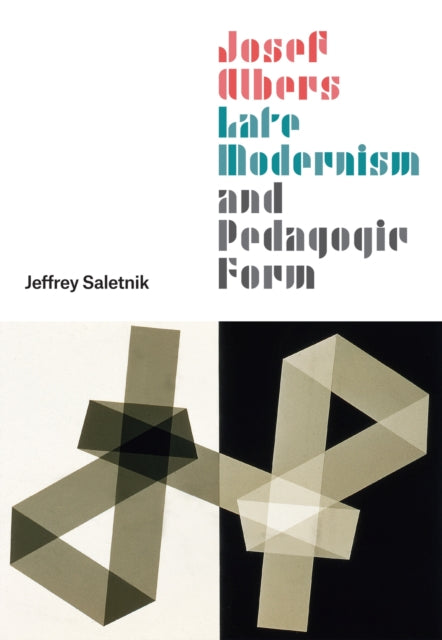
Josef Albers was an influential artist and teacher who shaped the Bauhaus school, established art and design programs at Black Mountain College and Yale University, and developed a dynamic approach to teaching that cultivated a material way of thinking among his students. Jeffrey Saletnik explores the origins of Albers' teaching practices and their significance in conveying attitudes about form, material, and sensory understanding to artists Eva Hesse and Richard Serra, positioning Albers' pedagogy as central to the life of modernism.
Format: Hardback
Length: 320 pages
Publication date: 13 October 2022
Publisher: The University of Chicago Press
Josef Albers, a renowned artist and teacher, left an indelible mark on the world of art and design through his innovative pedagogy. Hailing from Germany, Albers played a pivotal role in shaping the Bauhaus school and establishing art and design programs at institutions such as Black Mountain College in North Carolina and Yale University. His profound understanding of color theory, as encapsulated in his influential books, has resonated with generations of artists and designers. Albers' artistic contributions, characterized by their non-representational nature, are considered a testament to the high-modernist movement.
In his book, Jeffrey Saletnik delves into the origins and significance of Albers' teaching practices. He explores how Albers' pedagogy went beyond the confines of modernist agendas and fostered a material way of thinking among his students. Saletnik demonstrates how pedagogy serves as a framework that enables artistic discourse and how the methods by which artists learn manifest in their individual practices. By tracing the lines from Albers' training in German educational traditions to his influence on American postwar art, Josef Albers, Late Modernism, and Pedagogic Form establishes Albers' pedagogy as a central aspect of modernism's life.
Albers' teaching philosophy was characterized by his belief in the transformative power of visual perception. He encouraged his students to observe and analyze the world around them, emphasizing the importance of sensory understanding in the creative process. Through his teachings, Albers sought to develop a deeper appreciation for form, material, and the relationship between them. He emphasized the importance of experimentation and exploration, encouraging his students to push the boundaries of their artistic practices.
One of the key aspects of Albers' pedagogy was his emphasis on the relationship between the artist and the object. He believed that the artist should be in constant dialogue with their materials, exploring their properties and potentialities. Albers encouraged his students to approach their work with a sense of curiosity and openness, encouraging them to experiment with different techniques and mediums. He also emphasized the importance of craftsmanship, teaching his students the skills necessary to create high-quality works of art.
Albers' approach to teaching was highly influential, shaping the artistic practices of many artists who came after him. His emphasis on sensory understanding, material exploration, and craftsmanship has continued to inspire artists across different genres and mediums. His legacy lives on through his artworks, which are housed in prestigious museums and galleries worldwide, and through the continued study and appreciation of his teaching practices.
In conclusion, Josef Albers' pedagogy was a groundbreaking and transformative approach to teaching art and design. Through his emphasis on visual perception, sensory understanding, material exploration, and craftsmanship, Albers cultivated a material way of thinking among his students. His legacy continues to inspire artists and designers worldwide, and his teachings remain a valuable resource for those seeking to expand their artistic horizons.
Weight: 908g
Dimension: 187 x 262 x 24 (mm)
ISBN-13: 9780226699172
This item can be found in:
UK and International shipping information
UK and International shipping information
UK Delivery and returns information:
- Delivery within 2 - 3 days when ordering in the UK.
- Shipping fee for UK customers from £2.39. Fully tracked shipping service available.
- Returns policy: Return within 30 days of receipt for full refund.
International deliveries:
Shulph Ink now ships to Australia, Belgium, Canada, France, Germany, Ireland, Italy, India, Luxembourg Saudi Arabia, Singapore, Spain, Netherlands, New Zealand, United Arab Emirates, United States of America.
- Delivery times: within 5 - 10 days for international orders.
- Shipping fee: charges vary for overseas orders. Only tracked services are available for most international orders. Some countries have untracked shipping options.
- Customs charges: If ordering to addresses outside the United Kingdom, you may or may not incur additional customs and duties fees during local delivery.