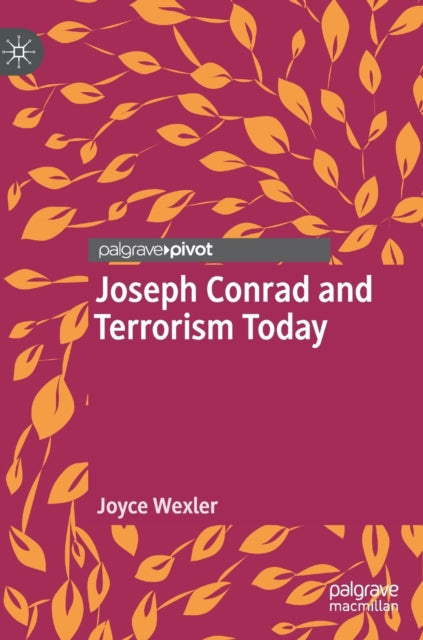
Joyce Wexler
Joseph Conrad and Terrorism Today
Joseph Conrad and Terrorism Today
💎 Earn 227 Points (£2.27) on this item.
We can order this item for you. Delivery usually takes about 4 to 6 weeks.
This item is not held in our immediate stock. We will order it for you after checkout.
Estimated delivery: About 4 to 6 weeks
YOU SAVE £9.57
- Condition: Brand new
- UK Delivery times: Usually arrives within 2 - 3 working days
- UK Shipping: Fee starts at £2.39. Subject to product weight & dimension
Bulk ordering. Want 15 or more copies? Get a personalised quote and bigger discounts. Learn more about bulk orders.
Couldn't load pickup availability
- More about Joseph Conrad and Terrorism Today
This book explores how Joseph Conrad's anarchist fiction can help us understand terrorism today by portraying anarchists and police as counterparts driven by the human desires for autonomy and affiliation. Postcritique encourages readers to consider the accuracy of such information and research in Terrorism Studies confirms Conrad's insights, showing his characters as more realistic and his political stance as more hopeful than recognized.
Format: Hardback
Length: 121 pages
Publication date: 31 October 2021
Publisher: Springer Nature Switzerland AG
This captivating book delves into the realm of Joseph Conrad's anarchist fiction, offering a profound exploration of its relevance in understanding terrorism in contemporary times. Conrad challenges the prevailing notion that terrorists are mere fanatics by presenting a nuanced portrayal of anarchists and police characters. He reveals that both groups are driven by fundamental human desires such as autonomy, affiliation, and the urge to control their own lives and be part of a collective. Through his postcritique approach, Conrad encourages readers to critically evaluate the accuracy of the information presented, and recent research in the field of Terrorism Studies validates his insights. It is evident that Conrad's characters are more realistic and his political stance is more hopeful than critics have acknowledged.
Conrad's portrayal of anarchists and police as counterparts driven by similar desires highlights the complex dynamics underlying terrorist activities. By humanizing these characters and showing their motivations, Conrad offers a more nuanced understanding of the factors that contribute to terrorism. This approach challenges the simplistic narratives often used to describe and understand terrorists, allowing for a deeper exploration of the complex social, political, and economic factors that fuel their actions.
One of the key insights provided by Conrad's fiction is the recognition of the role of autonomy and affiliation in shaping individuals' behavior. Anarchists, for example, are often portrayed as individuals who reject traditional authority and seek to establish their own independent communities. Conrad shows how these desires can be manipulated and exploited by individuals or groups with ulterior motives, leading to acts of terrorism. Similarly, police characters are portrayed as individuals who are driven by a desire to protect and serve their communities, but who may also be influenced by political agendas, power dynamics, or personal biases. Conrad's exploration of these themes highlights the importance of understanding the motivations behind individuals' actions, whether they are motivated by ideological beliefs or personal desires.
Another important aspect of Conrad's fiction is his portrayal of the need to control one's own life and be part of a group. This theme is particularly relevant in the context of terrorism, where individuals may feel a sense of disillusionment, marginalization, or a lack of control over their lives. By presenting characters who are seeking to establish their own identity and control their own destiny, Conrad offers a hopeful message that individuals can overcome these challenges and find meaning and purpose in their lives. This message is particularly relevant in today's world, where many people feel disenfranchised and powerless, and where the threat of terrorism continues to loom large.
Conrad's postcritique approach encourages readers to critically evaluate the information presented in his fiction. By challenging the assumptions and biases that often underpin our understanding of terrorism, Conrad encourages readers to develop a more nuanced and informed perspective on the issue. This approach is particularly valuable in the context of contemporary terrorism, where the nature of the threat is constantly evolving and where misinformation and propaganda can have significant consequences.
Recent research in the field of Terrorism Studies has confirmed the insights provided by Conrad's fiction. Studies have shown that Conrad's characters are more realistic than traditional stereotypes, and that his political stance is more hopeful than critics have recognized. For example, research has shown that Conrad's portrayal of anarchists as individuals who are driven by a desire for social justice and equality is more accurate than the portrayal of them as mere violent extremists. Similarly, research has shown that Conrad's portrayal of police characters as individuals who are motivated by a desire to protect and serve their communities is more accurate than the portrayal of them as mere tools of the state.
In conclusion, this captivating book delves into the realm of Joseph Conrad's anarchist fiction, offering a profound exploration of its relevance in understanding terrorism in contemporary times. Conrad challenges the prevailing notion that terrorists are mere fanatics by presenting a nuanced portrayal of anarchists and police characters. He reveals that both groups are driven by fundamental human desires such as autonomy, affiliation, and the urge to control their own lives and be part of a collective. Through his postcritique approach, Conrad encourages readers to critically evaluate the accuracy of the information presented, and recent research in the field of Terrorism Studies validates his insights. It is evident that Conrad's characters are more realistic and his political stance is more hopeful than critics have acknowledged. By humanizing these characters and showing their motivations, Conrad offers a more nuanced understanding of the factors that contribute to terrorism, allowing for a deeper exploration of the complex social, political, and economic factors that fuel their actions. This approach challenges the simplistic narratives often used to describe and understand terrorists, leading to a more comprehensive and effective response to the threat of terrorism in the modern world.
Weight: 314g
Dimension: 155 x 219 x 17 (mm)
ISBN-13: 9783030868444
Edition number: 1st ed. 2021
This item can be found in:
UK and International shipping information
UK and International shipping information
UK Delivery and returns information:
- Delivery within 2 - 3 days when ordering in the UK.
- Shipping fee for UK customers from £2.39. Fully tracked shipping service available.
- Returns policy: Return within 30 days of receipt for full refund.
International deliveries:
Shulph Ink now ships to Australia, Belgium, Canada, France, Germany, Ireland, Italy, India, Luxembourg Saudi Arabia, Singapore, Spain, Netherlands, New Zealand, United Arab Emirates, United States of America.
- Delivery times: within 5 - 10 days for international orders.
- Shipping fee: charges vary for overseas orders. Only tracked services are available for most international orders. Some countries have untracked shipping options.
- Customs charges: If ordering to addresses outside the United Kingdom, you may or may not incur additional customs and duties fees during local delivery.