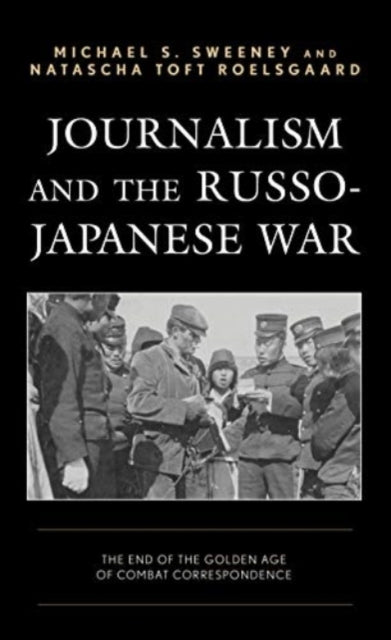
Michael S. Sweeney,Natascha Toft Roelsgaard
Journalism and the Russo-Japanese War: The End of the Golden Age of Combat Correspondence
Journalism and the Russo-Japanese War: The End of the Golden Age of Combat Correspondence
💎 Earn 191 Points (£1.91) on this item.
We can order this item for you. Delivery usually takes about 4 to 6 weeks.
This item is not held in our immediate stock. We will order it for you after checkout.
Estimated delivery: About 4 to 6 weeks
- Condition: Brand new
- UK Delivery times: Usually arrives within 2 - 3 working days
- UK Shipping: Fee starts at £2.39. Subject to product weight & dimension
Bulk ordering. Want 15 or more copies? Get a personalised quote and bigger discounts. Learn more about bulk orders.
Couldn't load pickup availability
- More about Journalism and the Russo-Japanese War: The End of the Golden Age of Combat Correspondence
During the Russo-Japanese War of 1904-05, Japan implemented methods of shaping the news to control the journalistic coverage and challenges, helping to shape the modern world of journalism by creating and packaging truth.
Format: Paperback / softback
Length: 260 pages
Publication date: 15 March 2022
Publisher: Lexington Books
The Russo-Japanese War of 1904-05, often referred to as World War Zero, is the subject of this book's examination of journalistic coverage and difficulties. The authors look at how Japan hampered and controlled journalists to prevent any damage to the country's goals at home or abroad and how it used techniques to mold the news. They contend that Japan contributed to the development of modern journalism by inventing and marketing facts.
The Russo-Japanese War of 1904-05 was a significant event in world history that had far-reaching consequences for both Japan and Russia. The war was fought over territorial claims in the Pacific Ocean and marked the beginning of Japan's rise as a global power.
The war began in February 1904 when Japan attacked Russia's fleet in Port Arthur, Manchuria. The Russian navy was defeated, and Japan gained control of the Liaodong Peninsula, which was a valuable strategic asset.
The following months saw a series of battles between Japan and Russia, including the Battle of Tsushima, which is considered one of the most significant naval battles in history. The Japanese navy defeated the Russian fleet, and Japan emerged as the dominant power in the Pacific Ocean.
The war also had significant political consequences. It led to the end of the Russian Empire and the rise of the Soviet Union. It also helped to shape the modern world order, as Japan became a major player in international politics.
The journalistic coverage of the war was significant, as it provided a window into the events that were shaping the world. Journalists were able to report on the battles, the casualties, and the political developments that were taking place.
However, the war also presented journalists with a number of challenges. One of the biggest challenges was the censorship that was imposed by the Japanese government. The government was concerned about the negative publicity that could be generated by the war, and it imposed strict controls on the media. Journalists were not allowed to report on the war in a way that could be construed as negative or critical of Japan.
Another challenge was the lack of access to information. Journalists were often unable to report on the war in a way that was accurate or comprehensive because of the restrictions that were imposed by the Japanese government. This made it difficult for journalists to provide a full picture of the events that were taking place.
Despite these challenges, journalists were able to provide a valuable contribution to the coverage of the war. They were able to report on the events that were taking place, and they were able to provide a voice to the people who were affected by the war.
One of the most significant contributions of journalists to the coverage of the war was their ability to provide a human perspective on the events that were taking place. Journalists were able to interview soldiers, civilians, and political leaders, and they were able to provide a sense of the human cost of the war.
Journalists were also able to challenge the propaganda that was being spread by the Japanese government. They were able to report on the truth.
The war also had a significant impact on the development of journalism. It led to the development of new technologies and techniques for reporting on the war, such as radio and television. It also led to the development of new standards for journalism, such as the importance of accuracy and objectivity.
In conclusion, the Russo-Japanese War of 1904-05 was a significant event in world history that had far-reaching consequences for both Japan and Russia. The war was fought over territorial claims in the Pacific Ocean and marked the beginning of Japan's rise as a global power. The journalistic coverage of the war was significant, as it provided a window into the events that were shaping the world. Despite the challenges that were presented by the war, journalists were able to provide a valuable contribution to the coverage of the war. They were able to report on the events that were taking place, provide a human perspective on the events, challenge the propaganda that was being spread by the Japanese government, and contribute to the development of new technologies and techniques for reporting on the war.
Dimension: 229 x 152 (mm)
ISBN-13: 9781793617927
This item can be found in:
UK and International shipping information
UK and International shipping information
UK Delivery and returns information:
- Delivery within 2 - 3 days when ordering in the UK.
- Shipping fee for UK customers from £2.39. Fully tracked shipping service available.
- Returns policy: Return within 30 days of receipt for full refund.
International deliveries:
Shulph Ink now ships to Australia, Belgium, Canada, France, Germany, Ireland, Italy, India, Luxembourg Saudi Arabia, Singapore, Spain, Netherlands, New Zealand, United Arab Emirates, United States of America.
- Delivery times: within 5 - 10 days for international orders.
- Shipping fee: charges vary for overseas orders. Only tracked services are available for most international orders. Some countries have untracked shipping options.
- Customs charges: If ordering to addresses outside the United Kingdom, you may or may not incur additional customs and duties fees during local delivery.