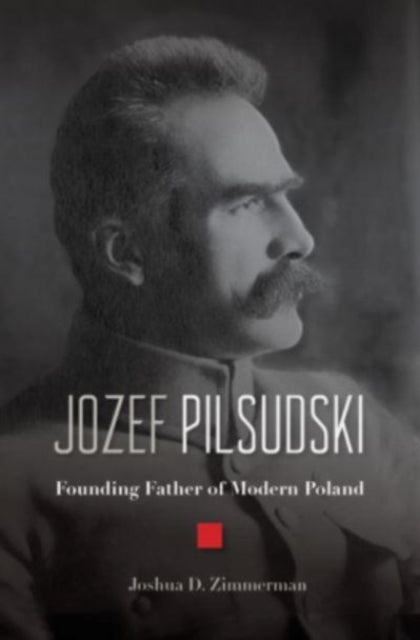
Joshua D. Zimmerman
Jozef Pilsudski: Founding Father of Modern Poland
Jozef Pilsudski: Founding Father of Modern Poland
💎 Earn 138 Points (£1.38) on this item.
YOU SAVE £7.31
- Condition: Brand new
- UK Delivery times: Usually arrives within 2 - 3 working days
- UK Shipping: Fee starts at £2.39. Subject to product weight & dimension
Bulk ordering. Want 15 or more copies? Get a personalised quote and bigger discounts. Learn more about bulk orders.
Couldn't load pickup availability
- More about Jozef Pilsudski: Founding Father of Modern Poland
Jozef Pilsudski, the founding father of modern Poland, was a brilliant military leader and statesman who betrayed his democratic vision by seizing power in a military coup. He was devoted to the idea of democracy but ceded power on constitutional terms, only to retake it in a coup. His legacy divides supporters and detractors, with Poland caught on the tortured edge between self-government and authoritarianism.
Format: Hardback
Length: 640 pages
Publication date: 24 June 2022
Publisher: Harvard University Press
The enigmatic Jozef Pilsudski, the founding father of modern Poland, is a fascinating and complex figure in the history of Europe. Born in 1867, Pilsudski devoted his life to reestablishing the Polish state that had ceased to exist in 1795. Ahead of World War I, he created a clandestine military corps to fight Russia, which held most Polish territory. After the war, his dream of an independent Poland realized, and he took the helm of its newly democratic political order. When he died in 1935, he was buried alongside Polish kings.
However, Pilsudski was a complicated figure. Passionately devoted to the idea of democracy, he ceded power on constitutional terms, only to retake it a few years later in a coup when he believed his opponents aimed to dismantle the democratic system. Joshua Zimmerman's authoritative biography examines a national hero in the thick of a changing Europe, and the legacy that still divides supporters and detractors.
The Poland that Pilsudski envisioned was modern, democratic, and pluralistic. Domestically, he championed equality for Jews. Internationally, he positioned Poland as a bulwark against Bolshevism. But in 1926, he seized power violently, then ruled as a strongman for nearly a decade, imprisoning opponents and eroding legislative power.
In Zimmerman's telling, Pilsudski's faith in the young democracy was shattered after its first elected president was assassinated. Unnerved by Poles brutally turning on one another, the father of the nation came to doubt his fellow citizens' democratic commitments and thereby betrayed his own. It is a legacy that dogs today's Poland, caught on the tortured edge between democracy and authoritarianism.
Pilsudski's legacy is a complex and multifaceted one. On the one hand, he is revered as a national hero for his role in reestablishing Poland's independence and his commitment to democracy. On the other hand, his seizure of power and his authoritarian rule have left a lasting stain on Polish history.
Pilsudski's belief in the power of the military to shape political outcomes was a defining characteristic of his political philosophy. He saw the military as a tool for national liberation and the defense of democracy. He believed that the military should be independent of political parties and the civilian government, and that it should be used to protect the interests of the Polish people.
However, Pilsudski's use of the military to seize power and maintain his grip on power was controversial. Some saw it as a betrayal of the democratic ideals that he had championed throughout his life. Others argued that his actions were necessary to protect Poland from the threat of communism and to ensure its survival as a nation.
Pilsudski's legacy is also shaped by his commitment to equality and social justice. He championed the rights of Jews and other minority groups, and he worked to promote social equality and economic development in Poland. He also implemented policies that aimed to improve the lives of the Polish people, such as land reform and education reform.
Despite his achievements, Pilsudski's legacy is also marked by his authoritarianism and his disregard for human rights. He imprisoned opponents and suppressed political dissent, and he used the military to maintain his grip on power. His actions led to the displacement of millions of people and the destruction of much of Poland's cultural heritage.
In conclusion, the story of Jozef Pilsudski is a complex and multifaceted one. He is revered as a national hero for his role in reestablishing Poland's independence and his commitment to democracy. However, his seizure of power and his authoritarian rule have left a lasting stain on Polish history. Pilsudski's legacy is shaped by his belief in the power of the military, his commitment to equality and social justice, and his disregard for human rights. His actions have had a profound impact on the political and social landscape of Poland, and they continue to be debated and discussed by historians and political analysts today.
Dimension: 235 x 156 (mm)
ISBN-13: 9780674984271
UK and International shipping information
UK and International shipping information
UK Delivery and returns information:
- Delivery within 2 - 3 days when ordering in the UK.
- Shipping fee for UK customers from £2.39. Fully tracked shipping service available.
- Returns policy: Return within 30 days of receipt for full refund.
International deliveries:
Shulph Ink now ships to Australia, Belgium, Canada, France, Germany, Ireland, Italy, India, Luxembourg Saudi Arabia, Singapore, Spain, Netherlands, New Zealand, United Arab Emirates, United States of America.
- Delivery times: within 5 - 10 days for international orders.
- Shipping fee: charges vary for overseas orders. Only tracked services are available for most international orders. Some countries have untracked shipping options.
- Customs charges: If ordering to addresses outside the United Kingdom, you may or may not incur additional customs and duties fees during local delivery.