MerrickAnderson
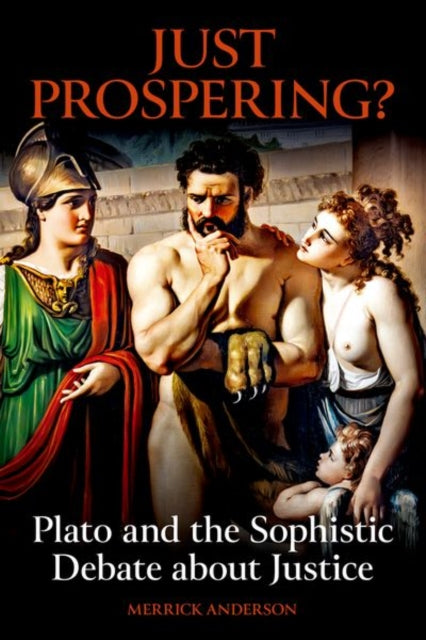
Just Prospering? Plato and the Sophistic Debate about Justice
Just Prospering? Plato and the Sophistic Debate about Justice
💎 Earn 429 Points (£4.29) on this item.
- Condition: Brand new
- UK Delivery times: Usually arrives within 2 - 3 working days
- UK Shipping: Fee starts at £2.39. Subject to product weight & dimension
Bulk ordering. Want 15 or more copies? Get a personalised quote and bigger discounts. Learn more about bulk orders.
Couldn't load pickup availability
- More about Just Prospering? Plato and the Sophistic Debate about Justice
Plato and the Sophistic Debate about Justice explores the Western Tradition's first secular discussions of the value of justice, challenging the idea that being just is always good. Anderson argues that some sophists argued that being just was bad for the just individual, while others defended justice by arguing that the just life was best. Plato, writing in the 4th Century, revived the earlier dialogue of the sophists in his Republic to argue that the just life is the best life for human beings.
Format: Hardback
Length: 236 pages
Publication date: 21 March 2024
Publisher: Oxford University Press
Plato and the Sophistic Debate about Justice introduces new research about the first secular discussions concerning the value of justice from the Western Tradition. In Part I, Anderson addresses the debates of the sophists, a group of politically minded intellectuals from the 5th Century BCE, considering relevant extant texts to produce the following conclusion: some of the sophists argued that being just was bad for the just individual, and that an individual would do well to be unjust instead, whereas others took it upon themselves to defend justice by arguing that the just life was best. Anderson continues in Part II to demonstrate that Plato, writing in the 4th Century, was aware of this debate and wanted to settle the matter himself. In his Republic, one of the great philosophical treatises of all time, he revives the earlier dialogue of the sophists to argue that the just life is the best life for human beings.
Plato's Republic is a seminal work in the history of Western philosophy, and its discussion of justice is one of its most significant themes. The Republic is a dialogue between Socrates and his interlocutors, and it explores the nature of justice, the just life, and the role of the philosopher in society. Plato argues that justice is not just a matter of obeying the law, but of living a virtuous life that is in harmony with the natural order of the universe. He believes that the just life is the best life for human beings because it leads to happiness and fulfillment.
One of the key arguments in the Republic is that the just life is not just a matter of individual happiness, but of the common good. Plato argues that the just life is necessary for the survival of society, and that individuals who live unjust lives will ultimately harm themselves and others. He uses the example of a city to illustrate this point. A city is a complex system that requires the cooperation of its citizens to function properly. If one citizen is unjust, he will harm the other citizens, and the city will eventually collapse.
Plato also argues that the just life is not just a matter of obeying the law, but of living a virtuous life that is in harmony with the natural order of the universe. He believes that the natural order of the universe is governed by a set of laws that are designed to promote harmony and balance. If individuals live unjust lives, they will disrupt the natural order of the universe and will ultimately harm themselves and others.
In addition to his discussion of justice, Plato also discusses the role of the philosopher in society. He believes that the philosopher is responsible for promoting the common good and for helping individuals to live just lives. He argues that the philosopher should be a teacher and a guide, and that he should be able to help individuals to understand the nature of justice and to live a virtuous life.
Plato's Republic has had a profound impact on Western philosophy and society. It has been studied and debated for centuries, and its ideas have been applied to a wide range of issues, including politics, ethics, and social justice. However, the Republic has also been criticized for its perceived elitism and its emphasis on the importance of the individual. Some critics argue that Plato's view of justice is too narrow and that it does not take into account the needs of the poor and the marginalized.
Despite these criticisms, Plato's Republic remains a significant work in the history of Western philosophy. Its discussion of justice is one of its most significant themes, and its ideas have been applied to a wide range of issues. If you are interested in learning more about Plato's Republic, there are many resources available to you. You can read the Republic itself, or you can read commentary on the Republic by other philosophers. You can also attend lectures or seminars on Plato's philosophy.
In conclusion, Plato and the Sophistic Debate about Justice introduces new research about the first secular discussions concerning the value of justice from the Western Tradition. In Part I, Anderson addresses the debates of the sophists, a group of politically minded intellectuals from the 5th Century BCE, considering relevant extant texts to produce the following conclusion: some of the sophists argued that being just was bad for the just individual, and that an individual would do well to be unjust instead, whereas others took it upon themselves to defend justice by arguing that the just life was best. Anderson continues in Part II to demonstrate that Plato, writing in the 4th Century, was aware of this debate and wanted to settle the matter himself. In his Republic, one of the great philosophical treatises of all time, he revives the earlier dialogue of the sophists to argue that the just life is the best life for human beings. Plato's Republic is a seminal work in the history of Western philosophy, and its discussion of justice is one of its most significant themes. Its ideas have been applied to a wide range of issues, and it remains a significant work in the history of Western philosophy. If you are interested in learning more about Plato's Republic, there are many resources available to you.
Weight: 500g
Dimension: 240 x 162 x 18 (mm)
ISBN-13: 9780197267660
This item can be found in:
UK and International shipping information
UK and International shipping information
UK Delivery and returns information:
- Delivery within 2 - 3 days when ordering in the UK.
- Shipping fee for UK customers from £2.39. Fully tracked shipping service available.
- Returns policy: Return within 30 days of receipt for full refund.
International deliveries:
Shulph Ink now ships to Australia, Belgium, Canada, France, Germany, Ireland, Italy, India, Luxembourg Saudi Arabia, Singapore, Spain, Netherlands, New Zealand, United Arab Emirates, United States of America.
- Delivery times: within 5 - 10 days for international orders.
- Shipping fee: charges vary for overseas orders. Only tracked services are available for most international orders. Some countries have untracked shipping options.
- Customs charges: If ordering to addresses outside the United Kingdom, you may or may not incur additional customs and duties fees during local delivery.