Joshua Mason
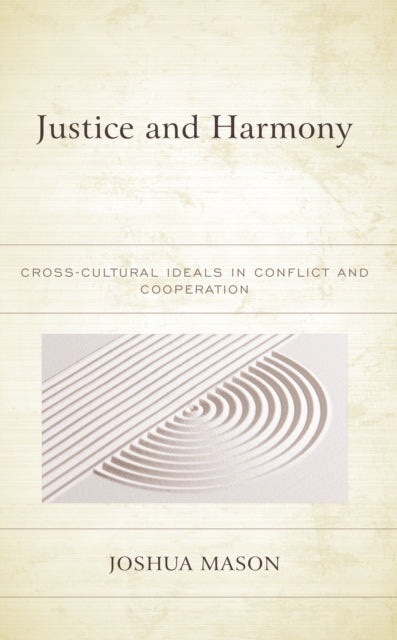
Justice and Harmony: Cross-Cultural Ideals in Conflict and Cooperation
Justice and Harmony: Cross-Cultural Ideals in Conflict and Cooperation
We can order this item for you. Delivery usually takes about 4 to 6 weeks.
This item is not held in our immediate stock. We will order it for you after checkout.
Estimated delivery: About 4 to 6 weeks
- Condition: Brand new
- UK Delivery times: Usually arrives within 2 - 3 working days
- UK Shipping: Fee starts at £3.89. Subject to product weight & dimension
Bulk ordering. Want 15 or more copies? Get a personalised quote and bigger discounts. Learn more about bulk orders.
Couldn't load pickup availability
- More about Justice and Harmony: Cross-Cultural Ideals in Conflict and Cooperation
Joshua Mason's book explores the relationship between justice and harmony across different cultures, challenging traditional dichotomies and proposing a three-part framework for understanding their interdependence.
Format: Hardback
Length: 292 pages
Publication date: 16 August 2022
Publisher: Bloomsbury Publishing Plc
Justice and harmony have long been two of the world's most treasured ideals, but much of modern moral and political philosophy puts them on opposite sides of the divide between liberal theories of the right and communitarian theories of the good. Joshua Mason argues that the encounter with their Chinese counterparts, zhengyi and hexie, can overcome this opposition, revealing a pattern that reframes justice and harmony as mutually interdependent concepts in a three-part framework of root harmony (benhe), harmonic justice (heyi), and just harmony (zhenghe). Broadly surveying the histories of Western and Chinese moral and political philosophies, Justice and Harmony: Cross-Cultural Ideals in Conflict and Cooperation explores our cross-cultural conceptual inventories and develops a comparative framework that can overcome entrenched binary oppositions and reconcile these grand global values.
In his book, Justice and Harmony: Cross-Cultural Ideals in Conflict and Cooperation, Joshua Mason argues that the encounter with their Chinese counterparts, zhengyi and hexie, can overcome this opposition, revealing a pattern that reframes justice and harmony as mutually interdependent concepts in a three-part framework of root harmony (benhe), harmonic justice (heyi), and just harmony (zhenghe). Broadly surveying the histories of Western and Chinese moral and political philosophies, Justice and Harmony: Cross-Cultural Ideals in Conflict and Cooperation explores our cross-cultural conceptual inventories and develops a comparative framework that can overcome entrenched binary oppositions and reconcile these grand global values.
Mason begins by examining the origins of justice and harmony in Western and Chinese thought. In Western philosophy, justice is often associated with the concept of rights, while harmony is associated with the concept of social order. In Chinese philosophy, justice is associated with the concept of benevolence, while harmony is associated with the concept of harmony between individuals and society.
Mason then explores the ways in which these ideals have been interpreted and applied in different contexts. In Western societies, justice has been used to justify a wide range of social and economic policies, including capitalism, democracy, and human rights. In Chinese societies, harmony has been used to justify a wide range of social and political policies, including Confucianism, Taoism, and Marxism.
However, Mason argues that these interpretations and applications have led to a number of problems. For example, in Western societies, the emphasis on individual rights has often led to a disregard for the needs of the community, while in Chinese societies, the emphasis on social order has often led to a disregard for the rights of individuals.
Mason proposes a solution to these problems by arguing that justice and harmony are not mutually exclusive but are actually mutually interdependent. He suggests that justice can be achieved through the promotion of social order, while harmony can be achieved through the promotion of individual rights.
To illustrate this point, Mason uses the example of the Chinese concept of zhengyi. Zhengyi is a system of social order that emphasizes the importance of harmony between individuals and society. It is based on the idea that individuals should be treated with respect and dignity, and that society should be organized in a way that promotes social harmony.
Mason argues that zhengyi can be applied to Western societies in a number of ways. For example, it can be used to promote social justice by ensuring that everyone has access to basic needs such as food, water, and shelter. It can also be used to promote economic growth by creating a stable and predictable environment for businesses.
However, Mason also acknowledges that there are some challenges to applying zhengyi to Western societies. For example, some Westerners may view zhengyi as a form of authoritarianism, while others may view it as a form of cultural imperialism.
To address these challenges, Mason suggests that Western societies should be more open to the idea of cultural exchange and learning. He suggests that Westerners should be willing to learn from Chinese culture and to incorporate some of its principles into their own societies.
Mason also suggests that Western societies should be more willing to address the root causes of social and economic inequality. He suggests that this can be done by implementing policies that promote economic growth, reduce poverty, and provide access to education and healthcare.
In conclusion, Justice and Harmony: Cross-Cultural Ideals in Conflict and Cooperation is a fascinating book that explores the relationship between justice and harmony in Western and Chinese thought. Mason argues that these ideals are not mutually exclusive but are actually mutually interdependent, and that they can be applied to Western societies in a number of ways. By being more open to cultural exchange and learning, and by addressing the root causes of social and economic inequality, Western societies can create a more just and harmonious world.
Weight: 580g
Dimension: 236 x 159 x 26 (mm)
ISBN-13: 9781793654977
UK and International shipping information
UK and International shipping information
We deliver throughout the United Kingdom and to 128 countries and territories worldwide, including the United States, Australia, Canada, Germany, Spain and France.