1
/
of
1
Franziska Aigner
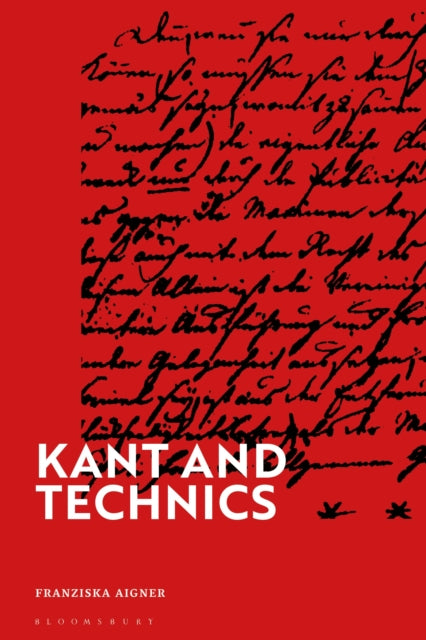
Kant and Technics: From the Critique of Pure Reason to the Opus Postumum
Kant and Technics: From the Critique of Pure Reason to the Opus Postumum
💎 Earn 153 Points (£1.53) on this item.
ORDERED FOR YOU
We can order this item for you. Delivery usually takes about 4 to 6 weeks.
This item is not held in our immediate stock. We will order it for you after checkout.
Estimated delivery: About 4 to 6 weeks
Regular price
£30.79 GBP
Regular price
Sale price
£30.79 GBP
Unit price
/
per
Taxes included.
Shipping calculated at checkout.
- Condition: Brand new
- UK Delivery times: Usually arrives within 2 - 3 working days
- UK Shipping: Fee starts at £2.39. Subject to product weight & dimension
Bulk ordering. Want 15 or more copies? Get a personalised quote and bigger discounts. Learn more about bulk orders.
Couldn't load pickup availability
- More about Kant and Technics: From the Critique of Pure Reason to the Opus Postumum
Martin Heidegger, Gilbert Simondon, and Bernard Stiegler each argued in their own way that, ever since its inception in ancient Greece, western philosophy is incapable of thinking technics, which reaches its clearest expression in the philosophy of Immanuel Kant. According to Heidegger, Kant articulated the essence of modern technics as enframing (Gestell) without understanding the nature of his own insight, while Simondon claimed that transcendental philosophy is structurally incapable of thinking technics as its answer to the question of technics either comes too early (a priori) or too later (a posteriori). Stiegler synthesized both positions in his claim that Kant was incapable of acknowledging the technical constitution of his own consciousness. All three thinkers thus argue, in one way or another, that Kant was essentially incapable of seeing, understanding, let alone thinking, technics. The intention of this book is two-fold. On the one hand, it argues that, despite Heidegger, Simondon, and Stiegler’s inability of recognizing it, there is an explicit concept of technics at work in Kant’s philosophy. This technics is however not a technics that was overlooked by Heidegger, Simondon, and Stiegler. Instead, this book shows that, from the Critique of Pure Reason (1780) until the posthumously published Opus Postumum (1796-1803), transcendental philosophy is at once constituted against, while at the same time relying upon, and proceeding from technics. On the other hand, this book engages with the broader relation between philosophy and technics. If there is indeed such a thing as a Kantian thought on technics, then Kant can no longer be considered philosophy’s most prominent ‘techno-oblivious’ thinker. The question about the relation between Kant and technics is thus nothing less than a question about the relation between philosophy and technics as a whole.
- Publication date: 28 May 2026
- Page count: 280
- Dimensions: Height 155 mm; Width 235 mm; Thickness 17 mm
- Publisher: Bloomsbury Publishing PLC
- Format: Paperback
- ISBN-13: 9781350299078
UK and International shipping information
UK and International shipping information
UK Delivery and returns information:
- Delivery within 2 - 3 days when ordering in the UK.
- Shipping fee for UK customers from £2.39. Fully tracked shipping service available.
- Returns policy: Return within 30 days of receipt for full refund.
International deliveries:
Shulph Ink now ships to Australia, Belgium, Canada, France, Germany, Ireland, Italy, India, Luxembourg Saudi Arabia, Singapore, Spain, Netherlands, New Zealand, United Arab Emirates, United States of America.
- Delivery times: within 5 - 10 days for international orders.
- Shipping fee: charges vary for overseas orders. Only tracked services are available for most international orders. Some countries have untracked shipping options.
- Customs charges: If ordering to addresses outside the United Kingdom, you may or may not incur additional customs and duties fees during local delivery.