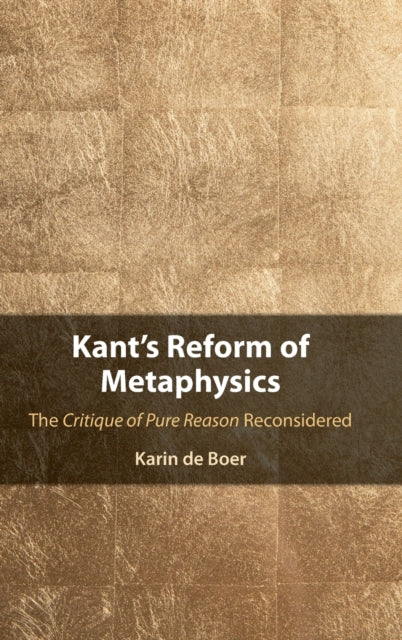
Karin de Boer
Kant's Reform of Metaphysics: The Critique of Pure Reason Reconsidered
Kant's Reform of Metaphysics: The Critique of Pure Reason Reconsidered
💎 Earn 410 Points (£4.10) on this item.
We can order this item for you. Delivery usually takes about 4 to 6 weeks.
This item is not held in our immediate stock. We will order it for you after checkout.
Estimated delivery: About 4 to 6 weeks
YOU SAVE £4.87
- Condition: Brand new
- UK Delivery times: Usually arrives within 2 - 3 working days
- UK Shipping: Fee starts at £2.39. Subject to product weight & dimension
Bulk ordering. Want 15 or more copies? Get a personalised quote and bigger discounts. Learn more about bulk orders.
Couldn't load pickup availability
- More about Kant's Reform of Metaphysics: The Critique of Pure Reason Reconsidered
Kant's Reform of Metaphysics interprets Kant's Critique of Pure Reason in light of his efforts to turn Christian Wolff's metaphysics into a science, offering fresh and in-depth analyses of key parts of the work. It situates Kant's pivotal work in the context of eighteenth-century German philosophy and reconstructs the outline of the system of pure reason for which the Critique was to pave the way.
Format: Hardback
Length: 310 pages
Publication date: 03 September 2020
Publisher: Cambridge University Press
Scholarly discussions surrounding the Critique of Pure Reason have predominantly revolved around epistemological inquiries. In a groundbreaking departure from this prevailing trend, Kant's Reform of Metaphysics emerges as the first comprehensive study to interpret Kant's Critique in the light of his remarkable endeavor to transform Christian Wolff's influential metaphysics into a rigorous scientific discipline. Karin de Boer skillfully situates Kant's pivotal work within the broader context of eighteenth-century German philosophy, tracing the evolution of Kant's conception of critique and providing insightful and detailed examinations of key chapters of the Critique of Pure Reason, including the Transcendental Deduction, the Schematism Chapter, the Appendix to the Transcendental Analytic, and the Architectonic. Beyond elucidating the coherence of Kant's project, this book also reconstructs the framework of the system of pure reason for which the Critique was intended to serve as a foundational cornerstone, although it remained unrealized throughout history.
Introduction:
The Critique of Pure Reason, penned by the renowned German philosopher Immanuel Kant, is a monumental work that has exerted a profound influence on the field of philosophy. Its exploration of the nature of knowledge, reason, and the limits of human understanding has sparked intense debates and discussions among scholars. In this essay, we will delve into the scholarly debates surrounding the Critique of Pure Reason, focusing on the epistemological questions that have shaped these discussions.
Epistemological Questions:
One of the central themes of the Critique of Pure Reason is the question of how we can know anything at all. Kant argues that our knowledge is limited by the structures of our minds, which he calls "categories." These categories are innate mental structures that organize our perception and understanding of the world. However, Kant also argues that our knowledge is not merely subjective or arbitrary, but is constrained by the laws of reason.
Scholars have engaged in extensive debates about the nature of knowledge and the role of reason in our understanding of the world. Some argue that Kant's account of knowledge is too restrictive and that we can know things beyond the limits imposed by our categories and reason. Others argue that Kant's account provides a valuable framework for understanding the limits of human knowledge and the importance of critical thinking.
Kant's Reform of Metaphysics:
Kant's Reform of Metaphysics is a significant work that seeks to transform the traditional metaphysical framework inherited from Aristotle. In this book, Kant argues that metaphysics should be based on empirical evidence and scientific principles rather than on abstract reasoning and metaphysical speculation. He also criticizes the traditional metaphysical concepts of substance, identity, and causality, arguing that they are not supported by empirical evidence.
Kant's Reform of Metaphysics has had a profound impact on the field of metaphysics. Some scholars argue that it provides a more rigorous and scientific approach to metaphysics, while others argue that it is too narrow and reductionist. Some scholars have even criticized Kant's approach for neglecting the role of consciousness and the subjective experience in our understanding of the world.
Karin de Boer's Interpretation:
Karin de Boer's book, Kant's Reform of Metaphysics, is a valuable contribution to the scholarly debates surrounding the Critique of Pure Reason. In this book, de Boer situates Kant's work within the broader context of eighteenth-century German philosophy and traces the development of Kant's conception of critique. She offers fresh and in-depth analyses of key parts of the Critique of Pure Reason, including the Transcendental Deduction, the Schematism Chapter, the Appendix to the Transcendental Analytic, and the Architectonic.
De Boer's interpretation of Kant's work is insightful and compelling. She argues that Kant's project is coherent and that his efforts to turn metaphysics into a science are significant. She also reconstructs the outline of the system of pure reason for which the Critique was to pave the way, although that system never saw the light.
Conclusion:
In conclusion, the Critique of Pure Reason has been the subject of extensive scholarly debates, largely shaped by epistemological questions. Kant's Reform of Metaphysics is a groundbreaking study that interprets Kant's Critique in the light of his efforts to transform metaphysics into a rigorous scientific discipline. Karin de Boer's book provides a valuable contribution to these debates, offering insightful and detailed analyses of key parts of the Critique of Pure Reason and reconstructing the outline of the system of pure reason for which the Critique was intended. While the system of pure reason remains unrealized, Kant's work continues to inspire and influence philosophical inquiry.
Weight: 570g
Dimension: 158 x 235 x 24 (mm)
ISBN-13: 9781108842174
UK and International shipping information
UK and International shipping information
UK Delivery and returns information:
- Delivery within 2 - 3 days when ordering in the UK.
- Shipping fee for UK customers from £2.39. Fully tracked shipping service available.
- Returns policy: Return within 30 days of receipt for full refund.
International deliveries:
Shulph Ink now ships to Australia, Belgium, Canada, France, Germany, Ireland, Italy, India, Luxembourg Saudi Arabia, Singapore, Spain, Netherlands, New Zealand, United Arab Emirates, United States of America.
- Delivery times: within 5 - 10 days for international orders.
- Shipping fee: charges vary for overseas orders. Only tracked services are available for most international orders. Some countries have untracked shipping options.
- Customs charges: If ordering to addresses outside the United Kingdom, you may or may not incur additional customs and duties fees during local delivery.