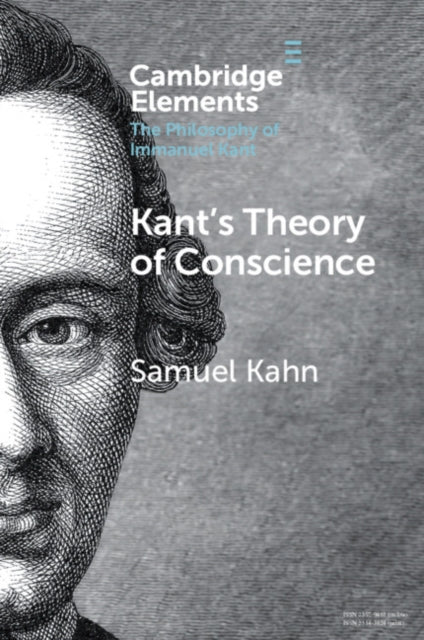
SamuelKahn
Kant's Theory of Conscience
Kant's Theory of Conscience
💎 Earn 84 Points (£0.84) on this item.
We can order this item for you. Delivery usually takes about 4 to 6 weeks.
This item is not held in our immediate stock. We will order it for you after checkout.
Estimated delivery: About 4 to 6 weeks
YOU SAVE £1.01
- Condition: Brand new
- UK Delivery times: Usually arrives within 2 - 3 working days
- UK Shipping: Fee starts at £3.89. Subject to product weight & dimension
Bulk ordering. Want 15 or more copies? Get a personalised quote and bigger discounts. Learn more about bulk orders.
Couldn't load pickup availability
- More about Kant's Theory of Conscience
The main body of this Element is divided into two sections. The first focuses on exegesis of Kant's ethics, arguing that context can dissolve apparent contradictions. The second section discusses philosophical issues in Kantian ethics, suggesting that traditional positions are at variance with Kant's ethics.
Format: Paperback / softback
Length: 75 pages
Publication date: 06 May 2021
Publisher: Cambridge University Press
The main body of this Element, which delves into Kant's theory of conscience, is organized into two distinct sections. The first section focuses on the exegesis of Kant's ethics, where one of the overarching theses emerges. Despite the initial appearance of inconsistencies in Kant's claims about conscience, a close examination of the contextual nuances often resolves apparent contradictions. The second section of the Element delves into philosophical issues within Kantian ethics. Here, another central thesis emerges. It suggests that many positions traditionally associated with Kantian ethics, such as the denial of moral luck, the nonaccidental rightness condition, and the portrayal of the objectively good, deviate from Kant's ethical framework.
Introduction:
Kant's theory of conscience is a central aspect of his philosophical framework, exploring the nature and role of moral judgment and responsibility. In this Element, we will examine Kant's views on conscience, exploring both his ethical and philosophical implications.
Section 1: Exegesis of Kant's Ethics:
The first section of the Element focuses on exegesis of Kant's ethics. We will explore Kant's arguments and claims about conscience, examining their consistency and coherence. One of the overarching theses of this section is that, although many of Kant's claims about conscience may appear inconsistent at first glance, a close examination of the contextual nuances generally can dissolve apparent contradictions.
Kant's ethical framework is grounded in the concept of categorical imperatives, which he argues provide a universal moral framework that applies to all rational beings. Central to Kant's ethics is the idea of the "good will," which he defines as the motivation to act from a sense of duty rather than from self-interest. Kant argues that conscience is the source of moral judgment and that it is essential for determining the rightness or wrongness of our actions.
However, Kant's views on conscience are complex and multifaceted. He argues that conscience is not a purely rational faculty, but rather a combination of rational and emotional elements. Conscience is not a fixed entity, but rather a dynamic process that develops and evolves over time as we engage with moral dilemmas and make moral decisions.
Kant also distinguishes between different types of conscience, including moral, practical, and aesthetic conscience. Moral conscience is concerned with determining the rightness or wrongness of our actions based on moral principles, while practical conscience is concerned with determining the rightness or wrongness of our actions based on their consequences. Aesthetic conscience is concerned with determining the rightness or wrongness of our actions based on their beauty or ugliness.
Despite the apparent complexity of Kant's views on conscience, one of the overarching theses of this section is that a close examination of the contextual nuances generally can resolve apparent contradictions. Kant's ethical framework is rich and nuanced, and it requires careful consideration and analysis to fully understand his arguments and claims.
Section 2: Philosophical Issues in Kantian Ethics:
The second section of the Element focuses on philosophical issues in Kantian ethics. We will explore Kant's views on moral luck, the nonaccidental rightness condition, and the guise of the objectively good. One of the overarching theses of this section is that many positions traditionally associated with Kantian ethics, including the denial of moral luck, the nonaccidental rightness condition, and the guise of the objectively good, are at variance with Kant's ethics.
Kant's denial of moral luck is a central aspect of his ethical framework. He argues that moral luck, the idea that our moral actions are determined by factors beyond our control, is not compatible with a just and rational moral system. Kant argues that moral responsibility is inherent in our nature and that we are responsible for our actions regardless of external circumstances.
The nonaccidental rightness condition is another position traditionally associated with Kantian ethics. This condition states that moral actions must be performed from a sense of duty rather than from self-interest. Kant argues that this condition is necessary for moral actions to be morally good and that it is incompatible with the idea of moral luck.
The guise of the objectively good is another position traditionally associated with Kantian ethics. This position states that moral actions are objectively good regardless of their consequences or the intentions of the actors. Kant argues that this position is false and that moral actions are good only if they are performed from a sense of duty and are motivated by a sense of respect for the moral law.
Despite the apparent consistency of these positions, one of the overarching theses of this section is that they are at variance with Kant's ethics. Kant's ethical framework is based on the idea of the "good will," which is motivated by a sense of duty and respect for the moral law. These positions, which deny moral luck, the nonaccidental rightness condition, and the guise of the objectively good, undermine the fundamental principles of Kant's ethical framework.
In conclusion, Kant's theory of conscience is a complex and multifaceted concept that requires careful examination and analysis. The main body of this Element, which delves into Kant's theory of conscience, is organized into two distinct sections. The first section focuses on the exegesis of Kant's ethics, where one of the overarching theses emerges. Despite the initial appearance of inconsistencies in Kant's claims about conscience, a close examination of the contextual nuances often resolves apparent contradictions. The second section of the Element delves into philosophical issues within Kantian ethics, where another central thesis emerges. It suggests that many positions traditionally associated with Kantian ethics, such as the denial of moral luck, the nonaccidental rightness condition, and the guise of the objectively good, deviate from Kant's ethical framework.
Weight: 118g
Dimension: 151 x 227 x 10 (mm)
ISBN-13: 9781108717359
UK and International shipping information
UK and International shipping information
We deliver throughout the United Kingdom and to 128 countries and territories worldwide, including the United States, Australia, Canada, Germany, Spain and France.