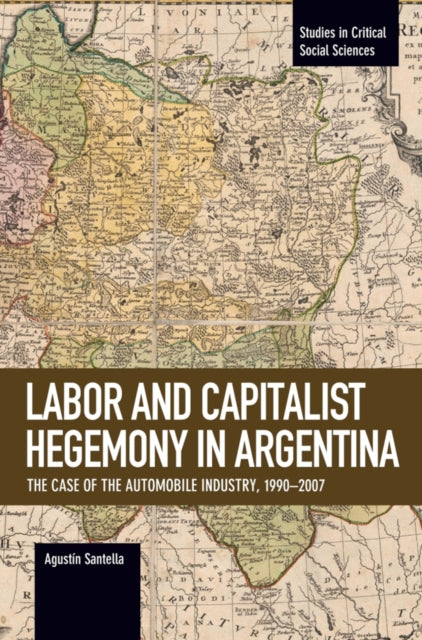
Agustin Santella
Labor Conflict And Capitalist Hegemony In Argentina: The Case of the Automobile Industry,1990-2007
Labor Conflict And Capitalist Hegemony In Argentina: The Case of the Automobile Industry,1990-2007
💎 Earn 115 Points (£1.15) on this item.
We can order this item for you. Delivery usually takes about 4 to 6 weeks.
This item is not held in our immediate stock. We will order it for you after checkout.
Estimated delivery: About 4 to 6 weeks
YOU SAVE £6.99
- Condition: Brand new
- UK Delivery times: Usually arrives within 2 - 3 working days
- UK Shipping: Fee starts at £2.39. Subject to product weight & dimension
Bulk ordering. Want 15 or more copies? Get a personalised quote and bigger discounts. Learn more about bulk orders.
Couldn't load pickup availability
- More about Labor Conflict And Capitalist Hegemony In Argentina: The Case of the Automobile Industry,1990-2007
Neoliberalism's labour flexibilisation has been resisted by workers in the auto industry in Argentina between 1990 and 2007, as shown in this study.
Format: Paperback / softback
Length: 237 pages
Publication date: 21 December 2017
Publisher: Haymarket Books
Neoliberalism has been a dominant policy force worldwide, pushing for labour flexibilisation and dismantling trade unions. In this study, Santella focuses on the auto industry in Argentina between 1990 and 2007 to examine how workers have resisted these changes. The book provides a comprehensive analysis of the industry's history, structure, and labour relations, and highlights the strategies used by workers to protect their rights and improve their working conditions.
One of the key strategies used by workers in Argentina was to form trade unions. Trade unions provided workers with a collective voice and a means to negotiate with employers. However, neoliberal policies have undermined the power of trade unions by introducing labour flexibilisation measures such as outsourcing, subcontracting, and flexible working hours. These measures have made it easier for employers to reduce costs and increase profits, while leaving workers vulnerable to exploitation and job insecurity.
To resist these changes, workers in Argentina have engaged in a range of activities. These include strikes, protests, and boycotts. Strikes are a powerful tool for workers to demand better wages, benefits, and working conditions. Protests and boycotts can be used to pressure employers to change their policies.
One of the most significant strikes in Argentina's auto industry occurred in 1990. The strike was led by the workers of the General Motors plant in Buenos Aires. The workers demanded better wages, benefits, and working conditions, and they were supported by the government and other trade unions. The strike lasted for several weeks and resulted in significant changes in the industry's labour relations.
Another important strike in Argentina's auto industry occurred in 2007. The strike was led by the workers of the Ford plant in Buenos Aires. The workers demanded better wages, benefits, and working conditions, and they were supported by the government and other trade unions. The strike lasted for several weeks and resulted in significant changes in the industry's labour relations.
Despite these challenges, workers in Argentina have made significant progress in improving their working conditions. For example, the government has implemented a number of labour laws that protect workers' rights, such as the minimum wage, overtime pay, and paid holidays. The government has also provided training programs to help workers improve their skills and increase their productivity.
However, there are still many challenges facing workers in Argentina's auto industry. For example, the industry is still dominated by large multinational corporations, which can exert significant control over workers' rights and working conditions. Additionally, the industry is facing a number of economic challenges, such as inflation and unemployment.
In conclusion, Neoliberalism has been a dominant policy force worldwide, pushing for labour flexibilisation and dismantling trade unions. In this study, Santella focuses on the auto industry in Argentina between 1990 and 2007 to examine how workers have resisted these changes. The book provides a comprehensive analysis of the industry's history, structure, and labour relations, and highlights the strategies used by workers to protect their rights and improve their working conditions. While there are still many challenges facing workers in Argentina's auto industry, there have been significant progress in improving their working conditions.
Weight: 348g
Dimension: 244 x 229 x 14 (mm)
ISBN-13: 9781608468096
UK and International shipping information
UK and International shipping information
UK Delivery and returns information:
- Delivery within 2 - 3 days when ordering in the UK.
- Shipping fee for UK customers from £2.39. Fully tracked shipping service available.
- Returns policy: Return within 30 days of receipt for full refund.
International deliveries:
Shulph Ink now ships to Australia, Belgium, Canada, France, Germany, Ireland, Italy, India, Luxembourg Saudi Arabia, Singapore, Spain, Netherlands, New Zealand, United Arab Emirates, United States of America.
- Delivery times: within 5 - 10 days for international orders.
- Shipping fee: charges vary for overseas orders. Only tracked services are available for most international orders. Some countries have untracked shipping options.
- Customs charges: If ordering to addresses outside the United Kingdom, you may or may not incur additional customs and duties fees during local delivery.