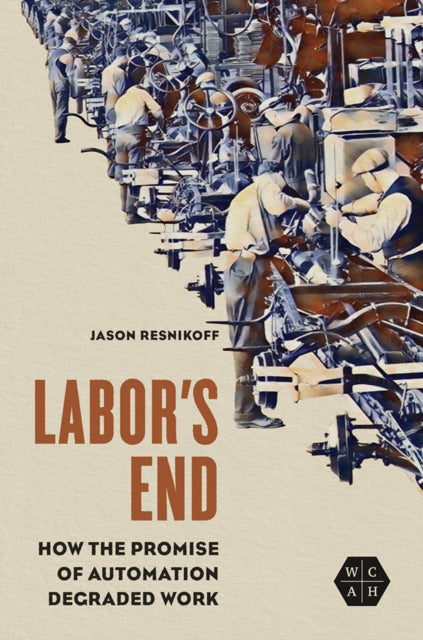
Jason Resnikoff
Labor's End: How the Promise of Automation Degraded Work
Labor's End: How the Promise of Automation Degraded Work
💎 Earn 81 Points (£0.81) on this item.
YOU SAVE £2.78
- Condition: Brand new
- UK Delivery times: Usually arrives within 2 - 3 working days
- UK Shipping: Fee starts at £2.39. Subject to product weight & dimension
Bulk ordering. Want 15 or more copies? Get a personalised quote and bigger discounts. Learn more about bulk orders.
Couldn't load pickup availability
- More about Labor's End: How the Promise of Automation Degraded Work
Labor's End explores the discourse around automation, revealing its belief that industrial progress would eliminate manual labor and hide the intensification of human work. This ideology perpetuated the idea that freedom was incompatible with work, leading to the exclusion of the workplace from politics and the dismissal of technological progress as deindustrialization.
Format: Paperback / softback
Length: 272 pages
Publication date: 18 January 2022
Publisher: University of Illinois Press
Labor's End delves into the discourse surrounding automation, tracing its origins in the factory to its far-reaching implications in political and social life. Jason Resnikoff demonstrates that the term "automation" initially expressed the belief that industrial progress would inevitably lead to the elimination of manual labor from industry. However, the true essence of the term concealed the intensification of human work and the consequent loss of power and protection for workers. The rhetorical strength of the automation ideology perpetuated the notion that freedom and work were inherently incompatible. As a result, political actors disregarded the workplace as a realm of political engagement, while some of labor's strongest allies dismissed increased workloads, accelerated tasks, and the gradual deindustrialization as manifestations of technological progress. Labor's End presents a compelling intellectual history that challenges prevailing assumptions about the transformative impact of automation on the American workplace.
Introduction:
Labor's End explores the discourse surrounding automation, tracing its historical roots from its emergence in the factory to its profound implications in political and social life. Jason Resnikoff's book delves into the term "automation," revealing its initial perception as a means to eradicate manual labor and usher in an era of industrial progress. However, as Resnikoff highlights, the true essence of automation concealed the intensification of human work and the subsequent loss of power and protection for workers.
Rhetorical Power of Automation Ideology:
The automation ideology wielded a powerful rhetorical force, perpetuating the belief that freedom and work were inherently incompatible. This ideology shaped political discourse, leading to the marginalization of the workplace as a realm of political engagement. At the same time, some of labor's staunchest allies dismissed increased workloads, accelerated tasks, and the gradual deindustrialization as manifestations of technological progress. This dismissal of worker concerns served to undermine the power and voice of labor in the face of technological change.
Consequences of Automation:
The consequences of automation have been far-reaching and profound. On the one hand, it has led to increased efficiency and productivity in many industries, resulting in economic growth and job creation. On the other hand, it has also contributed to the erosion of worker rights and protections, as employers have sought to maximize profits by reducing labor costs through automation. This has led to increased inequality, with a small elite of highly skilled workers benefiting from the technological advancements, while the majority of workers face job insecurity and reduced bargaining power.
Challenges to Automation:
Labor's End presents a compelling intellectual history that challenges entrenched assumptions about the transformative impact of automation on the American workplace. Resnikoff highlights the ways in which automation has perpetuated existing power structures and reinforced existing inequalities. He also explores the potential for workers to reclaim their power and voice in the face of technological change. This requires a shift in mindset, from viewing automation as a threat to workers' livelihoods to recognizing it as an opportunity to transform the workplace and create a more equitable and sustainable economy.
Conclusion:
In conclusion, Labor's End provides a valuable contribution to the ongoing discourse surrounding automation and its implications for workers, politics, and society. By delving into the historical roots and rhetorical power of the automation ideology, Resnikoff challenges prevailing assumptions and highlights the need for a more nuanced and worker-centered approach to automation. This requires a commitment to protecting worker rights and protections, promoting worker empowerment, and fostering a collaborative relationship between workers, employers, and policymakers. Only through such an approach can we ensure that the benefits of automation are shared equitably and that the workplace remains a place of dignity and respect for all workers.
Weight: 442g
Dimension: 154 x 233 x 26 (mm)
ISBN-13: 9780252086298
This item can be found in:
UK and International shipping information
UK and International shipping information
UK Delivery and returns information:
- Delivery within 2 - 3 days when ordering in the UK.
- Shipping fee for UK customers from £2.39. Fully tracked shipping service available.
- Returns policy: Return within 30 days of receipt for full refund.
International deliveries:
Shulph Ink now ships to Australia, Belgium, Canada, France, Germany, Ireland, Italy, India, Luxembourg Saudi Arabia, Singapore, Spain, Netherlands, New Zealand, United Arab Emirates, United States of America.
- Delivery times: within 5 - 10 days for international orders.
- Shipping fee: charges vary for overseas orders. Only tracked services are available for most international orders. Some countries have untracked shipping options.
- Customs charges: If ordering to addresses outside the United Kingdom, you may or may not incur additional customs and duties fees during local delivery.