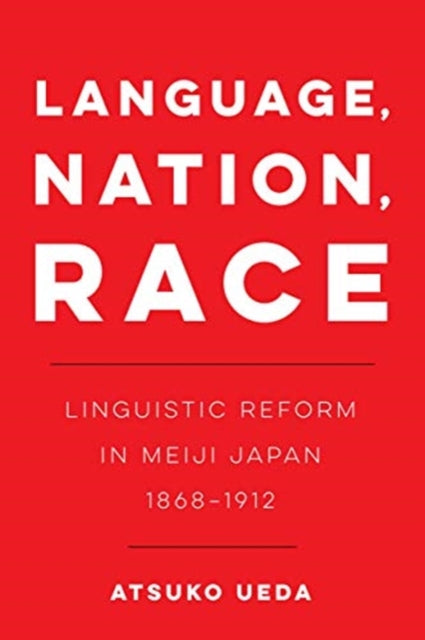
Atsuko Ueda
Language, Nation, Race: Linguistic Reform in Meiji Japan (1868-1912)
Language, Nation, Race: Linguistic Reform in Meiji Japan (1868-1912)
💎 Earn 120 Points (£1.20) on this item.
We can order this item for you. Delivery usually takes about 4 to 6 weeks.
This item is not held in our immediate stock. We will order it for you after checkout.
Estimated delivery: About 4 to 6 weeks
YOU SAVE £5.93
- Condition: Brand new
- UK Delivery times: Usually arrives within 2 - 3 working days
- UK Shipping: Fee starts at £2.39. Subject to product weight & dimension
Bulk ordering. Want 15 or more copies? Get a personalised quote and bigger discounts. Learn more about bulk orders.
Couldn't load pickup availability
- More about Language, Nation, Race: Linguistic Reform in Meiji Japan (1868-1912)
Language, Nation, Race explores the language reforms at the onset of Japanese modernity, focusing on the issue of race and contending that no analysis of imperialism or nationalism is possible without it.
Format: Paperback / softback
Length: 172 pages
Publication date: 01 June 2021
Publisher: University of California Press
Language, Nation, and Race delves into the intricate linguistic transformations that marked the dawn of Japanese modernity. During this transformative era, driven by the looming threat of Western colonialism, a "national language" (kokugo) emerged as a means to standardize and unify the diverse Japanese dialects. Recognizing the urgent need to educate the illiterate masses, Meiji intellectuals proposed a series of language reforms aimed at consolidating the language and fostering national unity. However, this book challenges the conventional categorization of language reforms as solely belonging to the realm of the "nation." At the time, the concept of a unified and cohesive nation was still in its infancy, and the reforms aimed at standardizing Japanese were driven by broader cultural and political aspirations.
Atsuko Ueda, the author of this groundbreaking work, draws upon a vast array of scholarship that engages with diverse fields such as postcolonial and cultural studies. Her meticulous analysis spans the first two decades of the Meiji period, with a particular focus on the issue of race. Ueda argues that any comprehensive understanding of imperialism or nationalism must incorporate a critical examination of race relations. By exploring the intersection of language, nation, and race, Language, Nation, and Race offers a fresh perspective on the complex dynamics of Japanese society during this pivotal period.
The book begins by tracing the historical roots of language reform in Japan. During the Edo period (1603-1867), the country was divided into feudal domains, each with its own distinct dialect and language. The Meiji Restoration in 1868 brought about a sudden shift in power, and the new government sought to modernize Japan by adopting Western technologies, ideologies, and practices. However, the process of modernization also led to a sense of cultural anxiety and a desire to assert Japanese identity and superiority.
One of the key initiatives of the Meiji government was the establishment of a national education system. To achieve this, the government introduced a standardized curriculum that included the teaching of Japanese as a "national language." The goal was to create a common language that could unite the diverse population of Japan and facilitate communication and learning across different regions. However, the implementation of this policy encountered significant challenges.
One of the most significant challenges was the resistance of local dialects and languages to standardization. Many Japanese people believed that their dialects and languages were essential parts of their cultural heritage and identity, and they were unwilling to adopt a standardized language that they perceived as foreign or imposed by the government. This resistance led to the development of regional dialects and languages that continued to thrive even after the Meiji period.
Another challenge was the issue of race. During the Meiji period, Japan was undergoing a rapid process of Westernization, and many Japanese intellectuals believed that adopting a standardized language would help to integrate Japan into the global community and promote cultural exchange. However, the implementation of language reform also raised concerns about the treatment of minority groups, particularly the indigenous Ainu people and other marginalized communities.
Ueda's book explores these challenges in depth, examining the various language reforms that were implemented during the Meiji period and their impact on Japanese society. She argues that the language reforms were not solely driven by a desire to standardize Japanese but also by broader cultural and political aspirations. The government sought to create a unified and cohesive nation that could compete with the Western powers.
At the same time, the language reforms were also influenced by the broader cultural context of the Meiji period. The government sought to promote a sense of national identity and unity by promoting the use of a standardized language that could be used across different regions and social classes. The language reforms were also part of a broader effort to modernize Japanese society and promote economic development.
However, the implementation of language reform was not without its critics. Many Japanese people believed that the language reforms were an attempt to erode their cultural heritage and identity and that they were being forced to adopt a language that was not their own. Some critics also argued that the language reforms were discriminatory and that they were used to marginalize minority groups and promote the dominance of the Japanese majority.
Despite these criticisms, the language reforms of the Meiji period had a significant impact on Japanese society. The standardized language helped to promote national unity and cohesion, and it facilitated communication and learning across different regions and social classes. The language reforms also played a significant role in the development of Japanese literature and culture, as they provided a common language for writers and artists to express their ideas and creativity.
In conclusion, Language, Nation, and Race is a groundbreaking work that offers a fresh perspective on the linguistic transformations that marked the dawn of Japanese modernity. By challenging the conventional categorization of language reforms as solely belonging to the realm of the "nation," Ueda's book reveals the broader cultural and political aspirations that drove these reforms. Through a meticulous analysis of the first two decades of the Meiji period, with a particular focus on the issue of race, Ueda provides a comprehensive understanding of the complex dynamics of Japanese society during this pivotal period. This book is essential reading for anyone interested in Japanese history, culture, and language, and it will undoubtedly inspire further research and discussion.
Weight: 252g
Dimension: 228 x 152 x 14 (mm)
ISBN-13: 9780520381711
This item can be found in:
UK and International shipping information
UK and International shipping information
UK Delivery and returns information:
- Delivery within 2 - 3 days when ordering in the UK.
- Shipping fee for UK customers from £2.39. Fully tracked shipping service available.
- Returns policy: Return within 30 days of receipt for full refund.
International deliveries:
Shulph Ink now ships to Australia, Belgium, Canada, France, Germany, Ireland, Italy, India, Luxembourg Saudi Arabia, Singapore, Spain, Netherlands, New Zealand, United Arab Emirates, United States of America.
- Delivery times: within 5 - 10 days for international orders.
- Shipping fee: charges vary for overseas orders. Only tracked services are available for most international orders. Some countries have untracked shipping options.
- Customs charges: If ordering to addresses outside the United Kingdom, you may or may not incur additional customs and duties fees during local delivery.