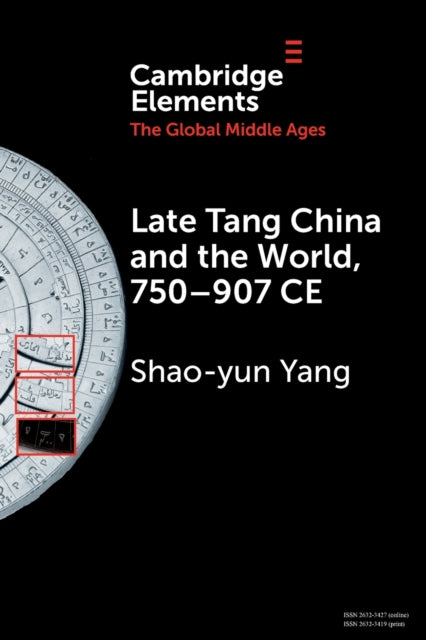
Shao-yunYang
Late Tang China and the World, 750-907 CE
Late Tang China and the World, 750-907 CE
💎 Earn 84 Points (£0.84) on this item.
We can order this item for you. Delivery usually takes about 4 to 6 weeks.
This item is not held in our immediate stock. We will order it for you after checkout.
Estimated delivery: About 4 to 6 weeks
YOU SAVE £1.01
- Condition: Brand new
- UK Delivery times: Usually arrives within 2 - 3 working days
- UK Shipping: Fee starts at £2.39. Subject to product weight & dimension
Bulk ordering. Want 15 or more copies? Get a personalised quote and bigger discounts. Learn more about bulk orders.
Couldn't load pickup availability
- More about Late Tang China and the World, 750-907 CE
The Tang dynasty (618-907) was once considered the most cosmopolitan period in Chinese history, but this narrative has been challenged by scholars who argue that xenophobic hostility replaced cosmopolitan openness after the An Lushan Rebellion. This Element provides a more nuanced interpretation of the Tang empire's foreign relations after 755, highlighting the complex and multifaceted nature of its interactions with other cultures.
Format: Paperback / softback
Length: 75 pages
Publication date: 25 May 2023
Publisher: Cambridge University Press
In recent years, the Tang dynasty (618-907) has garnered a reputation as the most cosmopolitan era in Chinese history. The prevailing narrative suggests that this cosmopolitan openness waned following the An Lushan Rebellion of 755-763, giving way to a xenophobic attitude towards foreign entities. However, this element aims to challenge the aforementioned narrative and presents a more empirically-supported and intricate understanding of the Tang empire's foreign relations post-755.
The Tang dynasty, renowned for its cultural and economic prosperity, witnessed a remarkable embrace of diversity and international exchange during its reign. This cosmopolitanism was evident in various aspects of society, including trade, diplomacy, and artistic exchange. The empire established extensive trade networks with neighboring regions, facilitating the exchange of goods, ideas, and cultural influences. Diplomatic relations with foreign powers were also maintained, with the Tang dynasty forging alliances and establishing diplomatic missions to promote mutual understanding and cooperation.
Furthermore, the Tang dynasty was a hub of artistic and intellectual excellence, attracting scholars, artists, and musicians from across the world. The empire's capital, Chang'an, was a bustling center of culture and learning, where diverse languages, religions, and philosophies coexisted harmoniously. The Tang dynasty's openness to foreign influences had a profound impact on its culture and society. It facilitated the exchange of knowledge, technology, and ideas, leading to the development of new technologies, art forms, and scientific discoveries. This cultural exchange also contributed to the enrichment of Chinese culture and the development of a more cosmopolitan worldview.
However, it is important to note that the cosmopolitanism of the Tang dynasty did not endure without challenges. The An Lushan Rebellion, which occurred in the late 8th century, marked a significant turning point in the empire's foreign relations. The rebellion was led by a military officer named An Lushan, who sought to overthrow the Tang dynasty and establish a new regime. An Lushan's rebellion was fueled by his xenophobic beliefs and his desire to restore traditional Chinese values and practices.
During the rebellion, An Lushan launched a series of attacks on the Tang dynasty's capital, Chang'an. He also sought to undermine the empire's foreign relations by attacking neighboring states and forming alliances with other foreign powers. The rebellion was ultimately unsuccessful, and the Tang dynasty was able to restore its stability and power. However, the An Lushan Rebellion left a lasting impact on the empire's foreign relations. It highlighted the vulnerability of the empire to external threats and the potential for xenophobic attitudes to emerge in times of crisis.
Despite the challenges posed by the An Lushan Rebellion, the Tang dynasty continued to maintain diplomatic relations with foreign powers. The empire's foreign policy was characterized by a pragmatic approach, seeking to balance the interests of different nations and maintain stability in the region. The Tang dynasty also continued to promote cultural exchange and cooperation, recognizing the value of diversity and the potential for mutual benefit.
In conclusion, the Tang dynasty's cosmopolitanism was a remarkable period in Chinese history, characterized by a profound embrace of diversity and international exchange. The empire's openness to foreign influences had a profound impact on its culture, society, and economy, leading to the development of new technologies, art forms, and scientific discoveries. However, the An Lushan Rebellion of 755-763 marked a significant turning point in the empire's foreign relations, highlighting the vulnerability of the empire to external threats and the potential for xenophobic attitudes to emerge in times of crisis. Despite this setback, the Tang dynasty continued to maintain diplomatic relations with foreign powers and promote cultural exchange, demonstrating its commitment to a more inclusive and interconnected world.
ISBN-13: 9781009397254
UK and International shipping information
UK and International shipping information
UK Delivery and returns information:
- Delivery within 2 - 3 days when ordering in the UK.
- Shipping fee for UK customers from £2.39. Fully tracked shipping service available.
- Returns policy: Return within 30 days of receipt for full refund.
International deliveries:
Shulph Ink now ships to Australia, Belgium, Canada, France, Germany, Ireland, Italy, India, Luxembourg Saudi Arabia, Singapore, Spain, Netherlands, New Zealand, United Arab Emirates, United States of America.
- Delivery times: within 5 - 10 days for international orders.
- Shipping fee: charges vary for overseas orders. Only tracked services are available for most international orders. Some countries have untracked shipping options.
- Customs charges: If ordering to addresses outside the United Kingdom, you may or may not incur additional customs and duties fees during local delivery.