Shulph Ink
Leadership Selection and Patron-Client Relations in the USSR and Yugoslavia
Leadership Selection and Patron-Client Relations in the USSR and Yugoslavia
We can order this item for you. Delivery usually takes about 4 to 6 weeks.
This item is not held in our immediate stock. We will order it for you after checkout.
Estimated delivery: About 4 to 6 weeks
- Condition: Brand new
- UK Delivery times: Usually arrives within 2 - 3 working days
- UK Shipping: Fee starts at £3.89. Subject to product weight & dimension
Bulk ordering. Want 15 or more copies? Get a personalised quote and bigger discounts. Learn more about bulk orders.
Couldn't load pickup availability
- More about Leadership Selection and Patron-Client Relations in the USSR and Yugoslavia
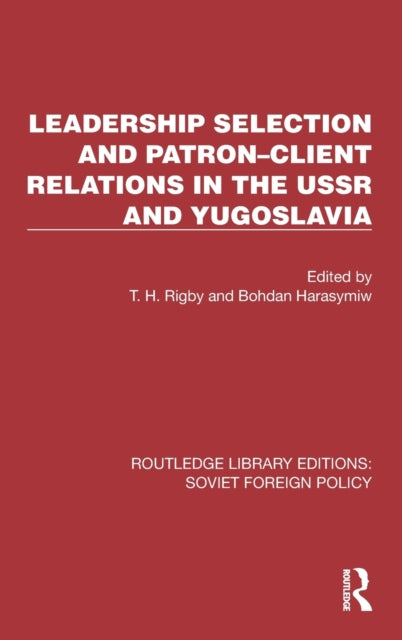
Leadership Selection and Patron-Client Relations in the USSR and Yugoslavia (1983) explores the nomenklatura system, a semi-secret network of rules and personal relationships in Soviet politics, and how other Communist countries modeled their systems after it.
Format: Hardback
Length: 246 pages
Publication date: 28 December 2022
Publisher: Taylor & Francis Ltd
The book "Leadership Selection and Patron-Client Relations in the USSR and Yugoslavia (1983)" delves into the intricate system of nomenklatura, a semi-secret network of quasi-bureaucratic rules and personal relationships that governed careers in Soviet politics. This study also encompasses other Communist countries, as they modeled their patronage relationship systems after the Soviet Union. By examining these systems, the book sheds light on the complex dynamics and power struggles within these political landscapes.
Nomenklatura, a system of hierarchical classification and personal connections, played a pivotal role in managing careers in Soviet politics. This study explores the intricacies of nomenklatura, including its origins, functions, and impact on political advancement. It also examines the role of patronage in shaping leadership selection and maintaining power within Communist countries.
The origins of nomenklatura can be traced back to the early years of the Soviet Union. It was developed as a means of organizing and controlling the vast bureaucracy of the state. The system was based on the principle of "socialism in one country," which emphasized the need for centralized control and uniformity in all aspects of society.
Nomenklatura consisted of a series of ranks and positions, each with its own set of responsibilities and privileges. The highest rank was the General Secretary of the Communist Party, followed by the Politburo, the Central Committee, and other influential bodies. Below these levels, there were various ministries, agencies, and institutions, each with its own nomenklatura.
The primary function of nomenklatura was to ensure the smooth operation of the state apparatus. It was used to allocate resources, assign responsibilities, and maintain control over the bureaucracy. Nomenklatura also played a crucial role in shaping political careers, as it determined who had access to important positions and resources.
Patronage, another important aspect of Communist politics, was closely intertwined with nomenklatura. Patronage relationships were based on personal connections and favors exchanged between individuals and groups. These relationships were essential for gaining access to power and resources and for maintaining stability and order within the political system.
In the USSR and Yugoslavia, patronage relationships were particularly influential in shaping leadership selection. Candidates for high-level positions were often selected based on their connections to powerful individuals or groups within the party or government. These connections could be based on family ties, ideological alignment, or previous political achievements.
Patronage relationships also played a role in maintaining power within the political system. Once individuals or groups had gained power, they used their connections to retain their positions and further their interests. This could involve allocating resources, promoting loyalists, or suppressing opposition.
However, patronage relationships were not without their challenges. They could lead to corruption, nepotism, and a lack of transparency in the political system. They also limited the ability of individuals to develop their skills and talents, as they were often selected based on their connections rather than their qualifications.
Despite these challenges, patronage relationships remained an important aspect of Communist politics in the USSR and Yugoslavia. They helped to maintain stability and order within the political system and provided opportunities for individuals to gain access to power and resources. However, they also highlighted the need for reform and transparency in the political system to ensure that power was distributed fairly and that individuals had the opportunity to develop their skills and talents.
In conclusion, nomenklatura and patronage relationships played a crucial role in managing careers in Soviet politics and other Communist countries. These systems of classification and personal connections were essential for maintaining control over the bureaucracy and shaping political careers. While they had their benefits, they also highlighted the need for reform and transparency in the political system to ensure that power was distributed fairly and that individuals had the opportunity to develop their skills and talents.
Weight: 644g
Dimension: 234 x 156 (mm)
ISBN-13: 9781032376295
UK and International shipping information
UK and International shipping information
We deliver throughout the United Kingdom and to 128 countries and territories worldwide, including the United States, Australia, Canada, Germany, Spain and France.