Shulph Ink
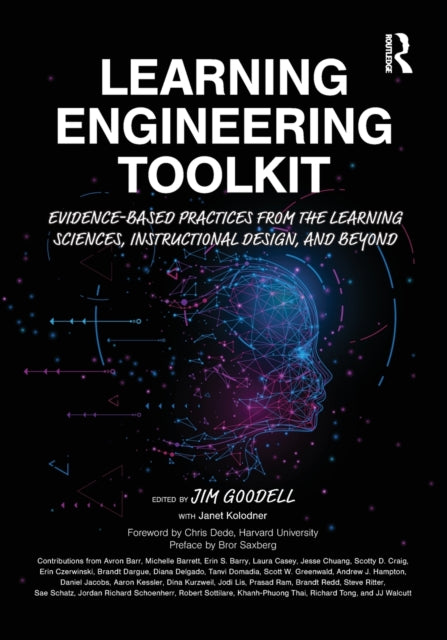
Learning Engineering Toolkit: Evidence-Based Practices from the Learning Sciences, Instructional Design, and Beyond
Learning Engineering Toolkit: Evidence-Based Practices from the Learning Sciences, Instructional Design, and Beyond
💎 Earn 193 Points (£1.93) on this item.
YOU SAVE £2.30
- Condition: Brand new
- UK Delivery times: Usually arrives within 2 - 3 working days
- UK Shipping: Fee starts at £2.39. Subject to product weight & dimension
Bulk ordering. Want 15 or more copies? Get a personalised quote and bigger discounts. Learn more about bulk orders.
Couldn't load pickup availability
- More about Learning Engineering Toolkit: Evidence-Based Practices from the Learning Sciences, Instructional Design, and Beyond
The Learning Engineering Toolkit is a practical guide to learning engineering, a rigorous and fast-emerging discipline that synthesizes learning sciences, instructional design, engineering design, and other methodologies to support learners. It explores essential foundations, approaches, and real-world challenges to ensure participatory, data-driven learning experiences across populations and contexts. The book is available as downloadable Open Access PDFs at http://www.taylorfrancis.com under a Creative Commons Attribution-Non Commercial-No Derivatives (CC-BY-NC-ND) 4.0 license.
Format: Paperback / softback
Length: 422 pages
Publication date: 15 July 2022
Publisher: Taylor & Francis Ltd
The Learning Engineering Toolkit is a comprehensive guide to the diverse applications of learning engineering, a rapidly evolving discipline that combines learning sciences, instructional design, engineering design, and other methodologies to enhance learning experiences. As learning engineering gains recognition as a formalized discipline and practice, there is a growing need for innovative insights and tools to assist education, training, design, and data analytics professionals in developing, testing, and improving complex systems for engaging and effective learning. Written in a friendly and engaging style, this book explores the fundamental principles, approaches, and real-world challenges associated with ensuring participatory, data-driven learning experiences across various populations and contexts.
Chapter 2: Learning Engineering Applies the Learning Sciences:
Learning engineering draws upon the learning sciences to understand and improve learning processes. It involves the application of scientific principles, theories, and methodologies to design, develop, and evaluate learning interventions. The learning sciences encompass various fields such as psychology, neuroscience, education, and computer science, and they provide valuable insights into how people learn, think, and behave.
One of the key principles of learning engineering is the importance of personalized learning. Learning engineering recognizes that each learner is unique and has different needs, preferences, and learning styles. By using personalized learning approaches, learning engineers can create learning experiences that are tailored to the individual learner's needs, which can lead to better learning outcomes.
Another important principle of learning engineering is the use of technology to enhance learning. Technology can provide learners with access to a wide range of resources, including online courses, interactive simulations, and virtual reality experiences. However, it is important to ensure that technology is used in a way that is effective and ethical. Learning engineers must work to develop technologies that are accessible, affordable, and safe for learners.
Learning engineering also involves the use of data analytics to improve learning outcomes. Data analytics can help learning engineers identify patterns in learner behavior and use this information to make informed decisions about learning interventions. For example, data analytics can help learning engineers identify which learners are struggling with a particular concept and develop targeted interventions to help them improve.
Chapter 3: Learning Engineering in Practice:
Learning engineering is being applied in a wide range of settings, including education, training, and healthcare. In education, learning engineering is being used to create personalized learning experiences that are tailored to the individual learner's needs. For example, learning engineering is being used to create adaptive learning systems that can adjust the pace and content of learning based on the learner's performance.
In training, learning engineering is being used to create training programs that are more effective and efficient. For example, learning engineering is being used to create virtual reality simulations that can help trainees practice their skills in a safe and controlled environment.
In healthcare, learning engineering is being used to create personalized treatment plans that are tailored to the individual patient's needs. For example, learning engineering is being used to create personalized medication regimens that can help patients manage their chronic conditions.
However, learning engineering also presents several challenges. One of the biggest challenges is the need to ensure that learning interventions are effective and ethical. Learning engineers must work to develop technologies that are effective and ethical and must also work to ensure that learners are aware of the risks associated with using technology.
Another challenge is the need to ensure that learning interventions are accessible to all learners. Learning engineering must work to develop technologies that are accessible to learners with disabilities and to learners in low-income communities.
In conclusion, the Learning Engineering Toolkit is a comprehensive guide to the diverse applications of learning engineering. Learning engineering is a rapidly evolving discipline that combines learning sciences, instructional design, engineering design, and other methodologies to enhance learning experiences. As learning engineering becomes more formalized, there is a growing need for innovative insights and tools to assist education, training, design, and data analytics professionals in developing, testing, and improving complex systems for engaging and effective learning. By applying the principles of learning engineering, learning engineers can create learning experiences that are tailored to the individual learner's needs, which can lead to better learning outcomes.
Dimension: 254 x 178 (mm)
ISBN-13: 9781032232829
This item can be found in:
UK and International shipping information
UK and International shipping information
UK Delivery and returns information:
- Delivery within 2 - 3 days when ordering in the UK.
- Shipping fee for UK customers from £2.39. Fully tracked shipping service available.
- Returns policy: Return within 30 days of receipt for full refund.
International deliveries:
Shulph Ink now ships to Australia, Belgium, Canada, France, Germany, Ireland, Italy, India, Luxembourg Saudi Arabia, Singapore, Spain, Netherlands, New Zealand, United Arab Emirates, United States of America.
- Delivery times: within 5 - 10 days for international orders.
- Shipping fee: charges vary for overseas orders. Only tracked services are available for most international orders. Some countries have untracked shipping options.
- Customs charges: If ordering to addresses outside the United Kingdom, you may or may not incur additional customs and duties fees during local delivery.