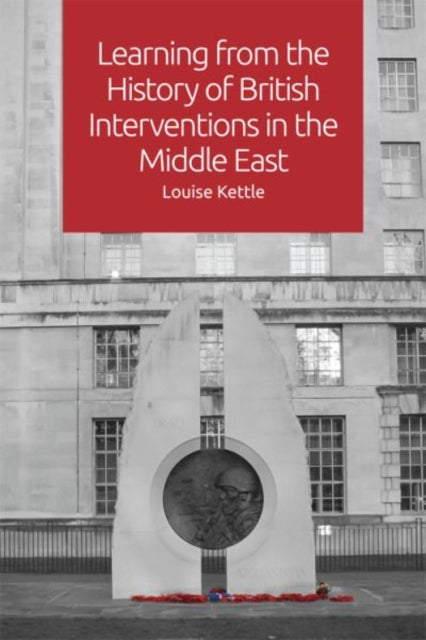
Louise Kettle
Learning from the History of British Interventions in the Middle East
Learning from the History of British Interventions in the Middle East
💎 Earn 115 Points (£1.15) on this item.
YOU SAVE £6.99
- Condition: Brand new
- UK Delivery times: Usually arrives within 2 - 3 working days
- UK Shipping: Fee starts at £2.39. Subject to product weight & dimension
Bulk ordering. Want 15 or more copies? Get a personalised quote and bigger discounts. Learn more about bulk orders.
Couldn't load pickup availability
- More about Learning from the History of British Interventions in the Middle East
Louise Kettle's analysis of British foreign and security policy questions whether the government learns from history, drawing on previously unseen documents and interviews with officials. It examines military interventions in the Middle East since the 1950s and the 2016 Iraq Inquiry report.
Format: Paperback / softback
Length: 292 pages
Publication date: 31 August 2020
Publisher: Edinburgh University Press
Learning from history is crucial for states to develop effective foreign and security policies that build upon past successes and avoid repeating past mistakes. Louise Kettle's insightful analysis, based on previously unseen documents obtained through Freedom of Information requests, along with interviews with government and intelligence agency officials, raises significant questions about whether the British government truly learns from history. The analysis delves into military interventions in the Middle East since the 1950s, providing a behind-the-scenes glimpse into Whitehall decision-making and a critical examination of the 2016 Iraq Inquiry report.
One of the key findings of the analysis is that the British government has a tendency to repeat the same mistakes in its foreign policy decisions. For example, the analysis highlights how the government's decision to intervene in Iraq in 2003 was based on flawed intelligence and a lack of understanding of the local context, leading to a prolonged and costly conflict that had far-reaching consequences for the region. Similarly, the analysis points to the government's decision to intervene in Libya in 2011, which was also based on flawed intelligence and resulted in a civil war that continues to this day.
Another significant finding of the analysis is that the British government has a tendency to prioritize its own interests over those of the local population. This is particularly evident in the case of the Iraq Inquiry report, which found that the government had failed to properly investigate the causes of the conflict and had instead focused on protecting its own reputation and interests. This lack of transparency and accountability has undermined the trust of the local population and has contributed to the ongoing instability in the region.
The analysis also highlights the role of intelligence agencies in shaping British foreign policy decisions. The analysis reveals that intelligence agencies often provide the government with biased and incomplete information, which can lead to poor decision-making. This is particularly concerning in the case of military interventions, where the use of force can have significant consequences for the local population and the wider region.
To address these issues, the analysis suggests that the British government should take a more proactive approach to learning from history. This should involve a comprehensive review of past foreign policy decisions, including the Iraq Inquiry report, to identify the lessons that can be learned. The government should also be more transparent and accountable in its decision-making processes, and should work to build stronger relationships with the local population.
In addition, the analysis suggests that the British government should prioritize the use of soft power in its foreign policy decisions. Soft power involves the use of cultural, economic, and diplomatic means to influence other countries and promote stability and peace. This can be a more effective approach than the use of force, particularly in situations where the use of force is not necessary or appropriate.
Finally, the analysis suggests that the British government should work to promote greater regional cooperation and stability. This can be achieved through the promotion of trade agreements, the resolution of regional conflicts, and the promotion of human rights and democracy. By working to promote greater regional cooperation and stability, the British government can help to create a more secure and prosperous world for all.
In conclusion, learning from history is crucial for states to develop effective foreign and security policies that build upon past successes and avoid repeating past mistakes. Louise Kettle's insightful analysis, based on previously unseen documents obtained through Freedom of Information requests, along with interviews with government and intelligence agency officials, raises significant questions about whether the British government truly learns from history. The analysis suggests that the British government should take a more proactive approach to learning from history, be more transparent and accountable in its decision-making processes, prioritize the use of soft power in its foreign policy decisions, and work to promote greater regional cooperation and stability. By doing so, the British government can help to create a more secure and prosperous world for all.
Weight: 466g
Dimension: 155 x 233 x 23 (mm)
ISBN-13: 9781474437967
UK and International shipping information
UK and International shipping information
UK Delivery and returns information:
- Delivery within 2 - 3 days when ordering in the UK.
- Shipping fee for UK customers from £2.39. Fully tracked shipping service available.
- Returns policy: Return within 30 days of receipt for full refund.
International deliveries:
Shulph Ink now ships to Australia, Belgium, Canada, France, Germany, Ireland, Italy, India, Luxembourg Saudi Arabia, Singapore, Spain, Netherlands, New Zealand, United Arab Emirates, United States of America.
- Delivery times: within 5 - 10 days for international orders.
- Shipping fee: charges vary for overseas orders. Only tracked services are available for most international orders. Some countries have untracked shipping options.
- Customs charges: If ordering to addresses outside the United Kingdom, you may or may not incur additional customs and duties fees during local delivery.