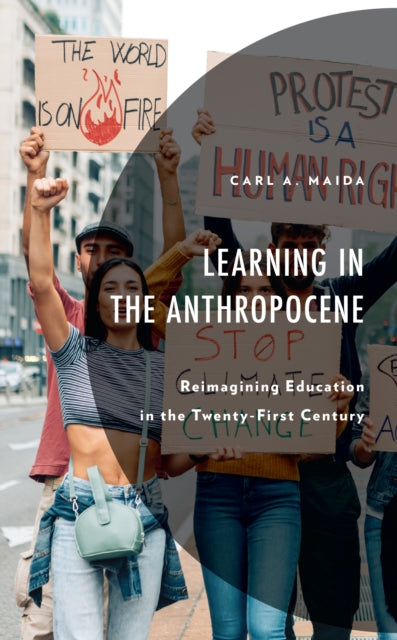
Carl A. Maida
Learning in the Anthropocene: Reimagining Education in the Twenty-First Century
Learning in the Anthropocene: Reimagining Education in the Twenty-First Century
💎 Earn 531 Points (£5.31) on this item.
We can order this item for you. Delivery usually takes about 4 to 6 weeks.
This item is not held in our immediate stock. We will order it for you after checkout.
Estimated delivery: About 4 to 6 weeks
- Condition: Brand new
- UK Delivery times: Usually arrives within 2 - 3 working days
- UK Shipping: Fee starts at £2.39. Subject to product weight & dimension
Bulk ordering. Want 15 or more copies? Get a personalised quote and bigger discounts. Learn more about bulk orders.
Couldn't load pickup availability
- More about Learning in the Anthropocene: Reimagining Education in the Twenty-First Century
Learning in the Anthropocene proposes a new approach to education in the twenty-first century, focusing on critical inquiry and reflection around biodiversity, energy, and sustainability concerns. It argues that education is critical to the public sphere, which is polarized by contentious debates over class, ethnicity, culture, and the fate of the planet.
Format: Hardback
Length: 370 pages
Publication date: 15 November 2023
Publisher: Lexington Books
Learning in the Anthropocene: Reimagining Education in the Twenty-First Century is a book that explores the future of education in the Anthropocene era, a time of rapid change and crisis. Carl A. Maida argues that diverse constituencies need to come together to create place-based arenas for critical inquiry and reflection around biodiversity, energy, and sustainability concerns. Education is essential to the public sphere, which is polarized by contentious debates over class, ethnicity, culture, and the fate of the planet. Maida proposes that two provinces—the school and society—can join together to afford students greater freedom to produce future knowledge by advancing experiential instructional approaches as humanity faces profound challenges to its existence.
The book begins by examining the current state of education and the challenges it faces in the Anthropocene era. Maida argues that the traditional education system is based on a linear model of knowledge acquisition that is no longer effective in a world that is rapidly changing. He suggests that a more holistic and interdisciplinary approach is needed to address the complex and interconnected issues of the Anthropocene.
One of the key challenges facing education in the Anthropocene era is the need to address the impact of climate change. Maida argues that climate change is a global crisis that requires urgent action and that education can play a critical role in raising awareness and promoting action. He suggests that schools should incorporate climate change education into their curriculum and that students should be taught about the science behind climate change, the impacts of climate change on different ecosystems, and the ways that individuals can reduce their carbon footprint.
Another challenge facing education in the Anthropocene era is the need to address the issue of biodiversity loss. Maida argues that biodiversity loss is a global crisis that requires urgent action and that education can play a critical role in raising awareness and promoting action. He suggests that schools should incorporate biodiversity education into their curriculum and that students should be taught about the importance of biodiversity, the threats to biodiversity, and the ways that individuals can help to protect biodiversity.
In addition to these challenges, Maida also argues that education in the Anthropocene era should focus on developing students' skills and competencies that will be necessary for them to thrive in a rapidly changing world. He suggests that schools should focus on developing students' critical thinking, problem-solving, and communication skills, as well as their ability to work collaboratively and to adapt to changing circumstances.
To address these challenges, Maida proposes a number of strategies. One of these strategies is to incorporate experiential learning into the curriculum. Experiential learning involves hands-on activities that allow students to apply their knowledge and skills in real-world situations. Maida suggests that schools should use experiential learning to teach students about climate change, biodiversity loss, and other environmental issues, as well as to develop their skills and competencies.
Another strategy is to promote interdisciplinary collaboration. Maida suggests that schools should work with other organizations and institutions to develop interdisciplinary programs that address the complex and interconnected issues of the Anthropocene. He suggests that schools should work with scientists, engineers, and policymakers to develop solutions to these issues and to promote public awareness and engagement.
In addition to these strategies, Maida also suggests that education in the Anthropocene era should be more inclusive and accessible. He suggests that schools should work to ensure that all students have access to education, regardless of their background or circumstances. He suggests that schools should also work to address the social and economic inequalities that exist in society and to promote social justice and equity.
Finally, Maida suggests that education in the Anthropocene era should be more responsive to the changing needs of society. He suggests that schools should be able to adapt to changing circumstances and to provide students with the skills and competencies that they need to thrive in a rapidly changing world.
In conclusion, Learning in the Anthropocene: Reimagining Education in the Twenty-First Century is a book that explores the future of education in the Anthropocene era. Carl A. Maida argues that diverse constituencies need to come together to create place-based arenas for critical inquiry and reflection around biodiversity, energy, and sustainability concerns. Education is essential to the public sphere, which is polarized by contentious debates over class, ethnicity, culture, and the fate of the planet. Maida proposes a number of strategies to address these challenges, including incorporating experiential learning into the curriculum, promoting interdisciplinary collaboration, making education more inclusive and accessible, and being more responsive to the changing needs of society. By implementing these strategies, we can help to ensure that future generations are prepared to face the challenges of the Anthropocene era and to create a more sustainable and equitable world.
Weight: 758g
Dimension: 236 x 159 x 33 (mm)
ISBN-13: 9781666924688
UK and International shipping information
UK and International shipping information
UK Delivery and returns information:
- Delivery within 2 - 3 days when ordering in the UK.
- Shipping fee for UK customers from £2.39. Fully tracked shipping service available.
- Returns policy: Return within 30 days of receipt for full refund.
International deliveries:
Shulph Ink now ships to Australia, Belgium, Canada, France, Germany, Ireland, Italy, India, Luxembourg Saudi Arabia, Singapore, Spain, Netherlands, New Zealand, United Arab Emirates, United States of America.
- Delivery times: within 5 - 10 days for international orders.
- Shipping fee: charges vary for overseas orders. Only tracked services are available for most international orders. Some countries have untracked shipping options.
- Customs charges: If ordering to addresses outside the United Kingdom, you may or may not incur additional customs and duties fees during local delivery.