Sean MacBlain
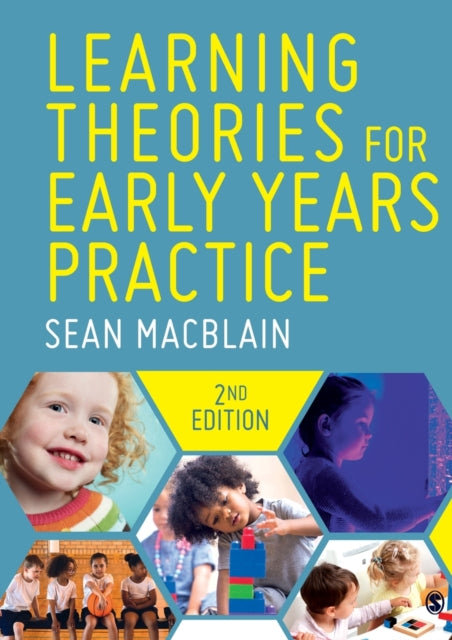
Learning Theories for Early Years Practice
Learning Theories for Early Years Practice
💎 Earn 396 Points (£3.96) on this item.
YOU SAVE £3.66
- Condition: Brand new
- UK Delivery times: Usually arrives within 2 - 3 working days
- UK Shipping: Fee starts at £2.39. Subject to product weight & dimension
Bulk ordering. Want 15 or more copies? Get a personalised quote and bigger discounts. Learn more about bulk orders.
Couldn't load pickup availability
- More about Learning Theories for Early Years Practice
This book is a comprehensive guide for students studying learning theories in the early years, covering key theorists and their theories, practical applications, strengths, and weaknesses, and their connections to other theorists. It includes updated content, case studies, activities, and critical questions.
Format: Hardback
Length: 152 pages
Publication date: 04 February 2022
Publisher: SAGE Publications Ltd
Revised and updated content throughout
The perfect guide for students who need to get to grips with learning theories and how they relate to the early years, this comprehensive book covers Early and Modern theorists and their theories, and how they apply today. Bursting with full-color photographs, case studies, activities, and discussion points, each chapter explores the theorist and the theory; what the theory looks like in practice; the strengths and weaknesses of each theory; and its links to other theorists. This new edition includes:
Three new chapters on Bowlby, Dweck, and Claxton
New reflective activities
New critical questions following the case studies
Revised and updated content throughout
Early Learning Theory:
Early learning theory is a branch of psychology that focuses on how children learn and develop. It emerged in the early 20th century and was influenced by the work of psychologists such as John Locke, Jean Piaget, and Lev Vygotsky.
One of the key principles of early learning theory is that children are active learners who construct their knowledge through their experiences. This means that children learn by exploring, experimenting, and interacting with their environment.
Early learning theorists also believe that children develop in stages. These stages include the sensorimotor stage, the preoperational stage, the concrete operational stage, and the formal operational stage. Each stage represents a different level of cognitive development and is characterized by specific behaviors and abilities.
For example, in the sensorimotor stage, children learn through their senses and motor skills. They learn to recognize objects, to grasp them, and to use them. They also learn to associate sounds and words with objects.
In the preoperational stage, children develop symbolic thinking and begin to understand concepts such as time, space, and cause and effect. They also develop a sense of self and begin to form relationships with others.
In the concrete operational stage, children develop logical thinking and begin to solve problems using concrete objects. They also begin to understand abstract concepts such as numbers and symbols.
In the formal operational stage, children develop critical thinking and begin to think abstractly. They can also solve complex problems and think about hypothetical situations.
Early learning theory has many practical applications in the early years setting. Teachers can use it to plan and implement effective teaching strategies that are tailored to the individual needs of their students.
For example, teachers can use sensory play to help children develop their sensory skills and to promote their cognitive development. They can also use storytelling and role-play to help children develop their language and social skills.
Early learning theory also has implications for early childhood education and policy. For example, it can help policymakers develop effective early childhood education programs that are designed to promote children's cognitive, social, and emotional development.
Modern Learning Theory:
Modern learning theory is a branch of psychology that focuses on how adults learn and develop. It emerged in the late 20th century and was influenced by the work of psychologists such as Abraham Maslow, Carl Rogers, and Jean Piaget.
One of the key principles of modern learning theory is that adults are self-directed learners who are motivated by their own goals and interests. This means that adults are more likely to learn if they are engaged in activities that are relevant to their own lives and that they find interesting.
Modern learning theory also emphasizes the importance of social learning and the role that social interactions play in learning. This means that adults are more likely to learn if they are able to interact with others and to receive feedback from them.
Modern learning theory also recognizes the importance of cognitive processes such as attention, memory, and problem-solving in learning. This means that adults are more likely to learn if they are able to focus their attention on the task at hand, to remember information, and to solve problems.
Modern learning theory has many practical applications in the workplace and in other settings. For example, it can help trainers and educators develop effective training programs that are designed to promote adult learning. It can also help managers develop effective leadership strategies that are designed to motivate and engage their employees.
In conclusion, early learning theory and modern learning theory are two branches of psychology that are concerned with how children and adults learn and develop. Both theories emphasize the importance of active learning, social learning, and cognitive processes in learning. Both theories have many practical applications in the early years setting and in other settings.
Weight: 670g
Dimension: 297 x 210 (mm)
ISBN-13: 9781529757071
Edition number: 2 Revised edition
This item can be found in:
UK and International shipping information
UK and International shipping information
UK Delivery and returns information:
- Delivery within 2 - 3 days when ordering in the UK.
- Shipping fee for UK customers from £2.39. Fully tracked shipping service available.
- Returns policy: Return within 30 days of receipt for full refund.
International deliveries:
Shulph Ink now ships to Australia, Belgium, Canada, France, Germany, Ireland, Italy, India, Luxembourg Saudi Arabia, Singapore, Spain, Netherlands, New Zealand, United Arab Emirates, United States of America.
- Delivery times: within 5 - 10 days for international orders.
- Shipping fee: charges vary for overseas orders. Only tracked services are available for most international orders. Some countries have untracked shipping options.
- Customs charges: If ordering to addresses outside the United Kingdom, you may or may not incur additional customs and duties fees during local delivery.