Daniel Barish
Learning to Rule: Court Education and the Remaking of the Qing State, 1861-1912
Learning to Rule: Court Education and the Remaking of the Qing State, 1861-1912
💎 Earn 121 Points (£1.21) on this item.
YOU SAVE £5.72
- Condition: Brand new
- UK Delivery times: Usually arrives within 2 - 3 working days
- UK Shipping: Fee starts at £2.39. Subject to product weight & dimension
Bulk ordering. Want 15 or more copies? Get a personalised quote and bigger discounts. Learn more about bulk orders.
Couldn't load pickup availability
- More about Learning to Rule: Court Education and the Remaking of the Qing State, 1861-1912
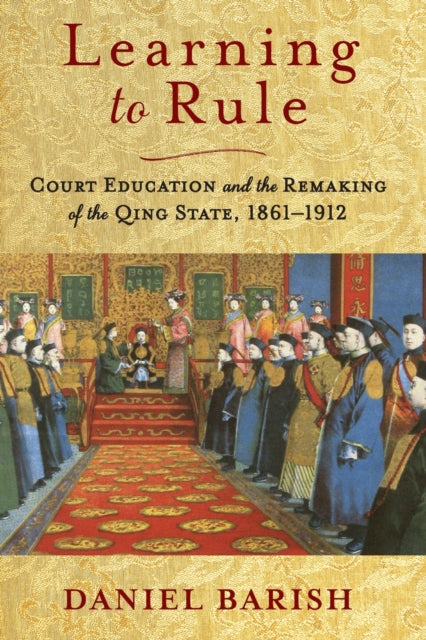
In the second half of the nineteenth century, local leaders around the Qing empire attempted to rebuild in the aftermath of domestic rebellion and imperialist aggression. Chinese scholars, Manchu and Mongolian officials, and writers in the press all competed to have their ideas included in the education of young rulers. Daniel Barish explores debates surrounding the education of the final three Qing emperors, showing how imperial curricula became proxy battles for divergent visions of how to restabilize the country. He emphasizes how changing ideas of education intersected with a push for a renewed imperial center and national unity, helping create a model of rulership for postimperial regimes.
Format: Paperback / softback
Length: 280 pages
Publication date: 08 February 2022
Publisher: Columbia University Press
In the latter half of the 19th century, local leaders across the Qing empire endeavored to rebuild in the aftermath of domestic rebellion and imperialist aggression. Simultaneously, the enthronement of a succession of children brought the issue of reconstruction to the forefront of the capital. Chinese scholars, Manchu and Mongolian officials, and writers in the press engaged in a fierce competition to have their ideas incorporated into the education of young rulers. Each group sought to leverage the power of the emperor, encompassing his functional role within the bureaucracy and his symbolic role as an exemplar for the people, to promote reform.
Daniel Barish delves into the debates surrounding the education of the final three Qing emperors, shedding light on how imperial curricula became proxy battles for divergent visions of how to stabilize the country. He explores the efforts of rival figures, who drew on China's dynastic history, Manchu traditions, and the statecraft tools of imperial powers, as they sought to remake the state. Barish traces how court education reflected arguments over the introduction of Western learning, the fate of the Manchu Way, the place of women in society, notions of constitutionalism, and emergent conceptions of national identity. He emphasizes how changing ideas of education intersected with a push for a renewed imperial center and national unity, helping create a model of rulership for postimperial regimes.
Through the lens of the education of young emperors, Learning to Rule offers a fresh perspective on the late Qing era and the relationship between the monarchy and the nation in modern China.
Weight: 380g
Dimension: 153 x 227 x 18 (mm)
ISBN-13: 9780231203296
This item can be found in:
UK and International shipping information
UK and International shipping information
UK Delivery and returns information:
- Delivery within 2 - 3 days when ordering in the UK.
- Shipping fee for UK customers from £2.39. Fully tracked shipping service available.
- Returns policy: Return within 30 days of receipt for full refund.
International deliveries:
Shulph Ink now ships to Australia, Belgium, Canada, France, Germany, Ireland, Italy, India, Luxembourg Saudi Arabia, Singapore, Spain, Netherlands, New Zealand, United Arab Emirates, United States of America.
- Delivery times: within 5 - 10 days for international orders.
- Shipping fee: charges vary for overseas orders. Only tracked services are available for most international orders. Some countries have untracked shipping options.
- Customs charges: If ordering to addresses outside the United Kingdom, you may or may not incur additional customs and duties fees during local delivery.