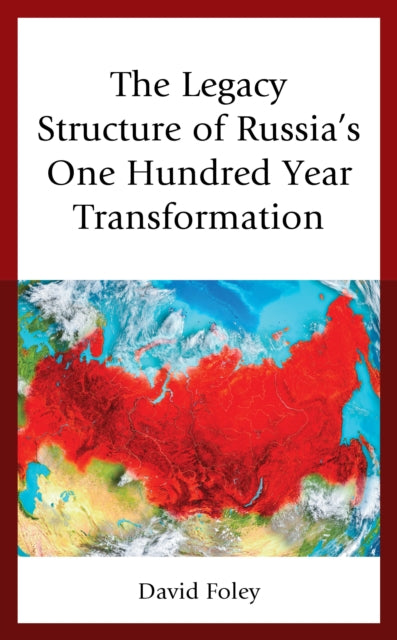
David Foley
Legacy Structure of Russia's One Hundred Year Transformation
Legacy Structure of Russia's One Hundred Year Transformation
💎 Earn 584 Points (£5.84) on this item.
We can order this item for you. Delivery usually takes about 4 to 6 weeks.
This item is not held in our immediate stock. We will order it for you after checkout.
Estimated delivery: About 4 to 6 weeks
- Condition: Brand new
- UK Delivery times: Usually arrives within 2 - 3 working days
- UK Shipping: Fee starts at £2.39. Subject to product weight & dimension
Bulk ordering. Want 15 or more copies? Get a personalised quote and bigger discounts. Learn more about bulk orders.
Couldn't load pickup availability
- More about Legacy Structure of Russia's One Hundred Year Transformation
The post-Soviet Russian experience of political, economic, and social change has been studied, with most early studies emphasizing the difficulties of adopting democratic and free-market institutions. Recent analyses have attempted to explain why the Putinist hybrid authoritarian democracy emerged to take control of the Russian state. This study presents a legacy analysis of the legacies and structures that have defied attempts at reform by the Bolsheviks, Soviets, and modern Republicans, and how they have shaped the political geography of Russia. Understanding the Imperial legacy's influences on the Russian transformation allows students to contextualize the strong linkages of historical governance structures with the one hundred years of Bolshevik and Soviet system capture and the struggles of transformation faced by the government and people of Russia today.
Format: Hardback
Length: 322 pages
Publication date: 16 November 2018
Publisher: Lexington Books
The study of the post-Soviet Russian experience has been a rich field of research and analysis, focusing on the complex and multifaceted changes that have taken place in the country. This experience has been shaped by a combination of political, economic, and social factors, with the Soviet legacy playing a significant role in shaping the transition process.
Early studies of the post-Soviet Russian transition emphasized the challenges of adopting democratic institutions and a free market economy in a society that was deeply entrenched in centralized command and control structures. These studies highlighted the difficulties of transitioning from a system that was based on state ownership and control to one that emphasized individual rights and market competition.
However, more recent analyses have sought to explain the emergence of a Putinist hybrid authoritarian democracy in Russia. These studies have explored the factors that have contributed to the consolidation of power by President Vladimir Putin and his ruling party, the United Russia Party. Some of the key factors that have been identified include the erosion of democratic institutions, the concentration of power in the hands of the government, and the use of propaganda and surveillance to maintain control over the population.
The political geography of Russia is also an important factor in understanding the post-Soviet transition. The country is characterized by a districting system that defines the people and places and represents an influential legacy structure that has had a long reach from the Russia of Imperialism to the Russia of Putinism and the twenty-first century. This political geography has played a role in shaping the political landscape of Russia and has contributed to the consolidation of power by the ruling party.
A clearer understanding of the influences the Imperial legacy brings to the Russian transformation enables the student of post-Soviet Russian transition to contextualize the strong linkages of historical governance structures with the one hundred years of Bolshevik and Soviet system capture and the struggles of transformation faced by the government and people of Russia today. This understanding can help us to better understand the challenges that Russia faces the country faces and to develop strategies for promoting democratic development and human rights in the country.
In conclusion, the study of the post-Soviet Russian experience has been a rich and complex field of research and analysis, with the Soviet legacy playing a significant role in shaping the transition process. While early studies focused on the challenges of adopting democratic institutions and a free market economy, more recent analyses have sought to explain the emergence of a Putinist hybrid authoritarian democracy in Russia. The political geography of Russia is also an important factor that has played a role in shaping the political landscape of the country and has contributed to the consolidation of power by the ruling party party. A clearer understanding of the influences the Imperial legacy brings to the Russian transformation enables the student of post-Soviet Russian transition to contextualize the strong linkages of historical governance structures with the one hundred years of Bolshevik and Soviet system capture and the struggles of transformation faced by the government and people of Russia today. This understanding can help us to better understand the challenges that Russia faces and to develop strategies for promoting democratic development and human rights in the country.
Weight: 624g
Dimension: 162 x 236 x 22 (mm)
ISBN-13: 9781498571784
UK and International shipping information
UK and International shipping information
UK Delivery and returns information:
- Delivery within 2 - 3 days when ordering in the UK.
- Shipping fee for UK customers from £2.39. Fully tracked shipping service available.
- Returns policy: Return within 30 days of receipt for full refund.
International deliveries:
Shulph Ink now ships to Australia, Belgium, Canada, France, Germany, Ireland, Italy, India, Luxembourg Saudi Arabia, Singapore, Spain, Netherlands, New Zealand, United Arab Emirates, United States of America.
- Delivery times: within 5 - 10 days for international orders.
- Shipping fee: charges vary for overseas orders. Only tracked services are available for most international orders. Some countries have untracked shipping options.
- Customs charges: If ordering to addresses outside the United Kingdom, you may or may not incur additional customs and duties fees during local delivery.