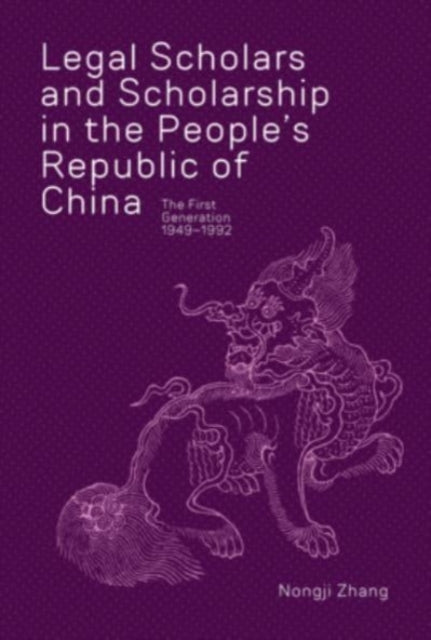
Nongji Zhang
Legal Scholars and Scholarship in the People's Republic of China: The First Generation, 1949-1992
Legal Scholars and Scholarship in the People's Republic of China: The First Generation, 1949-1992
💎 Earn 131 Points (£1.31) on this item.
YOU SAVE £7.56
- Condition: Brand new
- UK Delivery times: Usually arrives within 2 - 3 working days
- UK Shipping: Fee starts at £2.39. Subject to product weight & dimension
Bulk ordering. Want 15 or more copies? Get a personalised quote and bigger discounts. Learn more about bulk orders.
Couldn't load pickup availability
- More about Legal Scholars and Scholarship in the People's Republic of China: The First Generation, 1949-1992
Chinese legal scholarship played a crucial role in developing the new Communist legal system during the initial decades of the PRC. Scholars such as Li Hanjun, Chen Gongbo, and Xue Qingtian made significant contributions to this field.
Format: Hardback
Length: 210 pages
Publication date: 25 March 2022
Publisher: Harvard University, Asia Center
A comprehensive exploration of Chinese legal scholarship and the scholars who shaped the new Communist legal system during the early years of the People's Republic of China (PRC), following the abolition of the old system by the newly established Communist government. Delving into their intellectual contributions, we gain insights into the origins of Chinese legal studies and its trajectory.
The study of Chinese law has a rich and complex history, dating back thousands of years. During the ancient Chinese dynasties, legal systems were developed and refined to govern the various regions and societies of the country. These legal systems were based on a variety of principles, including Confucianism, Legalism, and Mohism.
However, with the establishment of the People's Republic of China in 1949, the old legal system was abolished, and a new Communist legal system was put in place. This new system was designed to serve the needs of the Communist government and to promote the ideals of socialism and communism.
The scholars who developed the new Communist legal system during the early years of the PRC were a diverse group of individuals with a wide range of backgrounds and expertise. Some of these scholars were lawyers and legal professionals who had worked in the old legal system before the Communist revolution, while others were political theorists and philosophers who had a deep understanding of Marxist and Leninist ideology.
One of the most influential scholars who shaped the new Communist legal system was Mao Zedong. Mao believed that the law should serve the interests of the working class and the poor, and he advocated for a legal system that was based on the principles of Marxism-Leninism. Mao's ideas were reflected in the Constitution of the People's Republic of China, which was adopted in 1954.
Another important scholar who contributed to the development of the new Communist legal system was Zhou Enlai. Zhou was a prominent leader of the Communist Party of China and was instrumental in the establishment of the PRC. He believed that the law should be used to promote the social and economic development of the country and to protect the rights and interests of the working class and the poor.
Other scholars who played a significant role in the development of the new Communist legal system include Li Hanjun, Chen Gongbo, and Wang Guangya. These scholars were all members of the Chinese Communist Party and were involved in the drafting and implementation of the new legal system.
The new Communist legal system was based on a number of principles, including the rule.
1. The principle of legality: The law must be based on the Constitution and other legal documents, and it must be consistent with the principles of Marxism-Leninism and the policies of the Communist Party of China.
2. The principle of social justice: The law must promote social justice and equality, and it must protect the rights and interests of the working class and the poor.
3. The principle of the rule.
4. The principle of the rule poor: The law must protect the rights and interests of the poor and vulnerable groups, and it must promote their social and economic development.
5. The principle of the rule of law: The law must be administered by the state in accordance.
6. The principle of the unity of the law: The law must be applied uniformly to all individuals and organizations, regardless of their political, social, or economic status.
7. The principle of the independence of the judiciary: The judiciary must be independent and impartial, and it must be able to make decisions based on the law and the Constitution.
8. The principle of the rule
9. The principle of the rule of law: The law must be enforced by the state in a fair and just manner.
10. The principle of the rule of law: The law must be enforced by the state in a fair and just manner.
The new Communist legal system has undergone significant changes and developments since its inception in 1949. Today, China has a complex legal system that is based on a combination of traditional Chinese law and Marxist-Leninist ideology. The system is administered by the Supreme People's Court, which is the highest court in the country. The system is divided into civil, criminal, administrative, and economic law, and it includes a number of specialized courts, including the People's Procuratorates, which are responsible for the prosecution of criminal cases.
The new Communist legal system has faced a number of challenges and criticisms over the years. Some of these challenges include the lack of transparency and accountability in the legal system, the lack of independence and impartiality of the judiciary, and the excessive use of the death penalty and other harsh punishments. However, the system has also made significant progress in recent years, particularly in terms of its efforts to promote the rule of law and to protect the rights and interests of the working class and the poor.
In conclusion, the study of Chinese law has a rich and complex history, dating back thousands of years. During the ancient Chinese dynasties, legal systems were developed and refined to govern the various regions and societies. However, with the establishment of the People's Republic of China in 1949, the old legal system was abolished, and a new Communist legal system was put in place. The scholars who developed the new Communist legal system during the early years of the PRC were a diverse group of individuals with a wide range of backgrounds and expertise. Mao Zedong and Zhou Enlai were two of the most influential scholars who shaped the new Communist legal system, and their ideas were reflected in the Constitution of the People's Republic of China, which was adopted in 1954. The new Communist legal system was based on a number of principles, including the principle.
The new Communist legal system has undergone significant changes and developments since its inception in 1949, and it has faced a number of challenges and criticisms over the years. However, the system has also made significant progress in recent years, particularly in terms of its efforts to promote the rule the rule of law and to protect the rights and interests of the working class and the poor.
Dimension: 229 x 152 (mm)
ISBN-13: 9780674267961
This item can be found in:
UK and International shipping information
UK and International shipping information
UK Delivery and returns information:
- Delivery within 2 - 3 days when ordering in the UK.
- Shipping fee for UK customers from £2.39. Fully tracked shipping service available.
- Returns policy: Return within 30 days of receipt for full refund.
International deliveries:
Shulph Ink now ships to Australia, Belgium, Canada, France, Germany, Ireland, Italy, India, Luxembourg Saudi Arabia, Singapore, Spain, Netherlands, New Zealand, United Arab Emirates, United States of America.
- Delivery times: within 5 - 10 days for international orders.
- Shipping fee: charges vary for overseas orders. Only tracked services are available for most international orders. Some countries have untracked shipping options.
- Customs charges: If ordering to addresses outside the United Kingdom, you may or may not incur additional customs and duties fees during local delivery.