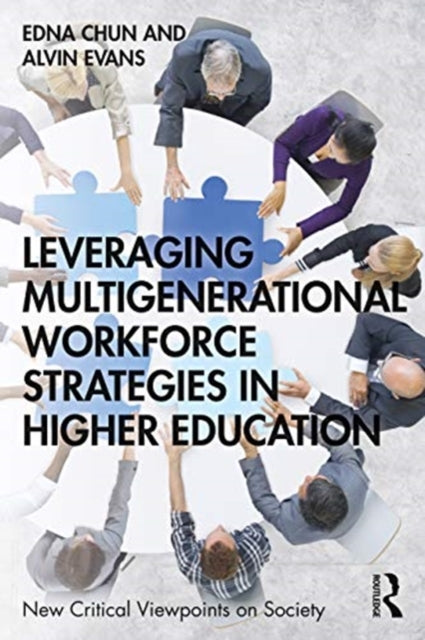
Edna Chun,Alvin Evans
Leveraging Multigenerational Workforce Strategies in Higher Education
Leveraging Multigenerational Workforce Strategies in Higher Education
We can order this item for you. Delivery usually takes about 4 to 6 weeks.
This item is not held in our immediate stock. We will order it for you after checkout.
Estimated delivery: About 4 to 6 weeks
YOU SAVE £3.69
- Condition: Brand new
- UK Delivery times: Usually arrives within 2 - 3 working days
- UK Shipping: Fee starts at £3.89. Subject to product weight & dimension
Bulk ordering. Want 15 or more copies? Get a personalised quote and bigger discounts. Learn more about bulk orders.
Couldn't load pickup availability
- More about Leveraging Multigenerational Workforce Strategies in Higher Education
The higher education literature on workplace diversity has overlooked the development of multigenerational workforce strategies as a key component of an inclusive talent proposition. Leveraging Multigenerational Workforce Strategies in Higher Education offers an in-depth look at multigenerational strategies that enhance institutional capacity and respond to educational needs. It examines the broad framing of generations that consists of stereotypes, narratives, images, and emotions and how ageist framing is magnified by other minoritized statuses, leading to structural inequality, process-based discrimination, and asymmetrical behavioral interactions in the higher education workplace. The book focuses on best-in-class HR and diversity policies and strategies that institutional leaders can deploy to overcome generational and ageist barriers and build an inclusive culture that values the contributions of all members.
Format: Paperback / softback
Length: 166 pages
Publication date: 15 April 2021
Publisher: Taylor & Francis Ltd
The higher education literature on workplace diversity has overlooked the development of multigenerational workforce strategies as a key component of an inclusive talent proposition. While race, gender, sexual orientation, disability, and other demographic attributes have gained considerable attention in diversity strategic planning, scant research pertains to building inclusive, multigenerational approaches within the culture and practices of higher education. Now, more than ever, there is an urgent and unmet need to identify actionable strategies and approaches that optimize the contributions of multigenerational talent across the faculty, administrator, and staff. With the goal of enhancing workforce capacity and creating more inclusive workplaces, Leveraging Multigenerational Workforce Strategies in Higher Education offers an in-depth look at multigenerational strategies that enhance institutional capacity and respond to educational needs. This book is the first to address the creation of multigenerational strategies in the higher education workplace based upon substantial empirical studies and qualitative research. Drawing on in-depth interviews with faculty and administrators, the book examines the broad framing of generations that consists of stereotypes, narratives, images, and emotions. Through the lens of these narratives, it describes how ageist framing is magnified by other minoritized statuses, including race/ethnicity, gender, and sexual orientation, and can result in structural inequality, process-based discrimination, and asymmetrical behavioral interactions in the higher education workplace. A major feature of the book is its focus on best-in-class HR and diversity policies and strategies that institutional leaders can deploy to overcome generational barriers.
The book highlights the importance of developing a multigenerational workforce strategy that recognizes the unique strengths and challenges of each generation. It provides practical insights and examples of how institutions can create a culture of inclusivity and engagement that leverages the diverse perspectives and experiences of all employees. By adopting a multigenerational approach, higher education institutions can enhance their competitiveness, attract and retain top talent, and improve their overall performance.
One of the key challenges facing higher education institutions is the increasing age of the faculty and staff. As the baby boomer generation retires, there is a growing need to attract and retain younger employees who can bring fresh ideas and perspectives to the workplace. However, this can be challenging due to generational differences in work ethic, communication styles, and technology usage.
The book offers strategies for bridging these generational gaps, such as implementing flexible work arrangements, providing training and development opportunities, and creating a culture of mentorship and collaboration. It also emphasizes the importance of recognizing and valuing the contributions of older employees, who can bring a wealth of experience and knowledge to the workplace.
Another challenge facing higher education institutions is the increasing diversity of the student population. With students from diverse backgrounds, cultures, and experiences, there is a need to create a learning environment that is inclusive and equitable. The book offers strategies for promoting diversity and inclusion, such as developing cultural competency training programs, providing support services for marginalized students, and creating a welcoming and inclusive campus culture.
In addition to these challenges, higher education institutions are also facing the impact of technological change on the workforce. With the rise of automation, artificial intelligence, and other digital technologies, there is a need to adapt and evolve to remain competitive. The book offers strategies for leveraging technology to enhance productivity and efficiency, such as implementing digital learning platforms, using automation to streamline processes, and creating a culture of innovation and creativity.
Overall, Leveraging Multigenerational Workforce Strategies in Higher Education is a valuable resource for institutional leaders who are committed to creating more inclusive and diverse workplaces. By adopting a multigenerational approach, higher education institutions can optimize the contributions of all employees, enhance their competitiveness, and improve their overall performance.
Weight: 282g
Dimension: 152 x 227 x 16 (mm)
ISBN-13: 9780367713430
UK and International shipping information
UK and International shipping information
We deliver throughout the United Kingdom and to 128 countries and territories worldwide, including the United States, Australia, Canada, Germany, Spain and France.