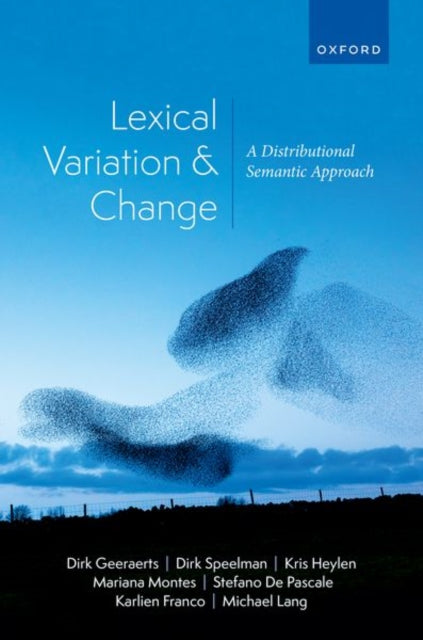

DirkGeeraerts,DirkSpeelman,KrisHeylen,MarianaMontes,StefanoDe Pascale,KarlienFranco,MichaelLang
Lexical Variation and Change: A Distributional Semantic Approach
Lexical Variation and Change: A Distributional Semantic Approach
We can order this item for you. Delivery usually takes about 4 to 6 weeks.
This item is not held in our immediate stock. We will order it for you after checkout.
Estimated delivery: About 4 to 6 weeks
- Condition: Brand new
- UK Delivery times: Usually arrives within 2 - 3 working days
- UK Shipping: Fee starts at £3.89. Subject to product weight & dimension
Bulk ordering. Want 15 or more copies? Get a personalised quote and bigger discounts. Learn more about bulk orders.
Couldn't load pickup availability
- More about Lexical Variation and Change: A Distributional Semantic Approach
This book provides a systematic framework for understanding and investigating lexical variation,using a distributional semantics approach. It explores how count-based token-level semantic vector spaces can be applied to the study of polysemy,lexical variation,and lectometry. The authors present a comprehensive model of lexical and semantic variation,based on a semasiological,onomasiological,and a lectal dimension. They illustrate this distributional methodology using case studies of Dutch and Spanish lexical data.
Format: Hardback
Length: 336 pages
Publication date: 07 November 2023
Publisher: Oxford University Press
This book presents a comprehensive framework for understanding and investigating lexical variation, employing a distributional semantics approach. Distributional semantics embodies the idea that the context in which a word occurs reveals its meaning. In contemporary corpus linguistics, this idea takes shape through various quantitative analyses of the corpus contexts in which words appear. In this book, the authors explore how count-based token-level semantic vector spaces, as advanced forms of such quantitative methodologies, can be applied to the study of polysemy, lexical variation, and lectometry.
What can distributional models reveal about meaning? How can they be used to analyze the semantic relationship between near-synonyms and to identify strict synonymy? How can they contribute to the study of lexical variation as a sociolinguistic variable and to the use of those variables to measure convergence or divergence between language varieties?
To answer these questions, the book presents a comprehensive model of lexical and semantic variation, based on the combination of a semasiological, an onomasiological, and a lectal dimension. It explains the mechanism of distributional modeling, both informally and technically, and introduces workflows and corpus linguistic tools that implement a distributional perspective in lexical research.
Combining a cognitive linguistic interest in meaning with a sociolinguistic interest in variation, the authors illustrate this distributional methodology using case studies of Dutch and Spanish lexical data that showcase the diverse ways in which distributional semantics can be applied to language analysis.
This book is a valuable resource for researchers, students, and practitioners interested in exploring the complexities of lexical variation and its implications for language understanding and communication. It provides a systematic approach to analyzing lexical data and offers insights into the cognitive and sociolinguistic factors that shape language variation.
Weight: 658g
Dimension: 242 x 165 x 25 (mm)
ISBN-13: 9780198890676
UK and International shipping information
UK and International shipping information
We deliver throughout the United Kingdom and to 128 countries and territories worldwide, including the United States, Australia, Canada, Germany, Spain and France.