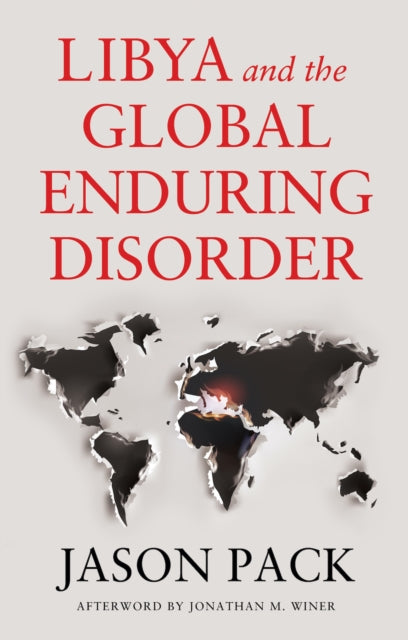
Jason Pack
Libya and the Global Enduring Disorder
Libya and the Global Enduring Disorder
YOU SAVE £5.05
- Condition: Brand new
- UK Delivery times: Usually arrives within 2 - 3 working days
- UK Shipping: Fee starts at £3.89. Subject to product weight & dimension
Bulk ordering. Want 15 or more copies? Get a personalised quote and bigger discounts. Learn more about bulk orders.
Couldn't load pickup availability
- More about Libya and the Global Enduring Disorder
The decline of one empire leads to a restoration in the balance of power, but this dynamic is absent today. Jason Pack contends that Libya's ongoing conflict is the ideal microcosm to identify the salient features of this new era of geopolitics, as it has been moulded by the stark absence of coherent international diplomacy and has precipitated cross-border contagion, further corroding global institutions and international partnership.
\n Format: Hardback
\n Length: 304 pages
\n Publication date: 16 December 2021
\n Publisher: C Hurst & Co Publishers Ltd
\n
The world we live in today is vastly different from the one that was governed by international coordination, a unified NATO bloc, or an American hegemon. In the past, when one empire declined, the balance of power would be restored through a struggle among rival systems of order. However, this traditional dynamic is surprisingly absent in today's world. Instead, the superpowers have all sought to promote what Jason Pack terms the "Enduring Disorder." Pack argues that Libya's ongoing conflict, more so than the civil wars in Yemen, Syria, Venezuela, or Ukraine, constitutes the ideal microcosm in which to identify the salient features of this new era of geopolitics.
The country's post-Qadhafi trajectory has been shaped by the stark absence of coherent international diplomacy. While Libya's incremental implosion has precipitated cross-border contagion, further corroding global institutions and international partnerships. Pack draws on over two decades of research in and on Libya and Syria to highlight the Kafkaesque aspects of today's global affairs. He shows how even the threats posed by the Arab Spring and the Benghazi assassination of US Ambassador J. Christopher Stevens could not occasion a unified Western response. Instead, they have further undercut global collaboration, demonstrating the self-reinforcing nature of the progressively collapsing world order.
The decline of the United States as the world's sole superpower has led to a shift in global power dynamics. The rise of China, India, and other emerging economies has created new challenges and opportunities for the world's major powers. The Middle East, in particular, has become a hotbed of conflict and instability, with the rise of ISIS and other extremist groups posing a significant threat to regional and global security.
One of the key features of the "Enduring Disorder" is the absence of a clear global leader or authority. The United Nations, which was established after World War II to promote international cooperation and peace, has struggled to maintain its effectiveness and relevance in the face of these challenges. The organization has been unable to address the complex and interconnected issues facing the world, such as climate change, terrorism, and economic inequality.
Another aspect of the "Enduring Disorder" is the rise of nationalism and populism. In many countries, people are becoming increasingly skeptical of international institutions and are more likely to prioritize their own national interests over those of the global community. This has led to a decline in trust and cooperation among nations, making it difficult to address global challenges such as climate change and pandemics.
The "Enduring Disorder" has also had a significant impact on the global economy. The rise of trade protectionism and the decline of free trade agreements have led to increased economic uncertainty and instability. This has made it difficult for businesses to operate globally and has contributed to the growth of economic inequality and poverty.
In conclusion, the world we live in today is vastly different from the one that was governed by international coordination, a unified NATO bloc, or an American hegemon. The decline of one empire leads to a restoration in the balance of power, via a struggle among rival systems of order. However, this dynamic is surprisingly absent today; instead, the superpowers have all, at times, sought to promote what Jason Pack terms the "Enduring Disorder." The country's post-Qadhafi trajectory has been moulded by the stark absence of coherent international diplomacy; while Libya's incremental implosion has precipitated cross-border contagion, further corroding global institutions and international partnership. Pack draws on over two decades of research in and on Libya and Syria to highlight the Kafkaesque aspects of today's global affairs. He shows how even the threats posed by the Arab Spring and the Benghazi assassination of US Ambassador J. Christopher Stevens could not occasion a unified Western response. Instead, they have further undercut global collaboration, demonstrating the self-reinforcing nature of the progressively collapsing world order. The decline of the United States as the world's sole superpower has led to a shift in global power dynamics. The rise of China, India, and other emerging economies has created new challenges and opportunities for the world's major powers. The Middle East, in particular, has become a hotbed of conflict and instability, with the rise of ISIS and other extremist groups posing a significant threat to regional and global security. One of the key features of the "Enduring Disorder" is the absence of a clear global leader or authority. The United Nations, which was established after World War II to promote international cooperation and peace, has struggled to maintain its effectiveness and relevance in the face of these challenges. The organization has been unable to address the complex and interconnected issues facing the world, such as climate change, terrorism, and economic inequality. Another aspect of the "Enduring Disorder" is the rise of nationalism and populism. In many countries, people are becoming increasingly skeptical of international institutions and are more likely to prioritize their own national interests over those of the global community. This has led to a decline in trust and cooperation among nations, making it difficult to address global challenges such as climate change and pandemics. The "Enduring Disorder" has also had a significant impact on the global economy. The rise of trade protectionism and the decline of free trade agreements have led to increased economic uncertainty and instability. This has made it difficult for businesses to operate globally and has contributed to the growth of economic inequality and poverty. In conclusion, the world we live in today is vastly different from the one that was governed by international coordination, a unified NATO bloc, or an American hegemon. The decline of one empire leads to a restoration in the balance of power, via a struggle among rival systems of order. However, this dynamic is surprisingly absent today; instead, the superpowers have all, at times, sought to promote what Jason Pack terms the "Enduring Disorder." The country's post-Qadhafi trajectory has been moulded by the stark absence of coherent international diplomacy; while Libya's incremental implosion has precipitated cross-border contagion, further corroding global institutions and international partnership. Pack draws on over two decades of research in and on Libya and Syria to highlight the Kafkaesque aspects of today's global affairs. He shows how even the threats posed by the Arab Spring and the Benghazi assassination of US Ambassador J. Christopher Stevens could not occasion a unified Western response. Instead, they have further undercut global collaboration, demonstrating the self-reinforcing nature of the progressively collapsing world order.
\n Weight: 864g\n
Dimension: 152 x 301 x 54 (mm)\n
ISBN-13: 9781787385689\n \n
UK and International shipping information
UK and International shipping information
We deliver throughout the United Kingdom and to 128 countries and territories worldwide, including the United States, Australia, Canada, Germany, Spain and France.