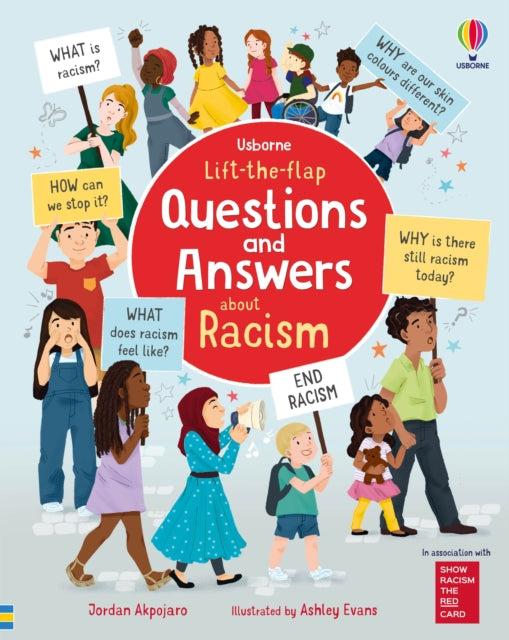
Jordan Akpojaro
Lift-the-flap Questions and Answers about Racism
Lift-the-flap Questions and Answers about Racism
💎 Earn 35 Points (£0.35) on this item.
YOU SAVE £2.92
- Condition: Brand new
- UK Delivery times: Usually arrives within 2 - 3 working days
- UK Shipping: Fee starts at £2.39. Subject to product weight & dimension
Bulk ordering. Want 15 or more copies? Get a personalised quote and bigger discounts. Learn more about bulk orders.
Couldn't load pickup availability
- More about Lift-the-flap Questions and Answers about Racism
This book tackles powerful, pertinent questions in a direct, accessible and thought-provoking way, revealing why racism is everyone's problem to solve and how we can all be part of the solution.
Format: Board book
Length: 14 pages
Publication date: 06 January 2022
Publisher: Usborne Publishing Ltd
This book tackles powerful, pertinent questions in a direct, accessible, and thought-provoking way. Discover why racism is everyone's problem to solve, and how we can all be part of the solution.
Why is life harder for people with darker skin?
The idea of race is often a complex and controversial topic, with many different perspectives and interpretations. While some people may argue that race is a biological or genetic construct that determines a person's characteristics and abilities, others believe that race is a social construct created by human societies and institutions.
One of the main criticisms of the idea of race is that it perpetuates harmful stereotypes and biases, which can lead to discrimination and prejudice against individuals based on their race. For example, people of color may be perceived as less intelligent, less capable, or more aggressive than white people, which can lead to unfair treatment and barriers to opportunities.
Another issue with the idea of race is that it can be used to justify discriminatory policies and practices, such as segregation, discrimination in employment, and housing. These policies can have serious consequences for individuals and communities, perpetuating cycles of poverty and inequality.
Despite these criticisms, some people argue that race is a useful tool for understanding and addressing social and economic disparities. For example, race may be used to identify specific populations that are at risk for certain health conditions or to target resources and support to those populations.
However, it is important to approach the idea of race with caution and sensitivity, and to recognize that race is not a fixed or universal construct. Different individuals may have different experiences and perspectives on race, and it is essential to respect and acknowledge these differences.
In conclusion, the idea of race is a complex and multifaceted topic that has many different perspectives and interpretations. While some people may argue that race is a biological or genetic construct, others believe that it is a social construct created by human societies and institutions.
While race can be useful for understanding and addressing social and economic disparities, it is important to approach the topic with caution and sensitivity, and to recognize that race is not a fixed or universal construct. Different individuals may have different experiences and perspectives on race, and it is essential to respect and acknowledge these differences.
Don t ALL lives matter?
The concept of "all lives matter" is a response to the Black Lives Matter movement, which emerged in 2013 in response to the shooting death of Trayvon Martin, a young black man, by George Zimmerman, a neighborhood watch volunteer. The movement seeks to raise awareness about the systemic racism and police brutality that disproportionately affects black communities and to advocate for policies that promote equality and justice for all people.
One of the main criticisms of the "all lives matter" movement is that it fails to recognize the unique experiences and challenges faced by black communities. Black people have historically been marginalized and oppressed in society, and they continue to face systemic barriers to success, such as discrimination in housing, education, and employment.
The "all lives matter" movement also tends to downplay the historical and systemic nature of racism, which has been a persistent feature of American society for centuries. Instead, it suggests that racism is a problem that can be solved by individual acts of kindness and empathy, rather than by systemic changes in policies and institutions.
Another criticism of the "all lives matter" movement is that it can be seen as a way of dismissing the Black Lives Matter movement and its goals. By focusing on the idea that all lives matter, the movement can undermine the urgency and importance of addressing the specific issues faced by black communities.
Despite these criticisms, some people argue that the "all lives matter" movement is a necessary response to the Black Lives Matter movement, and that it is important to promote a sense of unity and compassion for all people. They argue that the movement is not intended to undermine the Black Lives Matter movement, but rather to highlight the fact that all lives matter and that everyone should be treated with dignity and respect.
In conclusion, the "all lives matter" movement is a response to the Black Lives Matter movement, which seeks to raise awareness about the systemic racism and police brutality that disproportionately affects black communities. While the movement has faced criticism for failing to recognize the unique experiences and challenges faced by black communities, some people argue that it is important to promote a sense of unity and compassion for all people.
What s racism got to do with me?
Racism is a complex and pervasive issue that affects individuals and communities across the world. It is defined as the belief that one race is superior to another, or that certain races should be treated differently based on their race. Racism can manifest in various forms, including discrimination, prejudice, and hostility towards individuals based on their race.
One of the most significant impacts of racism is that it perpetuates inequality and injustice. Racism can lead to unequal access to education, healthcare, and employment opportunities, as well as to housing and other forms of discrimination. This can have a devastating impact on individuals and communities, leading to poverty, social exclusion, and reduced quality of life.
Racism can also have psychological and emotional effects on individuals who experience it. Racism can lead to feelings of anxiety, depression, and low self-esteem, as well as to a sense of isolation and disconnection from society. It can also contribute to the perpetuation of stereotypes and biases, which can lead to negative attitudes and behaviors towards individuals based on their race.
Despite these challenges, there are many efforts underway to address racism and promote equality and justice. These efforts include education and awareness campaigns, advocacy and activism, and policy changes. Education and awareness campaigns can help to raise awareness about the impacts of racism and promote understanding and empathy towards individuals from different racial backgrounds. Advocacy and activism can help to promote policy changes and social reforms that address the root causes of racism and promote equality and justice for all individuals.
In conclusion, racism is a complex and pervasive issue that affects individuals and communities across the world. It perpetuates inequality and injustice, has psychological and emotional effects, and contributes to the perpetuation of stereotypes and biases. However, there are many efforts underway to address racism and promote equality and justice, including education and awareness campaigns, advocacy and activism, and policy changes. By working together, we can create a more inclusive and just society for all individuals.
Weight: 522g
Dimension: 225 x 282 x 16 (mm)
ISBN-13: 9781474995825
This item can be found in:
UK and International shipping information
UK and International shipping information
UK Delivery and returns information:
- Delivery within 2 - 3 days when ordering in the UK.
- Shipping fee for UK customers from £2.39. Fully tracked shipping service available.
- Returns policy: Return within 30 days of receipt for full refund.
International deliveries:
Shulph Ink now ships to Australia, Belgium, Canada, France, Germany, Ireland, Italy, India, Luxembourg Saudi Arabia, Singapore, Spain, Netherlands, New Zealand, United Arab Emirates, United States of America.
- Delivery times: within 5 - 10 days for international orders.
- Shipping fee: charges vary for overseas orders. Only tracked services are available for most international orders. Some countries have untracked shipping options.
- Customs charges: If ordering to addresses outside the United Kingdom, you may or may not incur additional customs and duties fees during local delivery.