Dilek Kurban
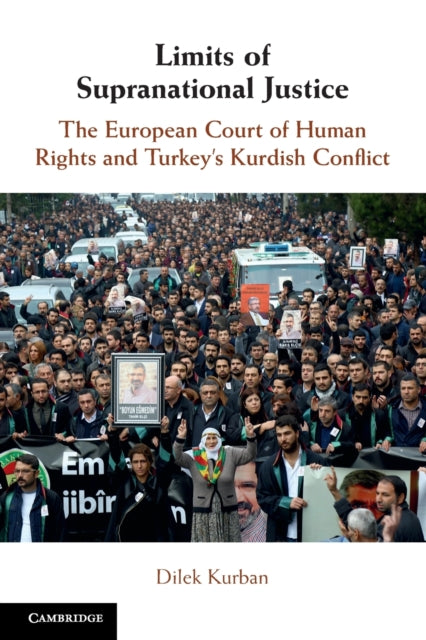
Limits of Supranational Justice: The European Court of Human Rights and Turkey's Kurdish Conflict
Limits of Supranational Justice: The European Court of Human Rights and Turkey's Kurdish Conflict
💎 Earn 141 Points (£1.41) on this item.
YOU SAVE £0.70
- Condition: Brand new
- UK Delivery times: Usually arrives within 2 - 3 working days
- UK Shipping: Fee starts at £2.39. Subject to product weight & dimension
Bulk ordering. Want 15 or more copies? Get a personalised quote and bigger discounts. Learn more about bulk orders.
Couldn't load pickup availability
- More about Limits of Supranational Justice: The European Court of Human Rights and Turkey's Kurdish Conflict
Limits of Supranational Justice examines the European Court of Human Rights' engagement in Turkey's Kurdish conflict since the early 1990s, highlighting its failure to end gross violations. It combines legal, political, sociological, and historical narratives to demonstrate the factors enabling state violence and political repression against the Kurds.
Format: Paperback / softback
Length: 409 pages
Publication date: 11 August 2022
Publisher: Cambridge University Press
Limits of Supranational Justice: A Socio-Legal Analysis of the European Court of Human Rights Engagement in Turkey's Kurdish Conflict Since the Early 1990s
The European Court of Human Rights (ECtHR) has been involved in Turkey's Kurdish conflict since the early 1990s, and its engagement has been a subject of much debate and analysis. In Limits of Supranational Justice, a book by Dr. S. Akman, the author examines the ECtHR's efforts to address the human rights violations committed against civilians in the Kurdish region under emergency rule. The book draws on a socio-legal account of the work of Kurdish lawyers in mobilizing the ECtHR and a doctrinal legal analysis of the ECtHR's jurisprudence in these cases.
The book begins by providing a historical overview of the Kurdish conflict in Turkey, including the emergence of the Kurdish Workers' Party (PKK) in the 1980s and the subsequent conflict between the PKK and the Turkish state. It then discusses the ECtHR's engagement in the conflict, including the cases that have been brought before the court and the decisions that have been made.
One of the key findings of the book is that the ECtHR has failed to end gross violations in the Kurdish region. The author argues that the ECtHR's jurisprudence has been shaped by a number of factors, including the political context of the conflict, the nature of the violations, and the legal framework that governs the ECtHR's jurisdiction.
The author highlights the fact that the ECtHR has been reluctant to intervene in cases where the Turkish state has been accused of committing human rights violations. This reluctance has been attributed to a number of factors, including the political sensitivity of the issue, the lack of evidence, and the fear of reprisals against the Turkish state.
Despite these challenges, the author argues that the ECtHR has made some progress in addressing the human rights violations committed against civilians in the Kurdish region. For example, the court has ruled that the Turkish state has violated the rights of Kurdish prisoners by subjecting them to torture and other forms of ill-treatment. The court has also ruled that the Turkish state has violated the rights of Kurdish civilians by engaging in forced displacement and by using excessive force during military operations.
However, the author argues that the ECtHR's jurisprudence has been limited in its ability to address the root causes of the conflict. The author argues that the ECtHR's focus on individual cases has led to a neglect of the broader political and social context of the conflict. This has resulted in a situation where the Turkish state has been able to continue to commit human rights violations with impunity.
The author suggests that there are a number of ways in which the ECtHR can improve its engagement in the Kurdish conflict. One of these ways is to adopt a more proactive approach to addressing the root causes of the conflict. This could involve, for example, conducting investigations into the human rights violations committed by the Turkish state and holding the Turkish state accountable for its actions.
Another way in which the ECtHR can improve its engagement in the Kurdish conflict is to increase its cooperation with other supranational courts and international organizations. This could involve, for example, sharing information and expertise with other courts and organizations and working together to develop a comprehensive strategy for addressing the conflict.
The book also highlights the importance of legal mobilization in addressing the Kurdish conflict. The author argues that Kurdish lawyers have played a critical role in mobilizing the ECtHR and in bringing attention to the human rights violations committed against civilians in the Kurdish region. The author argues that legal mobilization can be a powerful tool for promoting human rights and for holding governments accountable for their actions.
However, the author also notes that legal mobilization can be challenging in the Kurdish region. The author argues that the Turkish state has been able to use legal measures to suppress Kurdish political activity and to intimidate Kurdish lawyers. This has resulted in a situation where Kurdish lawyers have been unable to access the ECtHR and to bring their cases before the court.
In conclusion, Limits of Supranational Justice is a valuable contribution to the scholarship on supranational courts and legal mobilization. The book provides a socio-legal account of the work of Kurdish lawyers in mobilizing the ECtHR and a doctrinal legal analysis of the ECtHR's jurisprudence in these cases. The book demonstrates the ECtHR's failure to end gross violations in the Kurdish region and highlights the need for a reappraisal of current academic and jurisprudential approaches to authoritarian regimes. By adopting a more proactive approach to addressing the root causes of the conflict and by increasing its cooperation with other supranational courts and international organizations, the ECtHR can play a more effective role in promoting human rights and in holding governments accountable for their actions.
Weight: 600g
Dimension: 151 x 227 x 27 (mm)
ISBN-13: 9781108702324
This item can be found in:
UK and International shipping information
UK and International shipping information
UK Delivery and returns information:
- Delivery within 2 - 3 days when ordering in the UK.
- Shipping fee for UK customers from £2.39. Fully tracked shipping service available.
- Returns policy: Return within 30 days of receipt for full refund.
International deliveries:
Shulph Ink now ships to Australia, Belgium, Canada, France, Germany, Ireland, Italy, India, Luxembourg Saudi Arabia, Singapore, Spain, Netherlands, New Zealand, United Arab Emirates, United States of America.
- Delivery times: within 5 - 10 days for international orders.
- Shipping fee: charges vary for overseas orders. Only tracked services are available for most international orders. Some countries have untracked shipping options.
- Customs charges: If ordering to addresses outside the United Kingdom, you may or may not incur additional customs and duties fees during local delivery.