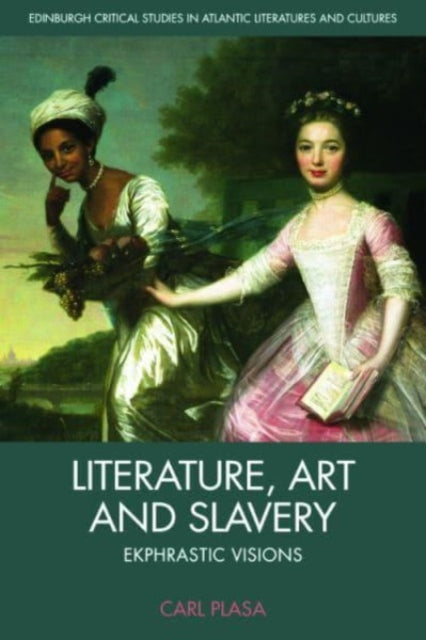
Carl Plasa
Literature, Art and Slavery: Ekphrastic Visions
Literature, Art and Slavery: Ekphrastic Visions
💎 Earn 364 Points (£3.64) on this item.
YOU SAVE £22.13
- Condition: Brand new
- UK Delivery times: Usually arrives within 2 - 3 working days
- UK Shipping: Fee starts at £3.89. Subject to product weight & dimension
Bulk ordering. Want 15 or more copies? Get a personalised quote and bigger discounts. Learn more about bulk orders.
Couldn't load pickup availability
- More about Literature, Art and Slavery: Ekphrastic Visions
The visual archive of Atlantic slavery has been the subject of critical work since 2000, exploring how images live on beyond their original context. This book focuses on transactions between texts and images from the mid-1990s to 2020, particularly in literature, with a focus on British, American, and French traditions.
Format: Hardback
Length: 240 pages
Publication date: 31 October 2023
Publisher: Edinburgh University Press
Since around 2000, there has been a significant increase in critical work on the visual archive of Atlantic slavery, leading to numerous important studies. While most of these contributions focus on images created during the era of slavery itself, some critics have taken a more historically expansive approach, exploring the ways in which such images continue to resonate beyond their original context of production, circulation, and consumption, reappearing imaginatively in various forms at different times and in different places. This book shares the fascination with the afterlives of these visual materials but emphasizes how that legacy has evolved in the realm of literature, particularly poetry. It centers on the interactions between texts written between the mid-1990s and 2020 and images of slavery that belong to British, American, and (in one case) French traditions, produced between c. 1779 and 1939.
One of the key themes of this book is the way in which images of slavery have been used to shape and reinforce narratives about the past. These images have been employed to justify and legitimize the institution of slavery, to depict the enslaved as inferior and subhuman, and to promote a sense of white superiority. However, as the book demonstrates, these images have also been subverted and challenged by writers and artists who have sought to expose the truth about slavery and its impact on individuals and communities.
One of the most significant examples of this subversion is the work of African American poets. These poets have used their poetry to challenge the dominant narratives of slavery and to celebrate the resilience and creativity of the enslaved. For example, Maya Angelou's "I Know Why the Caged Bird Sings" is a powerful account of her childhood in slavery, which highlights the strength and determination of the enslaved and the importance of education and self-discovery. Similarly, Langston Hughes's "Let America Be America Again" is a call for social justice and equality, which emphasizes the importance of the African American experience in shaping American culture.
Another important aspect of this book is the way in which images of slavery have been used in literature to explore the themes of race, gender, and power. For example, Toni Morrison's "Beloved" is a novel that explores the legacy of slavery and the impact it has had on the lives of African American women. The novel is set in the post-Civil War era and follows the story of a former slave named Sethe, who is haunted by the memory of her enslavement. Morrison's use of images of slavery in the novel is powerful and evocative, and it helps to bring the reader into the world of the enslaved and to understand the complexities of their experiences.
In addition to its focus on literature, this book also explores the ways in which images of slavery have been used in popular culture. For example, the film "12 Years a Slave" is a powerful and moving account of the life of Solomon Northup, a free black man who was kidnapped and sold into slavery in the United States. The film's use of images of slavery is powerful and evocative, and it helps to bring the story to life and to make it accessible to a wider audience.
However, the book also acknowledges the challenges that have been faced in the preservation and interpretation of images of slavery. Many of these images have been lost or destroyed, and it can be difficult to access them. This has led to a lack of understanding and appreciation of the history of slavery, and it has also contributed to the perpetuation of harmful stereotypes and beliefs about the enslaved.
To address these challenges, the book proposes a number of strategies for preserving and interpreting images of slavery. One of these strategies is to create new images of slavery that are more accurate and nuanced. This can be done by using historical research and by working with artists and filmmakers who have a deep understanding of the history of slavery. Another strategy is to use digital technologies to make these images more accessible to a wider audience.
In conclusion, this book is a fascinating and important contribution to the field of critical work on the visual archive of Atlantic slavery. It explores the ways in which images of slavery have been used to shape and reinforce narratives about the past, to subvert and challenge these narratives, and to explore the themes of race, gender, and power. By focusing on transactions between texts written between the mid-1990s and 2020 and images of slavery that belong to British, American, and French traditions, produced between c. 1779 and 1939, the book provides a unique and valuable perspective on the history of slavery and its impact on individuals and communities.
Weight: 504g
Dimension: 160 x 241 x 21 (mm)
ISBN-13: 9780748683543
UK and International shipping information
UK and International shipping information
We deliver throughout the United Kingdom and to 128 countries and territories worldwide, including the United States, Australia, Canada, Germany, Spain and France.