Shulph Ink
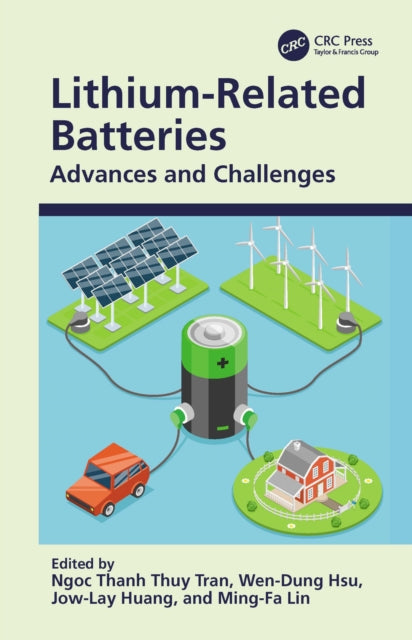
Lithium-Related Batteries: Advances and Challenges
Lithium-Related Batteries: Advances and Challenges
We can order this item for you. Delivery usually takes about 4 to 6 weeks.
This item is not held in our immediate stock. We will order it for you after checkout.
Estimated delivery: About 4 to 6 weeks
YOU SAVE £15.13
- Condition: Brand new
- UK Delivery times: Usually arrives within 2 - 3 working days
- UK Shipping: Fee starts at £3.89. Subject to product weight & dimension
Bulk ordering. Want 15 or more copies? Get a personalised quote and bigger discounts. Learn more about bulk orders.
Couldn't load pickup availability
- More about Lithium-Related Batteries: Advances and Challenges
Li-ion batteries, Na-ion batteries, lithium sulfur-, aluminum-, and iron-related batteries, advanced battery materials, and their fundamental properties are discussed, along with challenges to improving battery performance and theoretical predictions and experimental observations under a unified quasi-particle framework.
Format: Hardback
Length: 336 pages
Publication date: 10 March 2022
Publisher: Taylor & Francis Ltd
Lithium-ion (Li-ion) batteries and sodium-ion (Na-ion) batteries, along with their counterparts involving lithium sulfur, aluminum, and iron, are pivotal in powering a wide range of electronic devices. These batteries, characterized by their high energy density and long cycle life, have become indispensable in modern society. However, there is still room for improvement in terms of their performance, stability, and cost-effectiveness.
In recent years, researchers have been actively exploring advanced battery materials to address these challenges. One promising approach is the use of nanostructured materials, such as carbon nanotubes and graphene, which can enhance the battery's capacity, power density, and charging speed. Another area of focus is the development of new electrolytes, which can improve the battery's safety and stability while also increasing its energy efficiency.
One of the key challenges in improving battery performance is the development of theoretical predictions and experimental observations that are consistent with a unified quasi-particle framework. This framework provides a comprehensive understanding of the electronic and ionic processes that occur in batteries, allowing researchers to develop more accurate models and optimize their designs.
In this paper, we will review the current state of the art in advanced battery materials and their fundamental properties. We will then address the challenges to improving battery performance and develop theoretical predictions and experimental observations under a unified quasi-particle framework. Finally, we will target core issues like stability and efficiencies to achieve a breakthrough in battery technology.
Lithium-ion batteries are widely used in electronic devices such as smartphones, laptops, and electric vehicles. These batteries are characterized by their high energy density, which allows them to store large amounts of energy in a small space. However, one of the main challenges with Li-ion batteries is their limited cycle life, which means that they can only be charged and discharged a certain number of times before their performance begins to degrade.
To address this challenge, researchers have been exploring the use of nanostructured materials, such as carbon nanotubes and graphene, to enhance the battery's capacity and power density. These materials can improve the battery's charging and discharging rates, allowing it to be charged and discharged more times before its performance begins to degrade.
Another area of focus in improving battery performance is the development of new electrolytes. These electrolytes can improve the battery's safety and stability while also increasing its energy efficiency. For example, researchers have been exploring the use of ionic liquids, which have a high melting point and can be used to improve the battery's thermal stability.
In addition to these advanced materials, researchers are also exploring the use of other technologies, such as solid-state batteries and lithium-metal batteries, to improve battery performance. Solid-state batteries, for example, have the potential to provide higher energy densities and longer cycle lives than traditional lithium-ion batteries. Lithium-metal batteries, on the other hand, have the potential to provide faster charging and discharging rates.
However, there are still many challenges to be overcome in developing these technologies. For example, solid-state batteries have the potential to be more expensive and less flexible than traditional lithium-ion batteries. Lithium-metal batteries, on the other hand, have the potential to be more volatile and pose a safety risk.
To address these challenges, researchers are using a variety of techniques, such as simulation, modeling, and experimentation, to develop more accurate models and optimize their designs. They are also working to improve the battery's manufacturing process, which can reduce the cost and increase the efficiency of production.
In conclusion, lithium-ion and sodium-ion batteries, along with their counterparts involving lithium sulfur, aluminum, and iron, are critical in powering a wide range of electronic devices. While these batteries have made significant progress in recent years, there is still room for improvement in terms of their performance, stability, and cost-effectiveness.
Advanced battery materials, such as nanostructured materials and new electrolytes, are promising approaches to addressing these challenges. By developing theoretical predictions and experimental observations under a unified quasi-particle framework, researchers can optimize their designs and achieve a breakthrough in battery technology. With continued research and development, it is possible to create batteries that are more efficient, stable, and affordable, which will have a significant impact on our energy future.
Dimension: 234 x 156 (mm)
ISBN-13: 9781032203898
UK and International shipping information
UK and International shipping information
We deliver throughout the United Kingdom and to 128 countries and territories worldwide, including the United States, Australia, Canada, Germany, Spain and France.