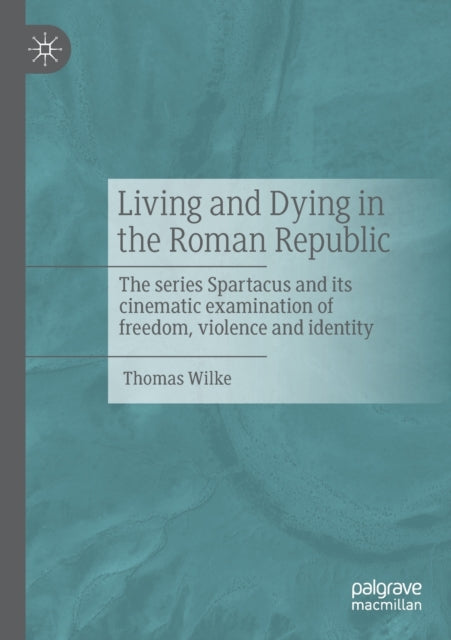
Thomas Wilke
Living and Dying in the Roman Republic: The Series Spartacus and its Cinematic Examination of Freedom, Violence and Identity
Living and Dying in the Roman Republic: The Series Spartacus and its Cinematic Examination of Freedom, Violence and Identity
💎 Earn 289 Points (£2.89) on this item.
We can order this item for you. Delivery usually takes about 4 to 6 weeks.
This item is not held in our immediate stock. We will order it for you after checkout.
Estimated delivery: About 4 to 6 weeks
YOU SAVE £12.18
- Condition: Brand new
- UK Delivery times: Usually arrives within 2 - 3 working days
- UK Shipping: Fee starts at £2.39. Subject to product weight & dimension
Bulk ordering. Want 15 or more copies? Get a personalised quote and bigger discounts. Learn more about bulk orders.
Couldn't load pickup availability
- More about Living and Dying in the Roman Republic: The Series Spartacus and its Cinematic Examination of Freedom, Violence and Identity
The TV series Spartacus and Rome draw on Greek and Roman antiquity for their political, economic, and philosophical ideas. While Rome provides a detailed historical backdrop, Spartacus largely ignores the historical context, reflecting contemporary ethical concerns and self-statements of the present or producers.
Format: Paperback / softback
Length: 144 pages
Publication date: 21 February 2023
Publisher: Springer
This comprehensive volume explores the intricate tapestry of American production Spartacus and the collaborative venture between Britain, America, and Italy known as Rome. As we delve into the present, a recurring trend emerges: a turn to Greek or Roman antiquity for insights into the foundations of Western society, politics, economics, and philosophy. This pursuit is not merely a rhetorical commonplace but a profound endeavor to uncover the roots of our civilization and derive comparative arguments for expansionist endeavors or decline. It is, therefore, not surprising that the television series format has also embraced this historical era.
In Rome, the series takes great care to meticulously adhere to historical guidelines, providing a detailed and accurate portrayal of the time. On the other hand, Spartacus presents a rather cursory sketch of the plot, with a notable disregard for the historical context. From a media ethical perspective, the series offers insightful approaches to responsibility, the transmission of values, loyalty, education, self-discipline, and religion. These aspects can be interpreted as self-statements of the present or the producers, reflecting the values and beliefs of the time.
The examination of the historical context in Rome highlights the importance of understanding the societal, political, and cultural nuances of the time. The series delves into the intricate web of relationships, power struggles, and political intrigues that shaped the ancient world. It explores the complex dynamics between different factions, such as the Roman Senate, the gladiatorial schools, and the slave rebellions. By examining these historical details, the series offers a deeper understanding of the human condition and the forces that have shaped our world.
In contrast, Spartacus takes a more streamlined approach to the historical setting, focusing primarily on the narrative and the characters. While the series does provide a basic framework of the historical context, it often neglects the intricate details and nuances that would enrich the viewer's understanding of the time. This lack of historical depth can sometimes lead to confusion or misunderstandings, particularly for those who are not familiar with the historical background of the Roman Empire.
However, it is important to note that Spartacus does not entirely disregard the historical context. The series incorporates elements of historical accuracy and authenticity, such as the portrayal of certain historical figures and events. It also seeks to capture the essence of the Roman Empire's brutal and oppressive nature, highlighting the struggles and hardships faced by the slaves and the resistance they mounted against their oppressors.
In conclusion, this volume provides a comprehensive exploration of American production Spartacus and the British-American-Italian co-production Rome. While Rome meticulously adheres to historical guidelines and offers a detailed portrayal of the time, Spartacus takes a more streamlined approach, focusing primarily on the narrative and the characters. From a media ethical perspective, the series offers insightful approaches to responsibility, the transmission of values, loyalty, education, self-discipline, and religion. These aspects can be interpreted as self-statements of the present or the producers, reflecting the values and beliefs of the time. By examining the historical context in both series, we can gain a deeper understanding of the human condition and the forces that have shaped our world.
Weight: 208g
Dimension: 210 x 148 (mm)
ISBN-13: 9783658388690
Edition number: 1st ed. 2023
UK and International shipping information
UK and International shipping information
UK Delivery and returns information:
- Delivery within 2 - 3 days when ordering in the UK.
- Shipping fee for UK customers from £2.39. Fully tracked shipping service available.
- Returns policy: Return within 30 days of receipt for full refund.
International deliveries:
Shulph Ink now ships to Australia, Belgium, Canada, France, Germany, Ireland, Italy, India, Luxembourg Saudi Arabia, Singapore, Spain, Netherlands, New Zealand, United Arab Emirates, United States of America.
- Delivery times: within 5 - 10 days for international orders.
- Shipping fee: charges vary for overseas orders. Only tracked services are available for most international orders. Some countries have untracked shipping options.
- Customs charges: If ordering to addresses outside the United Kingdom, you may or may not incur additional customs and duties fees during local delivery.