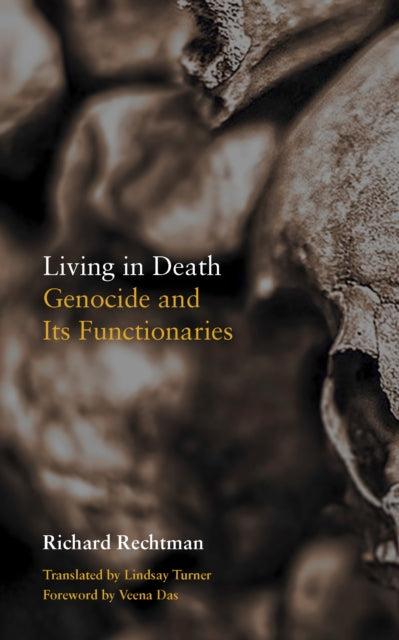
Richard Rechtman
Living in Death: Genocide and Its Functionaries
Living in Death: Genocide and Its Functionaries
💎 Earn 321 Points (£3.21) on this item.
YOU SAVE £7.74
- Condition: Brand new
- UK Delivery times: Usually arrives within 2 - 3 working days
- UK Shipping: Fee starts at £2.39. Subject to product weight & dimension
Bulk ordering. Want 15 or more copies? Get a personalised quote and bigger discounts. Learn more about bulk orders.
Couldn't load pickup availability
- More about Living in Death: Genocide and Its Functionaries
Richard Rechtman's "Living in Death" offers new answers to the question of who mass killers are and what their consciousness is. He explores the conditions under which administering death becomes a job like any other, drawing on archival research, psychological theory, and anecdotes from clinical work with refugees and former participants in genocide. Rechtman argues that there is nothing extraordinary or unusual about genocidaires' actions, but rather that they are preoccupied with the same mundane things that characterize any other job.
Format: Hardback
Length: 192 pages
Publication date: 02 November 2021
Publisher: Fordham University Press
Winner,Prix Littéraire Paris-Liège 2021 Winner,French Voices Award for Excellence in Publication and Translation When we speak of mass killers, we may think of radicalized ideologues, mediocrities who only obey orders, or bloodthirsty monsters. Who are these men who kill on a mass scale? What is their consciousness? Do they not feel horror or compassion? Richard Rechtman's Living in Death offers new answers to a question that has haunted us at least since the Holocaust. For Rechtman, it is not ideologies that kill, but people. This book descends into the ordinary life of people who execute hundreds every day, the same way others go to the office. Bringing philosophical sophistication to the ordinary, the book constitutes an anthropology of mass killers. Turning away from existing psychological and philosophical accounts of genocide's perpetrators, Rechtman instead explores the conditions under which administering death becomes a job like any other. Considering Cambodia, Rwanda, and other mass killings, Living in Death draws on a vast array of archival research, psychological theory, and anecdotes from the author's clinical work with refugees and former participants in genocide. Rechtman mounts a compelling case for reframing and refocusing our attempts to explain—and preempt—acts of mass torture, rape, killing, and extermination. What we must see, Rechtman argues, is that for genocidaires (those who carry out acts that are or approach genocide), there is nothing extraordinary, unusual, or world-historical about their actions. On the contrary, they are preoccupied with the same mundane things that characterize any other job: interactions with colleagues, living conditions, a drink and a laugh at the end of the day. To understand this is to understand how things came to be.
Richard Rechtman's "Living in Death" is a groundbreaking book that challenges our traditional understanding of mass killers. Rather than focusing on ideologies or psychological profiles, Rechtman delves into the everyday lives of individuals who commit mass murder, drawing parallels to ordinary work routines. By drawing on archival research, psychological theory, and personal anecdotes from his clinical work with refugees and genocide survivors, Rechtman offers a compelling argument for reframing our approach to understanding and preventing acts of mass torture, rape, killing, and extermination. At its core, "Living in Death" challenges the notion that genocidaires are extraordinary or unusual individuals. Instead, Rechtman reveals that they are preoccupied with the same mundane aspects of life as any other job: interactions with colleagues, living conditions, and social interactions. This book offers a fresh perspective on the psychology of mass killers and provides valuable insights into the factors that contribute to their actions. By reframing our understanding of mass killers, we can better prevent and address these horrific crimes in the future.
Dimension: 203 x 127 (mm)
ISBN-13: 9780823297856
This item can be found in:
UK and International shipping information
UK and International shipping information
UK Delivery and returns information:
- Delivery within 2 - 3 days when ordering in the UK.
- Shipping fee for UK customers from £2.39. Fully tracked shipping service available.
- Returns policy: Return within 30 days of receipt for full refund.
International deliveries:
Shulph Ink now ships to Australia, Belgium, Canada, France, Germany, Ireland, Italy, India, Luxembourg Saudi Arabia, Singapore, Spain, Netherlands, New Zealand, United Arab Emirates, United States of America.
- Delivery times: within 5 - 10 days for international orders.
- Shipping fee: charges vary for overseas orders. Only tracked services are available for most international orders. Some countries have untracked shipping options.
- Customs charges: If ordering to addresses outside the United Kingdom, you may or may not incur additional customs and duties fees during local delivery.