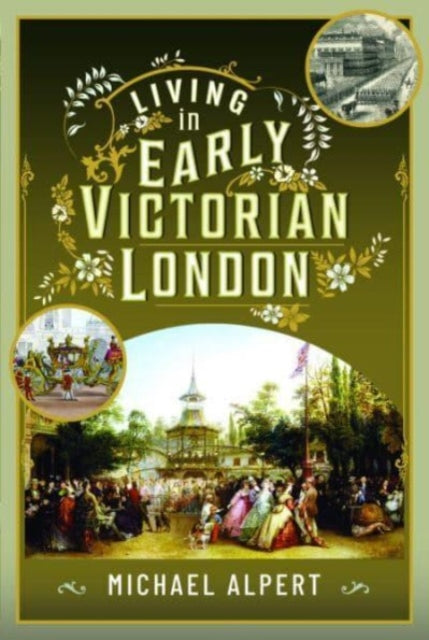
Michael Alpert
Living in Early Victorian London
Living in Early Victorian London
💎 Earn 77 Points (£0.77) on this item.
YOU SAVE £6.42
- Condition: Brand new
- UK Delivery times: Usually arrives within 2 - 3 working days
- UK Shipping: Fee starts at £2.39. Subject to product weight & dimension
Bulk ordering. Want 15 or more copies? Get a personalised quote and bigger discounts. Learn more about bulk orders.
Couldn't load pickup availability
- More about Living in Early Victorian London
In the 1840s, London was a sprawling, smoke-filled city of extreme wealth and poverty. The murder of Patrick O Connor by Frederick and Maria Manning in 1849 was the most sensational crime of the epoch. Michael Alpert uses trial records and other contemporary sources to illustrate how ordinary people lived in the crowded, noisy capital in the early decades of Victoria's reign, revealing their incomes, entertainments, religious practice, reading and education, hopes and anxieties.
Format: Hardback
Length: 224 pages
Publication date: 06 April 2023
Publisher: Pen & Sword Books Ltd
London in the 1840s was a sprawling and smoke-filled metropolis, a city of immense wealth and abject poverty. Some streets exuded elegance with brilliantly gas-lit shop windows displaying expensive items, while others were narrow, fetid, muddy, and in many cases foul with refuse and human filth. Railways, stations, and sidings were rapidly devouring entire districts, transforming them into sprawling slums or rookeries, where the poor of the city were crammed and where crime, disease, and prostitution thrived. The most sensational crime of the era, the murder of Patrick O Connor by Frederick and Maria Manning, captivated the press in the summer and autumn of 1849. Michael Alpert utilizes the trial record of this murder, coupled with numerous other contemporary sources, including journalism, diaries, and fiction, to shed light on how day-to-day lives, births, deaths, sickness, work, shopping, cooking, and buying clothes, were experienced in the crowded, noisy capital during the early decades of Victoria's reign. These sources provide a vivid illustration of how ordinary people lived in London, revealing their incomes, entertainment, religious practices, reading and education, hopes and anxieties. Life in Early Victorian London offers a revealing glimpse into the multifaceted lives of ordinary individuals like the Mannings and thousands of others who called the greatest capital city of the world their home.
Early Victorian London stood at a crossroads, poised for significant advancements, yet still exhibiting remnants of a mediaeval society. Its inhabitants enjoyed the convenience of the Penny Post and the omnibus, and they were somewhat protected by a police force. The Mannings, in their attempt to evade capture, fled their crime on the railway, only to be trapped by the newly invented telegraph and apprehended by detectives (a novel concept and word). However, their fate differed from that of murderers of centuries past. Instead of being executed privately, they were hanged in public, watched by a raucous, drunken, and swearing mob. This public execution, a long-standing tradition in London, served as a stark reminder of the consequences of committing heinous crimes in the city.
In conclusion, London in the 1840s was a complex and multifaceted city, characterized by extreme wealth and poverty, urbanization, and a vibrant criminal underworld. The murder of Patrick O Connor by Frederick and Maria Manning, along with other contemporary sources, provides a window into the lives of ordinary people, revealing their experiences, struggles, and hopes and anxieties. The trial record and other contemporary sources shed light on the day-to-day existence of Londoners, showcasing their incomes, entertainment, religious practices, reading and education, and their interactions with the city's infrastructure and law enforcement. The public execution of the Mannings, while a controversial and dramatic event, serves as a reminder of the harsh realities of life in early Victorian London and the consequences of committing heinous crimes.
Weight: 474g
Dimension: 239 x 166 x 29 (mm)
ISBN-13: 9781399060844
This item can be found in:
UK and International shipping information
UK and International shipping information
UK Delivery and returns information:
- Delivery within 2 - 3 days when ordering in the UK.
- Shipping fee for UK customers from £2.39. Fully tracked shipping service available.
- Returns policy: Return within 30 days of receipt for full refund.
International deliveries:
Shulph Ink now ships to Australia, Belgium, Canada, France, Germany, Ireland, Italy, India, Luxembourg Saudi Arabia, Singapore, Spain, Netherlands, New Zealand, United Arab Emirates, United States of America.
- Delivery times: within 5 - 10 days for international orders.
- Shipping fee: charges vary for overseas orders. Only tracked services are available for most international orders. Some countries have untracked shipping options.
- Customs charges: If ordering to addresses outside the United Kingdom, you may or may not incur additional customs and duties fees during local delivery.