Abigail Wheatley,Lucy Bowman
Living in Space
Living in Space
YOU SAVE £1.89
- Condition: Brand new
- UK Delivery times: Usually arrives within 2 - 3 working days
- UK Shipping: Fee starts at £3.89. Subject to product weight & dimension
Bulk ordering. Want 15 or more copies? Get a personalised quote and bigger discounts. Learn more about bulk orders.
Couldn't load pickup availability
- More about Living in Space
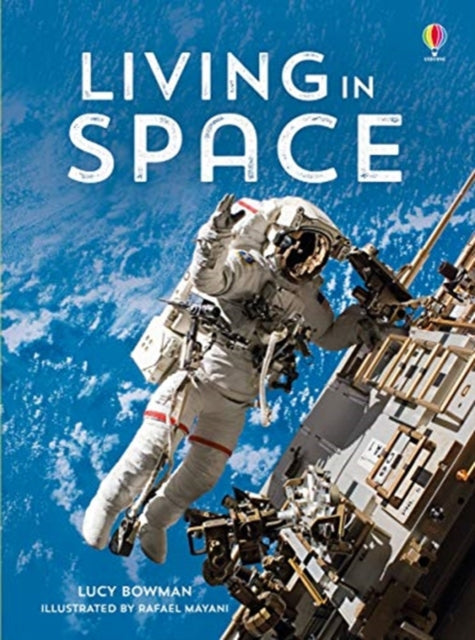
People live in space stations, which are orbiting Earth. They get there through rockets. Living and working in space is different from living on Earth, with limited gravity and no natural light.
\n Format: Hardback
\n Length: 32 pages
\n Publication date: 07 March 2019
\n Publisher: Usborne Publishing Ltd
\n
Space exploration has captivated the human imagination for centuries, and with the advent of modern technology, it has become a reality. Today, people live and work in space for various purposes, including scientific research, space tourism, and space station construction. In this article, we will explore the different aspects of space living, including where people live in space, how they get there, and what it is like to work, eat, and sleep in space.
Where do people live in space?
People live in space primarily on space stations, which are large spacecraft designed to orbit the Earth. Space stations are equipped with living quarters, laboratories, and other facilities necessary for long-term stays in space. Some space stations are permanently manned, while others are used for shorter missions.
One of the most famous space stations is the International Space Station (ISS), which is currently inhabited by a crew of six astronauts from Russia, the United States, Japan, and Canada. The ISS has been in orbit since 2000 and has served as a hub for scientific research, space tourism, and space station construction.
Another notable space station is the Chinese Space Station (CSS), which is currently under construction and is expected to be fully operational by 2022. The CSS will be the largest space station in the world and will be able to accommodate a crew of seven astronauts.
In addition to space stations, people also live in other types of spacecraft, such as capsules and rockets. Capsules are small, one-person spacecraft that are used for short-duration missions, such as space tourism or satellite launches. Rockets, on the other hand, are larger spacecraft that are used for long-duration missions, such as space exploration or satellite deployment.
How do people get to space?
Getting to space is a complex and challenging process that involves a combination of technology, training, and human effort. The first step in the process is to launch a spacecraft into space, which requires a powerful rocket engine. Once in space, astronauts use a variety of equipment to maintain their health and safety, including life support systems, spacesuits, and communication systems.
One of the most common methods of launching a spacecraft into space is the launch pad. Launch pads are large structures that are used to hold and launch rockets. Launch pads are located in remote areas, such as the Kennedy Space Center in Florida or the Baikonur Cosmodrome in Kazakhstan, to minimize the risk of damage to the environment and human life.
Another method of launching a spacecraft into space is the launch vehicle. Launch vehicles are specialized spacecraft that are designed to carry a spacecraft into space. Launch vehicles can be launched from launch pads or from other spacecraft, such as the ISS.
Once in space, astronauts use a variety of methods to maintain their position and navigate around the space station. Astronauts use a combination of handrails, ropes, and other equipment to move around the space station, and they use a variety of tools to perform their work.
What is it like to work, eat, and sleep in space?
Working, eating, and sleeping in space is a unique experience that requires a lot of adaptation and preparation. Astronauts must work closely together to maintain the space station and perform their work, and they must be able to work in a confined space for long periods of time.
One of the challenges of working in space is the lack of gravity. In space, astronauts experience a condition called microgravity, which means that they are weightless and have no sense of up or down. This can make it difficult to perform certain tasks, such as walking or working with tools.
To overcome this challenge, astronauts use a variety of techniques, such as floating around the space station or using specialized equipment to hold themselves in place. Astronauts also use a variety of tools to perform their work, such as robotic arms and hands.
Eating in space is also a challenge, as astronauts must eat a diet that is high in nutrients and low in waste. Astronauts eat a variety of foods, including freeze-dried meals, fruits, and vegetables, and they drink a lot of water to stay hydrated.
Sleeping in space is also a challenge, as astronauts must sleep in a small, confined space for long periods of time. Astronauts use a variety of techniques to sleep in space, such as sleeping bags and mattresses, and they use eye masks and earplugs to block out the noise and light of the space station.
In conclusion, space exploration has opened up new possibilities for human exploration and discovery, and people now live and work in space for various purposes. Space stations are the primary place where people live in space, and they are equipped with living quarters, laboratories, and other facilities necessary for long-term stays in space. To get to space, people use a combination of technology, training, and human effort, and they must be able to work in a confined space for long periods of time. Working, eating, and sleeping in space is a unique experience that requires a lot of adaptation and preparation, but it has opened up new possibilities for human exploration and discovery.
\n Weight: 166g\n
Dimension: 156 x 209 x 6 (mm)\n
ISBN-13: 9781474921831\n \n
UK and International shipping information
UK and International shipping information
We deliver throughout the United Kingdom and to 128 countries and territories worldwide, including the United States, Australia, Canada, Germany, Spain and France.